01 / Reading Guide
Reading Guide
Citation
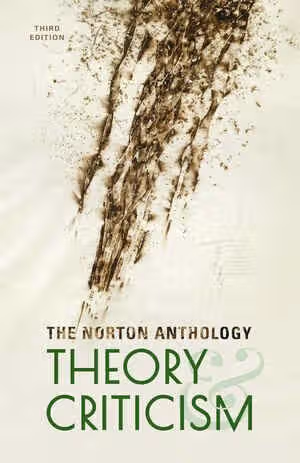
Leitch, V. B. (Gen. Ed.), Cain, W. E., Finke, L. A., McGowan, J., Sharpley-Whiting, T. D., & Williams, J. J. (2018). The Norton Anthology of Theory and Criticism (3rd ed.). W. W. Norton & Company.
Chapter Summary
The third edition of this anthology runs to close to 2,800 pages and reprints 191 pieces by 157 authors, with 48 selections new to this edition, mostly from the twentieth and twenty-first centuries. Texts range from the fifth century BCE to the present. Instead of chapters on topics, the book is arranged by author, in order of birth year. Most items are essays or book chapters, and some authors are represented more than once. The sections below group the third edition's authors in that order.
Antiquity and the Middle Ages: Gorgias to Christine de Pizan
The opening authors are Gorgias, Plato, Aristotle, Horace and Longinus, followed by Augustine, Maimonides, Aquinas, Dante, Boccaccio and Christine de Pizan. This stretch covers classical rhetoric and poetics and their medieval reception.
Renaissance to the eighteenth century: Du Bellay to Staël
The list moves through Du Bellay, Mazzoni, Sidney, Corneille, Dryden, Spinoza, Behn, Vico, Addison and Pope, then Johnson, Hume, Kant, Burke, Lessing, Schiller, Wollstonecraft and Germaine de Staël. Neoclassical criticism, aesthetics and early feminist argument appear side by side.
Romanticism and the nineteenth century: Schleiermacher to Freud
Schleiermacher and Hegel are followed by Wordsworth, Coleridge, Shelley, Emerson, Poe, Marx and Engels, Arnold, Pater, Henry James, Nietzsche, Wilde and Freud.
The early twentieth century: Saussure to Strauss
This large group includes Saussure, Du Bois, Woolf, Lukács, T. S. Eliot, Ransom, Heidegger, Gramsci, Hurston, Auerbach, Benjamin, Bakhtin, Horkheimer and Adorno, Leavis, Jakobson, Hayek and Leo Strauss.
Mid-century: Lacan to Fanon
Authors born in the following decades include Lacan, Langston Hughes, Trilling, Arendt, Brooks, Wimsatt and Beardsley, Beauvoir, Lévi-Strauss, Austin, Frye, Barthes, Althusser, de Man, Narasimhaiah, Raymond Williams and Fanon.
Late twentieth century: Deleuze and Guattari to Mulvey
The sequence runs from Deleuze and Guattari, Lyotard, Foucault, Iser, Hayden White, Baudrillard and Habermas through Rich, Achebe, Adonis, Bloom, Bourdieu, Derrida, Li Zehou, Morrison, Hall, Sontag, Jameson, Said, Wittig, Anderson, Gilbert and Gubar, Cixous, Fish, Ngũgĩ, Todorov, Karatani and Kristeva to Mulvey.
Recent decades: Agamben to Bogost
The last part includes Agamben, Anzaldúa, Spivak, Eagleton, Greenblatt, Haraway, Latour, Nussbaum, Bhabha, Žižek, Gates, Moretti, Sedgwick, hooks, Butler, Gilroy, Hardt and Negri, Halberstam, Morton, Ngai and Bogost, closing with the most recent work.
Key Concepts
Strands of theory represented
- Classical poetics and rhetoric: Plato, Aristotle, Horace and Longinus, the starting point of the Western critical tradition.
- Marxist and cultural criticism: Marx and Engels, Lukács, Gramsci, Benjamin, Horkheimer and Adorno, Althusser, Williams, Hall and Jameson.
- Formalist and New Critical reading: Ransom, Brooks, Wimsatt and Beardsley, and Jakobson.
- Structuralism and post-structuralism: Saussure, Lévi-Strauss, Barthes, Foucault, Derrida and de Man.
- Psychoanalytic theory: Freud, Lacan and Kristeva.
- Feminist, gender and queer theory: Woolf, Beauvoir, Rich, Gilbert and Gubar, Cixous, Wittig, Sedgwick and Butler.
- Postcolonial, race and global approaches: Du Bois, Fanon, Achebe, Ngũgĩ, Said, Spivak, Bhabha, Gilroy and Gates, along with Narasimhaiah, Li Zehou, Adonis and Karatani.
Critical Analysis
Strengths
- Range. The collection spans some twenty-five centuries and includes authors from beyond Europe and North America, such as Narasimhaiah, Adonis, Li Zehou and Karatani, so that "theory" is not confined to one tradition.
- Currency and breadth. Forty-eight selections are new to this edition, and the list of authors runs up to figures such as Alondra Nelson, Sianne Ngai, Timothy Morton and Ian Bogost. In 2003 the literary theorist Jonathan Culler called the first edition "the most comprehensive collection around".
- Chronological order. Arranging authors by birth year lets readers follow how arguments respond to one another across periods and compare, for instance, Plato's and Kant's views on art with Marxist or feminist ones.
Limitations
- Size. At close to 2,800 pages the book is difficult to read straight through. Culler observed that its length, range and weight suggest it may be more useful in sections by period.
- Editorial choices. Critics have noted the effect of market and editorial decisions. David Richter called the first edition "a product of a culture industry attempting to establish the canon of theory", and Steven Mailloux observed in 2020 that Kenneth Burke is still absent from the third edition.
- Author order hides themes. Because entries follow birth year and not topic, readers who want to study a single approach must assemble a reading path themselves.
- Excerpts. Most pieces are essays or book chapters, so the volume gives a taste of a thinker's argument, not a full book-length account.
Where It Fits in the Course
Within the course on literary theory, this anthology is the source of primary texts. It is not an introduction. Peter Barry's Beginning Theory, Lois Tyson's Critical Theory Today and Jonathan Culler's Literary Theory: A Very Short Introduction are short guides for readers meeting the schools for the first time, and Terry Eagleton's Literary Theory: An Introduction is a comprehensive introduction to the major schools.
M. A. R. Habib's A History of Literary Criticism is a single-author narrative from Plato to the present and pairs naturally with the anthology: read Habib's account of a period, then the original essays in the Norton for that period.
How to Use This Book
The anthology suits advanced undergraduates and graduate students in literary studies, and also readers in philosophy, history and cultural studies who want primary sources. Use a short introduction first so that the names in the contents have some context.
Do not plan to read it cover to cover. Pick a thread, such as Marxist criticism, structuralism or postcolonial theory, and use the author lists above to read the relevant pieces in chronological order. For a first survey, a short selection from each stretch is enough: for example Plato or Aristotle, Kant, Marx and Engels, Saussure, Woolf, Barthes, Foucault, Derrida, Said, Butler. Read each essay twice, first for its main claim and then against a poem or novel you know. Treat a theorist's absence from the volume as a prompt to look elsewhere, not as a judgement.