01 / Reading Guide
Reading Guide
Citation
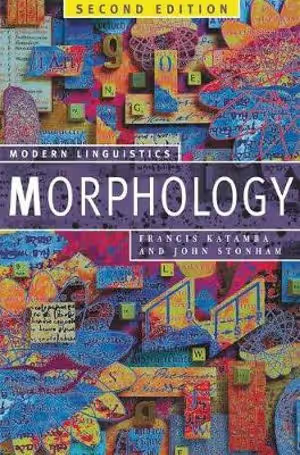
Katamba, F., & Stonham, J. (2006). Morphology (2nd ed.). Palgrave Macmillan.
Chapter Summary
The book is part of the Palgrave Modern Linguistics series. Its main text has thirteen chapters on about 345 pages (pp. 3–347), followed by back matter that includes a bibliography (pp. 357–370 according to the Library of Congress record) and indexes; the Library of Congress contents listing also names a glossary. Chapter lengths vary widely: the first ten chapters run from roughly 14 to 26 pages each, while the last three on inflection, grammatical functions and the lexicon–syntax relationship run to about 37–44 pages each. The publisher's descriptions call the second edition completely revised, with up-to-date discussion of morphological issues, in-text exercises, a new chapter on Optimality Theory and extended references and further reading.
Chapters 1–2: Introduction; Introduction to Word-Structure
Chapter 1 (about 14 pages) opens the subject, and Chapter 2 (about 25 pages) introduces the structure of words. Together they form the book's introductory stretch, before the chapters on particular word-formation topics begin.
Chapters 3–4: Types of Morphemes; Productivity in Word-Formation
Chapter 3 (about 25 pages) classifies the types of morphemes. Chapter 4 (about 20 pages) turns to productivity in word formation, that is, how readily a pattern produces new words.
Chapters 5–7: Introducing Lexical Morphology; Insights from Lexical Morphology; Lexical Morphology: An Appraisal
These three chapters of about 21–22 pages each give one theoretical framework a sustained, staged treatment: an introduction to lexical morphology, then what can be learned from it, then an evaluation. Chapter 7's title marks it as a critical assessment of the framework.
Chapters 8–9: Templatic Morphology; Templatic and Prosodic Morphology
Two chapters (about 26 and 24 pages) cover morphology in which word shapes are organised by templates and prosodic structure. The second title adds prosodic morphology to the templatic morphology of the first.
Chapter 10: Optimality Theory and Morphology
The new chapter of the second edition (about 17 pages). As its title says, it applies Optimality Theory to morphology.
Chapters 11–13: Inflectional Morphology; Morphological Mapping of Grammatical Functions; The Interpretation of the Lexicon, Morphology and Syntax
The last three chapters are the longest in the book. Chapter 11 (about 44 pages) treats inflection, Chapter 12 (about 37 pages) deals with how grammatical functions are mapped morphologically, and Chapter 13 (about 44 pages) looks at the relationship between the lexicon, morphology and syntax.
Key Concepts
Chapters 1–4
- Morpheme types: the classification of the building blocks of words (Chapter 3).
- Productivity: the degree to which a word-formation pattern creates new words (Chapter 4).
Chapters 5–10
- Lexical morphology: a framework for word formation that the book introduces, draws insights from and appraises (Chapters 5–7).
- Templatic and prosodic morphology: word formation shaped by templates and prosodic units (Chapters 8–9).
- Optimality Theory: a constraint-based theory applied to morphology in Chapter 10.
Chapters 11–13
- Inflection: the grammatical forms of words (Chapter 11).
- Mapping of grammatical functions: how grammatical functions are expressed by morphological means (Chapter 12).
- Lexicon, morphology and syntax: the interpretation of how these components relate (Chapter 13).
Critical Analysis
Strengths
- Exercises that ask the reader to do morphology. The publisher stresses numerous in-text exercises in which readers formulate hypotheses and test them against data from English and many other languages.
- A stated route to the research literature. The Library of Congress description presents the book as taking absolute beginners to a point where they can approach the current literature on morphology, and the second edition has extended references and further-reading suggestions.
- Breadth of theory. The chapter sequence covers lexical morphology, templatic and prosodic morphology, and Optimality Theory, and ends with inflection, grammatical functions and the lexicon–syntax relationship, so a reader meets several analytical traditions in one book.
- Space for inflection and the grammar interface. The final three chapters, on inflection, grammatical functions and the lexicon–syntax relationship, are the longest in the book, which gives these topics more room than a compact introduction would.
Limitations
- Theory arrives early and takes most of the book. Basic concepts occupy Chapters 1–4, about a quarter of the main text; Chapters 5–10 are organised around specific frameworks. Readers who want mainly practice in analysing data will find a more hands-on structure elsewhere.
- Date. The second edition is from 2006, and later work in morphological theory is not covered.
- Level claim versus structure. The publisher presents the book as suitable for absolute beginners, yet half of the chapters are devoted to named theoretical frameworks; a student with no linguistics background should expect a demanding read.
Where It Fits in the Course
Within the morphology course list, this book's chapter sequence is built around theoretical frameworks, which sets it apart from the other general textbooks. Lieber's Introducing Morphology is a compact, hands-on first course; Aronoff and Fudeman's What Is Morphology? is a concise problem-based introduction; and Booij's The Grammar of Words treats word structure as part of grammar as a whole. Katamba and Stonham makes sense after one of these, or as the main text for a course that is meant to introduce the major theoretical frameworks.
For the next step, Haspelmath and Sims's Understanding Morphology is described as a theory-aware textbook with wide cross-linguistic coverage that contrasts morpheme-based and word-based models, and is a useful comparison for readers who want a view independent of the frameworks emphasised here. The Oxford Reference Guide to English Morphology is a large descriptive reference on English, a place to check English data while working through exercises.
How to Use This Book
The publisher says the book is designed for beginners; a course in introductory linguistics, including basic phonology and syntax, will make Chapters 5–13 considerably easier.
A practical plan:
- Core: Chapters 1–4 give the vocabulary; Chapter 11 on inflection is the natural next core chapter, and Chapter 13 relates morphology to the lexicon and to syntax.
- Theory sequence: read Chapters 5–7 as one unit, Chapters 8–9 as another and Chapter 10 on Optimality Theory afterwards. A course can sample one or two of these units if time is short.
- Mapping chapter: read Chapter 12 after Chapter 11, since both deal with how grammatical information is expressed in word forms.
- Exercises: work through the in-text exercises as they appear and compare your hypotheses with the data before reading on.
- Further reading: use the extended reading suggestions to move into the primary literature.