01 / Reading Guide
Reading Guide
Citation
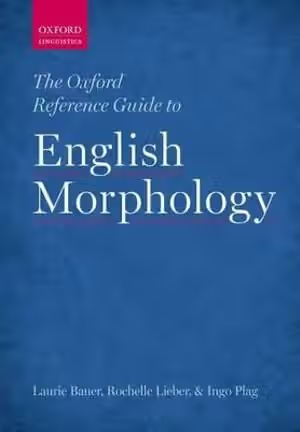
Bauer, L., Lieber, R., & Plag, I. (2015). The Oxford Reference Guide to English Morphology. Oxford University Press.
Chapter Summary
The book is a reference description of English word structure in 29 chapters and six parts, running to roughly 690 pages. Its distinguishing feature, as the publisher describes it, is that the description rests on large corpora, including the Corpus of Contemporary American English and the British National Corpus, and that it gives equal weight to form and to meaning. It was first published in 2013; the 2015 printing is the paperback.
Part I, Introduction: Chapters 1–4
Chapter 1, Aims and Structures, sets out what the book covers and how it is organised. Chapters 2 and 3, Basic principles: terminology and Basic principles: methods, supply the vocabulary and the methods used in the later description. Chapter 4, Orthography, deals with the orthographic side of morphology.
Part II, Inflection: Chapters 5–8
The inflection chapters take the word classes in turn: Verb inflection, Adjective and adverb inflection, Noun inflection, and Function words: pronouns, determiners, wh-forms, deictics.
Part III, Derivation: Chapters 9–18
This is the longest part. Chapter 9, Derivation: phonological considerations, covers how affixation interacts with sound structure. The chapters that follow are organised by what is derived and what is meant: Derived nouns in three groups (event, state, result; personal and participant; quality, collective, and other abstracts), then Derived verbs, Derived adjectives and Derived adverbs. The final three chapters deal with Locatives of time and space, Negatives, and Size, quantity, and attitude. The publisher notes that this part includes areas that have received less attention than well-studied topics, such as adjective formation, locatives, negatives and evaluatives.
Part IV, Compounding: Chapters 19–20
Two chapters, Compounds: formal considerations and Compounds: semantic considerations, separate how compounds are built from what they mean.
Part V, Interaction: Chapters 21–23
Chapter 21, Combination of affixes, Chapter 22, Affixation on compounds and phrases, and Chapter 23, Paradigmatic processes, examine how the processes described separately in earlier parts combine.
Part VI, Themes: Chapters 24–29
The closing chapters turn from description to analysis: Inflection versus derivation; The analysis and limits of conversion; Blocking, competition, and productivity; The nature of stratification; English morphology in a typological perspective; and English morphology and theories of morphology.
Key Concepts
Parts I–II: Introduction and inflection
- Terminology and methods: the framework and the corpus-based procedures that the later chapters rely on.
- Orthography: the spelling side of morphology.
- Inflection by word class: separate treatments of verbs, adjectives and adverbs, nouns, and function words.
Parts III–V: Derivation, compounding and interaction
- Derivation by output category: nouns, verbs, adjectives and adverbs, plus locatives, negatives and size, quantity and attitude.
- Compounding: formal and semantic classification of compounds.
- Paradigmatic processes: word formation that is not simply the stacking of affixes.
Part VI: Themes
- Conversion: the analysis of category change without an overt affix, and its limits.
- Blocking, competition and productivity: why some possible words are not formed and what governs the use of rival processes.
- Stratification: the question of whether English morphology divides into layers, discussed in Chapter 27.
Critical Analysis
Strengths
- Corpus evidence throughout. The description is built on large corpora, not constructed examples, and is presented as data-rich. This makes it a source of attested forms for research on English words.
- Comprehensive scope. The publisher describes it as the first comprehensive treatment of contemporary English that covers both inflection and word-formation. The chapter list bears this out, reaching beyond well-studied nouns and verbs to adverbs, locatives, negatives and evaluative formations.
- Description separated from theory. Parts II to V describe the facts, and only Part VI asks what they mean for morphological theory. A reader who needs the data can use the book without adopting a framework.
- Recognition. The publisher records that it won the 2015 Bloomfield Book Award.
Limitations
- A reference work, not a course. Its structure by word class and process, and its separate indexes of affixes, names and subjects, suit consultation more than sequential reading, and it is not a gentle way into morphology.
- Language-specific. Apart from the typological chapter, the coverage is English only, so it cannot replace a cross-linguistic textbook.
- Theory comes last. Readers expecting a theoretical argument will find it condensed into the closing chapters.
Where It Fits in the Course
The other morphology books on this list are textbooks. Lieber's Introducing Morphology and Aronoff and Fudeman's What is Morphology? are undergraduate introductions with examples and exercises, Katamba and Stonham's Morphology is a theory-oriented introduction, and Booij's The Grammar of Words and Haspelmath and Sims's Understanding Morphology treat the field with a cross-linguistic and theoretical emphasis. The Oxford guide is a different kind of book: it is where to turn after one of these, to see in detail what English actually does.
Read it together with whichever textbook the course uses, looking up the chapter on the process currently under study. Chapters 24 to 29 pair well with the theoretical discussions in Haspelmath and Sims and in Booij.
How to Use This Book
It suits students who have taken a morphology course and know basic English phonology and syntax, and researchers who need descriptive coverage of English words.
A practical approach:
- Core: Chapters 2 and 3 for terminology and methods; then the chapters on the process you are studying.
- For research projects: use Parts III and IV as a catalogue of attested patterns and the indexes of affixes to find particular formatives.
- For theory: read Chapters 24 to 29 as a set, after the relevant descriptive chapters.
- Optional: Chapter 4 on orthography and Chapter 28 on typology, unless they bear on your topic.
Do not read the book straight through; choose chapters to answer specific questions.