01 / Reading Guide
Reading Guide
Citation
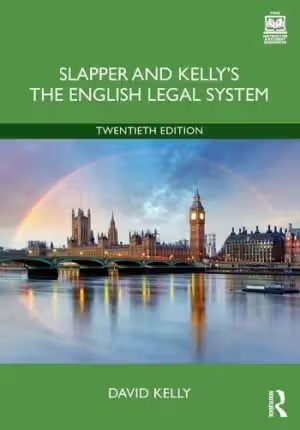
Kelly, D. (2024). Slapper and Kelly's The English Legal System (20th ed.). Routledge.
Chapter Summary
The twentieth edition has seventeen chapters in about 770 pages. The publisher describes the book as explaining and critically assessing what law is, how it is made and applied, and how it affects the general public. This edition is said to have been restructured, updated and "extensively refocused" to give an analysis of the legal system in a post-Brexit, post-Covid United Kingdom. The contents list shows no division into parts, but the chapters fall into recognisable groups: foundations, sources of law, civil and criminal courts and processes, the people who operate the system, and access to justice. The publisher lists chapter summaries, "food for thought" questions at the end of each chapter, and sources for further reading and suggested websites among the book's learning features.
Chapters 1–2: Law and Legal Study; The Rule of Law and Human Rights
The opening chapters introduce the study of law and then turn to two foundational themes, the rule of law and human rights, which are placed before the chapters on the sources of law.
Chapters 3–5: Sources of Law: Legislation; Sources of Law: Case Law; Sources of Law: Europe and the United Nations
Three chapters deal with where English law comes from. Chapter 3 covers legislation, Chapter 4 covers case law, and Chapter 5 covers Europe and the United Nations. The publisher notes that the accompanying website supplies extra contextual material on the European Union.
Chapters 6–8: The Civil Courts; The Civil Process; Family Law, the Family Courts and the Coroners' Courts
Chapters 6 and 7 are on the civil courts and the civil process. Chapter 8 groups family law, the family courts and the coroners' courts in a single chapter.
Chapters 9–11: Crime and the Criminal Courts; The Criminal Process: (1) The Investigation of Crime; The Criminal Process: (2) The Prosecution
The criminal side of the system is treated in three chapters: the criminal courts (Chapter 9), then the criminal process in two parts, first the investigation of crime (Chapter 10) and then prosecution (Chapter 11).
Chapters 12–14: The Judiciary; Judicial Reasoning and Politics; The Jury
These chapters turn to the people who decide cases. Chapter 12 deals with the judiciary, Chapter 13 with judicial reasoning and politics, and Chapter 14 with the jury.
Chapters 15–17: Arbitration and Alternative Dispute Resolution; Legal Services; The Funding of Legal Services
The last three chapters cover arbitration and alternative dispute resolution (Chapter 15), legal services (Chapter 16) and how legal services are funded (Chapter 17).
Key Concepts
Chapters 1–5: Foundations and Sources of Law
- The rule of law and human rights: the constitutional values that the book introduces before the sources of law, in Chapter 2.
- Legislation and case law: the two main sources of English law, with separate chapters.
- Europe and the United Nations: the international sources of law treated in Chapter 5.
Chapters 6–11: Courts and Processes
- Civil and criminal process: the procedures by which civil disputes and criminal cases move through the courts.
- Coroners' courts and family courts: courts grouped with family law in Chapter 8.
- Investigation and prosecution: the two stages of the criminal process, Chapters 10 and 11.
Chapters 12–17: People and Access to Justice
- Judicial reasoning and politics: the relationship between judicial decision-making and its political setting, Chapter 13.
- The jury: the lay element in trials, Chapter 14.
- Alternative dispute resolution: arbitration and other routes outside court, Chapter 15.
- Legal services and funding: who provides legal advice and how it is paid for, Chapters 16 and 17.
Critical Analysis
Strengths
- Full coverage in a single volume. Seventeen chapters take the reader from the study of law and the rule of law, through sources, courts and procedures, to the judiciary, juries, alternative dispute resolution and legal services. A course on the English legal system can be taught from this one book.
- A critical stance. The publisher says the book not only explains but "critically assesses" the system, and the chapter on judicial reasoning and politics (Chapter 13) shows that the book gives space to questions about the political context of judging.
- Learning features in every chapter. The publisher lists chapter summaries as a checkpoint, "food for thought" questions to prompt critical thinking and reflection, and further reading and suggested websites. These give students ways to test understanding and to follow up.
- Online resource with skills material. The accompanying website includes a practical guide to legal skills such as mooting and negotiating, a glossary with interactive flashcards, and further reading including extra contextual material on the European Union.
Limitations
- Length. At about 770 pages, the book is long, and a student may need guidance on which chapters to prioritise.
- Some material is online. The companion website holds further reading, including extra contextual material on the European Union, and the skills guide, so students who want these must go online.
- Currency. The edition is dated 2024 and the publisher stresses its refocus on a post-Brexit, post-Covid United Kingdom. Because courts, legal aid and procedure change through statute and policy, details in Chapters 6 to 17 should be checked for later developments.
- A system book, not a skills course. The book explains institutions and processes; the contents list no chapters on reading cases and statutes or writing essays. The publisher places the skills guide on the website, and students beginning a degree may want a separate skills text.
Where It Fits in the Course
Slapper and Kelly's book is one of the two general course textbooks on the English legal system in this course list. The other, Emily Allbon and Sanmeet Kaur-Dua's Elliott & Quinn's English Legal System, is also a course textbook explaining where English law comes from, who makes and applies it, and how civil and criminal cases move through the system, with discussion of strengths, weaknesses and reform proposals. A student can choose either as the main text and use the other for comparison on topics where the course has a particular emphasis.
Two books are aimed at the skills of studying law rather than the system itself: Emily Finch and Stefan Fafinski's Legal Skills explains how to find and read statutes and cases, write essays and answer problem questions, and Charlotte Harrison and Amanda Millmore's Glanville Williams: Learning the Law is a long-established guide to the skills needed at the start of a degree. Either is a natural companion to Kelly's book. William Twining and David Miers's How to Do Things with Rules studies the interpretation of rules in general and suits students who want to go deeper into method after the first course. Rosemary Hunter's More than Just a Different Face? is a graduate-level study of judicial diversity and decision-making, and relates to Chapters 12 and 13.
How to Use This Book
The book is for students studying the English legal system, typically at the start of a law degree. The publisher states no prerequisites, and the book can be read alongside a first-year legal skills or method course.
A practical plan:
- Core: Chapters 1 to 5 for the foundations and sources of law, then the chapters on the civil and criminal courts and processes (Chapters 6, 7, 9, 10 and 11).
- By module: the judiciary and judicial reasoning (Chapters 12 and 13) for modules on the role of judges; the jury (Chapter 14) and alternative dispute resolution (Chapter 15) as the course requires; legal services and funding (Chapters 16 and 17) for modules on the legal profession and access to justice.
- Optional: family law and the coroners' courts (Chapter 8) if the course covers them.
Use the chapter summaries as a checkpoint after reading, and treat the "food for thought" questions as seminar and essay preparation. For skills, use the online guide on mooting and negotiating, and for the European Union background use the website material the publisher mentions. Check statutes, court structures and funding arrangements for developments after 2024.