01 / Reading Guide
Reading Guide
Citation
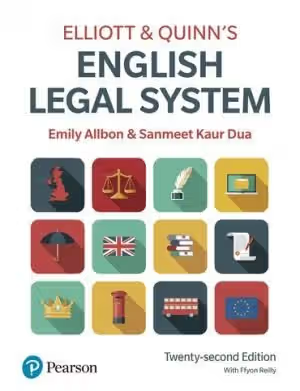
Allbon, E., & Kaur-Dua, S. (2024). Elliott & Quinn's English Legal System (22nd ed.). Pearson.
Chapter Summary
The book has an introduction followed by five parts, with the front matter listing the preface, tables of cases, statutes and statutory materials and a guide to cases, law reports and case references. Pearson's contents list names the chapters under each part without numbering them, so they are given here by title. The book runs to about 790 pages. Pearson describes it as covering how the English legal system and its processes operate in everyday life, from theory to practice, with features such as "Bigger Picture" sections, "Key Case" analyses and end-of-chapter questions.
Introduction
An introduction precedes the five parts and the chapters on the sources of law.
Part 1: Sources of Law
This part has nine chapters: Case Law; Statute Law; Statutory Interpretation; Delegated Legislation; European Law; Custom; Equity; Treaties; and Law Reform. It covers where English law comes from, from case law and legislation to statutory interpretation and delegated legislation, adds European law, custom, equity and treaties, and ends with law reform.
Part 2: People Working in the Legal System
Five chapters cover The Judges and Magistrates; The Legal Professions; The Jury; Administration of Justice; and Paying for Legal Services. The part deals with the people who apply and administer the law, and with how legal services are paid for.
Part 3: Human Rights
Two chapters, Introduction to Human Rights and Remedies for Infringement of Human Rights, set out the protection of human rights and the remedies available when rights are infringed. Pearson's description mentions topical debates in law, ethics and human rights.
Part 4: Criminal Justice System
This part has five chapters: The Police; The Criminal Trial Process; Sentencing; Youth Justice; and Criminal Appeals. It follows a case through the criminal process from policing to appeal, with separate treatment of youth justice.
Part 5: Civil Justice System
The last part has four chapters: The Civil Trial Process; Tribunals; Alternative Methods of Dispute Resolution; and Civil Appeals and Judicial Review. It covers the civil courts, the alternatives to them and the routes of challenge.
Key Concepts
Part 1: Sources of Law
- Case law and statute law: the two main sources of English law, with statutory interpretation and delegated legislation completing the picture.
- Equity and custom: further sources of law, each treated in its own chapter.
- Law reform: how the law is changed, treated in the last chapter of the part.
Parts 2–3: People and Human Rights
- Judges, magistrates and the jury: those who decide cases.
- The legal professions and legal services: who provides legal advice and how it is paid for.
- Remedies for infringement of human rights: the focus of the second chapter in Part 3.
Parts 4–5: Criminal and Civil Justice
- Criminal trial process, sentencing and youth justice: the stages and special regime of criminal justice.
- Tribunals and alternative dispute resolution: forms of dispute resolution outside the civil trial process.
- Civil appeals and judicial review: the routes for challenging decisions.
Critical Analysis
Strengths
- Comprehensive scope in five parts. The structure covers sources, personnel, human rights, criminal justice and civil justice, so one book spans the main parts of the English legal system.
- Study features. According to Pearson, "Bigger Picture" sections explain the context in which the law operates, "Key Case" analyses highlight legal principles, and end-of-chapter questions test understanding and the ability to argue with evidence.
- Debates as well as description. Pearson says the content analyses how law and legal processes operate in everyday life and includes topical debates in law, ethics and human rights, to encourage critical thinking and debating.
- Established text. It is in its 22nd edition and Pearson says generations of students have relied on it.
Limitations
- Size. At about 790 pages in five parts, it is a large book for a first course, and students will need to select chapters.
- Law for England and Wales. The book is concerned with the English legal system; it does not appear to cover other jurisdictions, and students elsewhere will need a local text.
Where It Fits in the Course
Elliott & Quinn is a main course textbook for the English legal system. Its closest alternative in this list is David Kelly's Slapper & Kelly's The English Legal System (20th edition), a full course textbook that explains the sources of law and institutions from Parliament and the courts to the judiciary, the legal professions and the civil and criminal processes, with attention to how the system affects ordinary people. A student can choose either as the main book and the other for a second view.
Two books on skills pair with it: Charlotte Harrison and Amanda Millmore's Glanville Williams: Learning the Law (a guide to the skills needed at the start of a law degree, including reading cases and statutes) and Emily Finch and Stefan Fafinski's Legal Skills (finding and reading statutes and cases, essays and problem questions). For further reading beyond a first course, William Twining and David Miers's How to Do Things with Rules studies rules and their interpretation, and Rosemary Hunter's article More than Just a Different Face? examines judicial diversity and decision-making.
How to Use This Book
The book is aimed at students on English legal system modules, usually early in a law degree, and no earlier legal study appears to be assumed. The guide to cases, law reports and case references in the front matter helps new readers with citations.
A practical plan:
- Core: Part 1 (sources of law), the chapters in Part 2 on the judges and magistrates and on the jury, and Parts 4 and 5 (criminal and civil justice).
- Human rights: Part 3, two chapters on human rights and the remedies for their infringement.
- Selective: Chapters on the legal professions, paying for legal services and law reform, depending on the syllabus.
Use the Key Case analyses to learn cases and the end-of-chapter questions as essay practice. For reading and writing skills, pair the book with one of the skills guides above.