01 / Reading Guide
Reading Guide
Citation
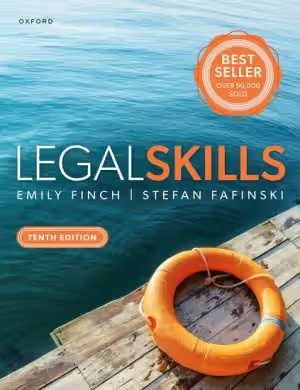
Finch, E., & Fafinski, S. (2025). Legal Skills (10th ed.). Oxford University Press.
Chapter Summary
The tenth edition has twenty-two chapters in three parts and runs to about 560 pages. The publisher presents it as a guide for students new to law, meant to carry them from the transition out of school through to final-year exams and dissertations, with self-test questions and practical activities throughout and frequent diagrams, screenshots and examples. New in this edition are a chapter on drafting, a "skills beyond study" feature on the transferability of legal skills, updated coverage of Brexit and retained (now assimilated) EU law, and a section on looking after oneself during assessment, including support for mental health and accessibility.
Part 1, Chapter 1: Getting started
The opening chapter answers common questions from students about to start a law degree: what law is and how it affects society, how the degree is structured, and how teaching and assessment work.
Chapters 2–4: Legislation; Finding legislation; Using legislation
Chapter 2 explains how Acts of Parliament are made, delegated legislation, the European Convention on Human Rights and the Human Rights Act 1998, and EU legislation during UK membership, ending with the current status of assimilated EU law. Chapter 3 shows how to find statutes and statutory instruments online and in print, check whether there is legislation on a topic and whether it is in force, and locate the Convention and EU texts. Chapter 4 walks through the parts of an annotated Act and the approaches to statutory interpretation, including the effect of the Human Rights Act, the past influence of EU law and interpretation since the Retained EU Law (Revocation and Reform) Act 2023.
Chapters 5–7: Case law; Finding cases; Using cases
Chapter 5 covers common law, equity and custom, the court hierarchy, and the European Court of Human Rights. Chapter 6 explains case citations and how to find domestic and European decisions in libraries and on research platforms. Chapter 7 dissects a law report, shows how to extract the legal principle, and explains the doctrine of precedent and how the Human Rights Act and EU law affect it.
Chapters 8–9: Books, journals, and official publications; Finding books, journals, and official publications
Part 1 ends with secondary sources: the kinds of book, journal and official publication (Command Papers, Bills, debates, Law Commission reports) a student will meet and why they matter for written work, and then how to find them, including Halsbury's Laws of England and Hansard.
Part 2, Chapters 10–13: Study skills; Writing skills; Legal reasoning and legal ethics; Referencing and avoiding plagiarism
Chapter 10 covers lectures, seminars and tutorials, note-taking, working with others, time management, feedback, support and resilience. Chapter 11 treats language, grammar and punctuation in academic legal writing, choosing quotations and writing within word limits. Chapter 12 introduces theories of judicial reasoning, how judges reason in practice, multiple judgments and legal ethics. Chapter 13 explains plagiarism and academic misconduct and the OSCOLA referencing system.
Chapters 14–17: Essay writing; Answering problem questions; Assessment skills; Dissertations
These chapters apply the earlier skills to assessment. Chapter 14 takes an essay from interpreting the question through planning, research and structure. Chapter 15 shows how to identify the issues in a problem scenario and apply the law with supporting authority. Chapter 16 covers revision strategy and the different forms of assessment. Chapter 17 deals with choosing a topic and research question, the proposal, research, writing, working with a supervisor and common problems.
Part 3, Chapters 18–22: Presentation skills; Mooting skills; Negotiation skills; Drafting skills; Employability skills
Chapter 18 covers preparing and delivering a presentation, including timing and nerves. Chapter 19 is a step-by-step guide to a moot, built around a sample moot, from research and skeleton argument to handling judicial interventions. Chapter 20 introduces preparation, negotiation styles and problems that arise. The new Chapter 21 distinguishes drafting from writing and works through a statement of case under the Civil Procedure Rules 1998, ending with a worked revision of particulars of claim. Chapter 22 turns to careers inside and outside law, skills reflection and planning, commercial awareness and networking.
Key Concepts
Part 1: Sources of law
- Primary and delegated legislation: Acts of Parliament and law made under their authority.
- Assimilated EU law: the current status of EU-derived law after Brexit and the 2023 Act.
- Statutory interpretation: the approaches courts use to read legislative wording.
- Judicial precedent: how principles extracted from cases bind later courts within the court hierarchy.
- Secondary sources: textbooks, journals and official publications that explain and evaluate the law.
Part 2: Academic legal skills
- Legal reasoning: how judges reach decisions, in theory and in practice.
- OSCOLA and plagiarism: the standard citation system in academic law and the misconduct it helps avoid.
- Problem-question method: identifying issues and applying law to new facts with authority.
Part 3: Practical legal skills
- Mooting: arguing a legal appeal before a mock court, with a skeleton argument.
- Negotiation: preparation, styles and strategies for reaching agreement.
- Legal drafting: writing documents with a legal purpose that comply with procedural requirements.
- Employability: reflecting on and evidencing skills for legal and non-legal careers.
Critical Analysis
Strengths
- Finding and using sources are taught together. Each kind of primary source has a "what it is", a "finding" and a "using" chapter (legislation in Chapters 2–4, cases in 5–7), so research skills are tied to understanding what is being looked for.
- Breadth across the degree. The book reaches from the first week (Chapter 1) to dissertations, presentations, moots, negotiation, drafting and careers, so it can be used across the whole degree, not only in induction.
- Concrete, worked material. The publisher points to self-test questions, activities, diagrams and screenshots; individual chapters use an annotated Act (Chapter 4), the anatomy of a law report (Chapter 7), a sample moot (Chapter 19) and a worked redraft of particulars of claim (Chapter 21).
- Current on post-Brexit sources. The edition covers assimilated EU law and interpretation under the Retained EU Law (Revocation and Reform) Act 2023, so its account of sources reflects the position after Brexit.
Limitations
- England and Wales only. The sources, courts, procedure rules and referencing conventions are those of England and Wales; students elsewhere will need local equivalents.
- A skills book, not a legal system text. Institutions and the court system appear only as far as needed to find and use sources; a course on the English legal system will need a full textbook.
- Length and screenshots. At about 560 pages the book is meant for selective use rather than reading through, and screenshots of research platforms date as interfaces change.
Where It Fits in the Course
In this course, Legal Skills is the practical workbook for the methods side. Glanville Williams: Learning the Law is a long-established guide to reading cases and statutes, finding the law and approaching study and assessment; the two overlap, and many students will use one as the main guide and dip into the other. Elliott & Quinn's English Legal System and Slapper & Kelly's The English Legal System are full textbooks on where English law comes from and how its institutions and processes work, and complement Part 1 of this book, which teaches the sources from the user's side.
William Twining and David Miers's How to Do Things with Rules takes interpretation much further, as a general framework for why rules produce doubt; read it after Chapters 4, 7 and 12 here. Rosemary Hunter's More than Just a Different Face? is a research study of judicial diversity and decision-making, which connects with the discussion of judicial reasoning in Chapter 12.
How to Use This Book
The book is aimed at students beginning a law degree, conversion or foundation course, and assumes no prior study of law. It is designed to be used, not read through.
A practical plan:
- Weeks 1–4 of the first year: read Chapter 1, then Chapters 2–7 alongside the first research tasks, doing the self-test questions and activities with a database open. Read Chapter 13 before the first written piece.
- Before each assessment: return to Chapter 11 and then Chapter 14 or 15, depending on the task; Chapter 16 before exams.
- When a skill is needed: use Part 3 when a moot, presentation, negotiation or drafting exercise comes up; Chapter 22 when applying for placements.
- Final year: Chapter 17 at the start of a dissertation.
Use the online resources, including the videos on presentation, mooting and negotiation. Practise on real materials from the course rather than only the book's examples, and check research-platform instructions against the current interface.