01 / Reading Guide
Reading Guide
Citation
Merkin, R., & Saintier, S. (2025). Poole's Textbook on Contract Law (17th ed.). Oxford University Press.
Chapter Summary
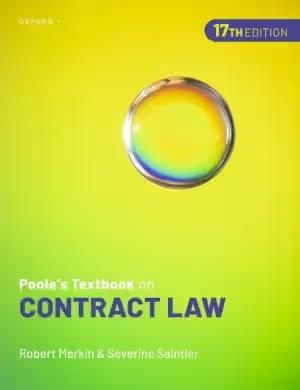
The book has fifteen chapters, an opening introduction followed by four parts: formation; content, interpretation, performance and privity; vitiating factors; and performance and termination of contract. The publisher describes it as a book that has guided students through contract law for over twenty years, setting the law within its commercial context and combining case-driven content and succinct explanations with summaries, questions, examples and further-reading guides. The seventeenth edition is revised by Robert Merkin and Séverine Saintier; the book was originally written by Jill Poole.
Chapter 1: Introduction to the Law of Contract
A stand-alone opening chapter of about thirty pages (pp. 1–32) that precedes the four parts. Its internal contents are not itemised in the sources available for this guide.
Part 1, Formation (Chapters 2–4)
Three chapters on how an enforceable contract comes into being, about 150 pages in all. Chapter 2, "Agreement", is followed by Chapter 3, "Enforceability of promises: consideration and promissory estoppel", and Chapter 4, "Intention to be legally bound, formalities, and capacity to contract".
Part 2, Content, Interpretation, Performance, and Privity (Chapters 5–7)
Chapter 5, "Content of the contract and principles of interpretation", deals with what the parties have agreed and how a court reads it. Chapter 6, "Exemption clauses and unfair contract terms", is the book's treatment of control of terms, and Chapter 7, "Privity of contract and third party rights", covers who may enforce a contract. The part runs for about 160 pages.
Part 3, Vitiating Factors (Chapters 8–11)
Four chapters on the grounds for challenging an agreement: Chapter 8, "Mistake"; Chapter 9, "Misrepresentation"; Chapter 10, "Duress, undue influence, and unconscionable bargains"; and Chapter 11, "Illegality". This part is about 160 pages.
Part 4, Performance and Termination of Contract (Chapters 12–15)
Chapter 12, "Discharge by frustration: subsequent impossibility", opens the closing part. Chapter 13, "Breach of contract", leads to the two remedies chapters: Chapter 14, "Damages for breach of contract", and Chapter 15, "Remedies providing for specific relief and restitutionary remedies". The part runs to about 180 pages before the index.
New Cases in the Seventeenth Edition
The publisher names three key new cases without saying where each is discussed: Kajima Construction Europe (UK) Ltd v Children's Ark Partnership Ltd (2023), on what constitutes an enforceable contract; Phillip v Barclays Bank UK plc (2023), on a bank's duties towards its customers; and SFL Ace 2 Inc v DCW Management Ltd (2024), on the difference between a claim in debt and an action for damages.
Key Concepts
Part 1: Formation
- Agreement: the subject of Chapter 2, on how parties reach a binding consensus.
- Consideration and promissory estoppel: the two routes to enforceability of promises named in the title of Chapter 3.
- Intention, formalities and capacity: the further requirements for an enforceable contract in Chapter 4.
Part 2: Content, Interpretation, Performance and Privity
- Interpretation: the principles by which courts determine what a contract means.
- Exemption clauses and unfair contract terms: the controls placed on terms that limit or exclude liability.
- Privity and third-party rights: who may enforce a contract.
Parts 3 and 4: Vitiating Factors; Performance and Termination
- Mistake, misrepresentation, duress, undue influence and unconscionable bargains: the grounds for avoiding an agreement.
- Illegality: the final chapter of the vitiating factors part.
- Frustration: discharge by subsequent impossibility.
- Damages, specific relief and restitutionary remedies: the remedies for breach.
Critical Analysis
Strengths
- A clear map of the subject. The fifteen chapters follow the order of most English contract courses: formation, terms, challenges to the agreement, and ending the contract with remedies. Each chapter title names a topic a student can look up directly.
- Commercial context. The publisher says that the law of contract is placed within its commercial context, and the inclusion of a chapter on exemption clauses and unfair contract terms shows that control of terms is given its own space.
- Learning supports. Chapters include summaries, questions, examples and further-reading guides, and the e-book and Law Trove add videos, self-test questions, open-ended questions and answer guidance.
- Companion materials. The publisher presents the book as suited for independent use or alongside Poole's Casebook on Contract Law, which is useful for readers who want the cases themselves.
Limitations
- Emphasis on rules and cases. The publisher's list of features centres on case-driven content and succinct explanation. Debate about the theory and justification of contract doctrine is not among the advertised features, so students writing essays on law reform may want to pair the book with a more reflective text.
- Length. The contents run to about 685 pages before the index, which is a lot to read for a first course; the four-part structure helps readers select what to study.
- Some supports are digital only. The videos, self-test questions and answer guidance are described as e-book and Law Trove features, so print-only readers do not have them.
Where It Fits in the Course
Poole's Textbook is the contract book in this list that is most closely tied to the established order of an English contract course, and it works well as a main text. Chen-Wishart's Contract Law covers similar ground but is described as heavily illustrated and more concerned with the values and controversies behind the rules, so it is a good partner for essay-writing and law-reform questions. Taylor and Taylor's Contract Law, in Oxford's Directions series, is a plainer introduction with highlighted case extracts and self-test features, suited to a first read before this book.
Anson's Law of Contract is the long-established treatise, used for looking up detailed authority rather than as a course text. Burrows's A Casebook on Contract provides primary materials starting with offer and acceptance, and Stephen Smith's article on duress, a theoretical study, complements Chapter 10.
How to Use This Book
The book is designed for undergraduate students taking a first course in English contract law, and for readers who want a systematic account that sets the rules in a commercial setting. Because the chapters correspond closely to the usual syllabus, the book can be used as the spine of a course.
A practical plan:
- Core: read Part 1 and Part 3 first for an understanding of formation and the grounds on which an agreement fails, then Part 2 on terms and Part 4 on termination and remedies. Chapter 1 is the general introduction.
- Order within the course: Chapter 7 on privity sits in Part 2 with content and interpretation; read it when the course reaches third-party rights.
- Practice: use the chapter summaries as a revision outline, then try the questions at the end of each chapter and follow the further-reading guides for essay topics. Read the three new cases named by the publisher (Kajima, Phillip v Barclays and SFL Ace 2) with the relevant chapters to see how recent authority is used.