01 / Reading Guide
Reading Guide
Citation
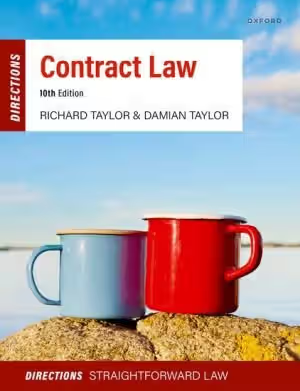
Taylor, R., & Taylor, D. (2026). Contract Law Directions (10th ed.). Oxford University Press.
Chapter Summary
The tenth edition runs to about 460 pages. After an introductory chapter, thirteen chapters are arranged in four parts that follow the life of a contractual obligation: how it is created, what it contains and where its borders lie, what defects can undermine it, and how it ends and is enforced. Two appendices on study and examinations close the book. The publisher describes the Directions approach as scene-setting introductions, highlighted case extracts, an introduction to the main areas of debate, self-test features and pointers on how to go further.
Chapter 1: Introduction
A short opening chapter of about fourteen pages that precedes the four parts and introduces the subject before the detailed rules begin.
Part 1, Creation of Obligations (Chapters 2–4): Agreement; Certainty and the intention to create legal relations; Consideration and estoppel
The first part, about ninety pages long, deals with how a binding obligation comes into existence. Chapter 2 covers agreement; Chapter 3 the requirements of certainty and of an intention to create legal relations; Chapter 4 consideration together with estoppel. The publisher lists Guest v Guest in the Supreme Court as a new estoppel case in this edition.
Part 2, Contents and Borders (Chapters 5–7): Positive terms; Exemption clauses; Misrepresentation
The second part, roughly a hundred pages, turns to what the parties have undertaken. Chapter 5 covers positive terms; the publisher lists two new Supreme Court decisions on implied terms, Barton v Morris and Tesco v USDAW. Chapter 6 treats exemption clauses; the publisher notes that it continues to follow the progress, or lack of it, of the draft codes issued under the Parking (Code of Practice) Act 2019. Chapter 7 places misrepresentation in this part, next to terms, rather than with mistake and duress in Part 3. Patarkatsishvili v Woodward-Fisher is listed as a new misrepresentation case.
Part 3, Defects (Chapters 8–9): Mistake; Duress, undue influence and unconscionable bargains
The shortest part, about sixty pages, deals with defects in the making of a contract. Chapter 8 covers mistake. Chapter 9 brings duress, undue influence and unconscionable bargains together; the publisher names Law Debenture Trust v Ukraine (duress) and Nature Resorts v First Citizens Bank and Waller-Edwards v One Savings Bank (undue influence) among the new cases.
Part 4, Finishing and Enforcing Obligations (Chapters 10–13): Frustration; Damages; Specific remedies; Privity and the interests of third parties
The final part, a little over a hundred pages, covers the end of the obligation and its enforcement. Chapter 10 treats frustration, Chapter 11 damages and Chapter 12 specific remedies, for which Tesco v USDAW is also listed. Privity comes last: Chapter 13, on privity and the interests of third parties, closes the book's legal content, with SSHD v Public and Commercial Services Union named as a new privity case.
Appendices 1–2: Efficient and creative study; Examinations and how to take advantage of them
About thirty pages of study advice: one appendix on studying efficiently and creatively, and one on examinations.
Key Concepts
Part 1: Creation of Obligations
- Agreement: the starting point for the existence of a contract, covered in Chapter 2.
- Certainty and intention to create legal relations: the further conditions for an agreement to be enforceable, paired in Chapter 3.
- Consideration and estoppel: the requirement of something given in return for a promise, and the doctrine that can make a promise binding without it.
Part 2: Contents and Borders
- Positive terms: the obligations the contract contains, whether express or implied.
- Exemption clauses: terms that exclude or limit liability, and their control.
- Misrepresentation: false statements made before the contract that induce it.
Part 3: Defects
- Mistake: the circumstances in which an error affects the validity of a contract.
- Duress, undue influence and unconscionable bargains: the grounds for setting aside a contract obtained by illegitimate pressure or the abuse of a relationship or weakness.
Part 4: Finishing and Enforcing Obligations
- Frustration: discharge of a contract by later events.
- Damages and specific remedies: compensation for breach, and orders for performance.
- Privity: who can enforce a contract, and how third parties' interests are protected.
Critical Analysis
Strengths
- A manageable length for a whole subject. About 380 pages of legal content cover formation, terms, invalidity, discharge and remedies, well under the length of Poole's textbook in this list, whose contents run to about 685 pages before the index. The publisher's stated aim is just the right amount of detail, neither overloading students nor leaving them short.
- A clear organising idea. The four parts follow an obligation from creation to enforcement, and part titles such as "Contents and Borders" and "Defects" give a map of the subject that is easy to remember.
- Current authority. The tenth edition adds a set of recent decisions, most of them from the Supreme Court, across estoppel, implied terms, specific performance, misrepresentation, duress, undue influence and privity.
- Built-in study support. Highlighted case extracts, self-test features and two appendices on study and on examinations suit students who are also learning how to study law. The e-book and Law Trove versions add self-test questions and guidance on the end-of-chapter questions.
Limitations
- Some topics have no chapter of their own. The contents list no separate chapters on illegality, on breach and termination, or on capacity and formalities, which other contract textbooks give their own space. Students whose course teaches these topics separately should check the index and supplement them from a longer text.
- An unusual order. Misrepresentation sits with terms rather than with the other vitiating factors, and privity comes at the very end. Courses that teach privity alongside formation or terms will need to read Chapter 13 out of order.
- Explanation more than primary material. The cases appear as highlighted extracts within the authors' account, so reading the judgments themselves needs a casebook or the law reports.
Where It Fits in the Course
This is the most compact explanatory textbook in the course list and a natural first book. Poole's Textbook on Contract Law and Chen-Wishart's Contract Law cover the same ground at greater length: Poole's book follows the established course order through the leading cases and their commercial context, while Chen-Wishart pays more attention to the values and policy choices behind the rules. Either can replace this book as the main text for students who want more depth, or follow it once the outline is secure.
Burrows's A Casebook on Contract is the companion for reading the judgments themselves; it pairs well with this book, which explains each topic first. Anson's Law of Contract is a detailed, closely referenced treatise to consult for a specific point or a dissertation, not to read through in a first course. Stephen Smith's Contracting Under Pressure is a monograph on the theory of duress, best read after Chapter 9 by students writing an essay on that topic.
How to Use This Book
The book suits first-year law undergraduates, students on conversion and graduate-entry courses, and others whose programmes include a contract module. No previous study of contract is assumed; some familiarity with reading cases helps.
A practical plan:
- Start with Chapter 1 and the two appendices. The appendices on study and on examinations are short, and are more useful at the start of the year than in the week before the exam.
- Read the parts in course order. Part 1 (formation) and Part 2 (terms and misrepresentation) are core in almost every course. Parts 3 and 4 follow; if the course teaches privity early, read Chapter 13 straight after Part 1.
- Read the chapter before the seminar, then read the leading judgments for that topic in a casebook or the law reports. The highlighted extracts in this book show which passages matter.
- Use the self-test features to check understanding after each chapter, and the end-of-chapter questions with their online guidance to practise problem and essay answers.
- Fill the gaps. Check the course syllabus for illegality, capacity, formalities and breach, and read those topics in a longer textbook if they are examined.
- Watch the new cases. The decisions added to this edition, such as Guest v Guest on estoppel and Barton v Morris on implied terms, are recent enough to feature in essay questions.