01 / Reading Guide
Reading Guide
Citation
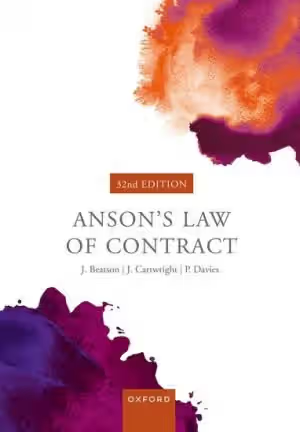
Beatson, J., Cartwright, J., & Davies, P. S. (2026). Anson's Law of Contract (32nd ed.). Oxford University Press.
Chapter Summary
The thirty-second edition runs to 840 pages and is organised in an introduction and six parts with twenty-three chapters in all. The publisher describes it as an authoritative and detailed account of contract law, aimed at students and also used by practitioners and academics. The structure follows the life of a contract, from making it, through its terms and the grounds on which it may fail, to performance, remedies and the effect on third parties. Each part is introduced below with the chapters it contains, as listed in the table of contents.
Chapter 1: Introduction
The first chapter takes about the first thirty pages (pp. 1–28) and opens the book before the doctrinal parts begin.
Part 1, Chapters 2–4: Formation of Contract
Chapter 2 deals with "The agreement", chapter 3 with "Form", and chapter 4 with "Consideration and promissory estoppel". The part runs for just over a hundred pages and covers what is needed for a contract to exist.
Part 2, Chapters 5–6: Contents of the Contract
Chapter 5 is "The terms of the contract", and chapter 6 is "Exemption clauses and unfair terms". Together they take up what the parties have promised and how clauses limiting liability are controlled. The publisher singles out the exemption-clause decision in Triple Point Technology v PTT as new case law in this edition.
Part 3, Chapters 7–11: Factors Tending to Defeat Contractual Liability
This is the largest part, at over two hundred pages. Its chapters are "Incapacity", "Mistake", "Misrepresentation and non-disclosure", "Duress, undue influence, and unconscionable bargains" and "Illegality and restraint of trade". Among the new material the publisher lists Supreme Court and Privy Council decisions on third-party misrepresentation and undue influence, on inducement in misrepresentation and on 'lawful act' duress, together with three cases on illegality and restraint of trade.
Part 4, Chapters 12–16: Performance and Discharge
The chapters are "Performance", "Discharge by agreement", "Discharge by frustration", "Discharge by breach" and "Discharge by operation of law". They explain how contractual obligations come to an end, whether by performance or by one of several kinds of discharge.
Part 5, Chapters 17–20: Remedies for Breach of Contract
Chapter 17 treats "Damages", chapter 18 "Specific remedies", chapter 19 "Restitutionary awards" and chapter 20 "Limitation of actions".
Part 6, Chapters 21–23: Limits of the Contractual Obligation
The final part concerns who can be bound or benefit. Its chapters are "Third parties", "Assignment" and "Agency". The publisher notes that the edition includes the first Supreme Court decision on the Contracts (Rights of Third Parties) Act 1999.
Key Concepts
Part 1: Formation
- Agreement, form and consideration: the elements needed to make a contract.
- Promissory estoppel: treated together with consideration in chapter 4.
Parts 2–3: Terms and vitiating factors
- Exemption clauses and unfair terms: the control of clauses that limit or exclude liability.
- Mistake, misrepresentation and non-disclosure: grounds on which a contract may be defeated for what the parties believed or were told.
- Duress, undue influence and unconscionable bargains: grounds based on pressure or exploitation.
- Illegality and restraint of trade: public-policy limits on enforceability.
Parts 4–6: Ending, remedies and third parties
- Discharge: by agreement, frustration, breach or operation of law.
- Damages, specific remedies and restitutionary awards: the remedies the book separates into three chapters.
- Third parties, assignment and agency: the ways in which a contract affects persons other than the original parties.
Critical Analysis
Strengths
- Full coverage in a logical sequence. The twenty-three chapters take the topic from formation to third parties, and a student who knows the outline of a first contract course will find every familiar topic in the order of a contract's life.
- Current case law. The publisher states that new material has been added in every chapter, with decisions from the Supreme Court, the Privy Council, the Court of Appeal and the High Court, and the largest legislative change is to retained EU-derived consumer law by the Digital Markets, Competition and Consumers Act 2024.
- Authorship. It is written by three authors with experience of research, teaching and practice, according to the publisher, and the book has been through thirty-one earlier editions.
- Navigation. The publisher highlights the division of content into manageable sections and headings, and the book includes tables of cases, statutes and conventions as well as an index.
Limitations
- Reference scale. At 840 pages, with long tables of cases and legislation before the text, it is a treatise to consult and not a short course text.
- Jurisdiction. The book states English law and refers to the UK statutes, so a student studying another system will need to adjust.
- Assumes a first course. It is addressed to students but is most useful for those who already know the outline of the subject; it is not designed as a first introduction.
- Edition-specific currency. Much of what is new in this edition concerns the cases and statutes of 2021 to 2025, so use the current edition for case citations.
Where It Fits in the Course
The contract law group has books for different stages. Taylor and Taylor's Contract Law Directions is a first, student-oriented textbook, and Burrows's A Casebook on Contract is a collection of cases with commentary. Chen-Wishart's Contract Law and Poole's Textbook on Contract Law are course textbooks that explain the rules through the leading cases and place them in context. Stephen Smith's Contracting Under Pressure is a monograph on a single topic, duress, at graduate level.
Anson sits above the textbooks as the full treatise on the whole subject. Read it after a first course and one textbook, when the aim is detailed authority on a topic, such as an essay on misrepresentation or remedies. Its chapter on duress, undue influence and unconscionable bargains gives the overview of that topic which Smith's monograph then treats in depth.
How to Use This Book
The book is for law students who have already completed a first course in contract and have met the main doctrines in a standard textbook, and for postgraduates and practitioners who need a reliable statement of the law with authorities.
A practical plan:
- Read selectively. Use the table of contents to find the chapter for the topic at hand, and read that chapter together with the topic's place in its part.
- For essays and problem questions, begin with the relevant chapter, then follow its references to the authorities.
- For revision, read the introductions to each part to reconnect the topics with the structure of the whole subject.
- Alongside a textbook. Keep a short textbook for orientation and use Anson for depth, and keep a current statute and case book at hand, since a number of the points in this edition turn on recent decisions.