01 / Reading Guide
Reading Guide
Citation
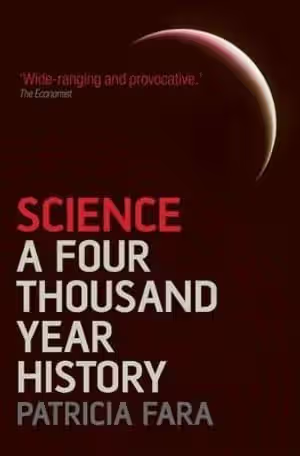
Fara, P. (2010). Science: A Four Thousand Year History. Oxford University Press. (Paperback; first published 2009.)
Chapter Summary
The book is a one-volume history of science from ancient Babylon to the early twenty-first century, told in an introduction, forty-nine short chapters arranged in seven parts of seven chapters each, and a postscript. In the 2009 hardback the chapters average about seven pages. Each chapter has a one-word title and typically opens with a quotation. The notes give references for quotations only; a separate "Special Sources" section names the main works each chapter relies on. Fara, a historian of science at the University of Cambridge, sets out to show science as part of the practical world of war, politics and business, and to question both heroic and Eurocentric stories.
Introduction
The introduction opens with McArthur's "Universal Corrective Map of the World", an Australian map with the south at the top, to show how much depends on point of view, and discusses how difficult it is to define science at all.
Part I: Origins (Sevens; Babylon; Heroes; Cosmos; Life; Matter; Technology)
The first part argues that science's foundations lie in techniques and concepts now often dismissed as magical. It begins with the special status of the number seven, from Babylonian sky-watching to Newton's seven-coloured rainbow, then describes Babylonian mathematical astronomy and its calendrical legacy. "Heroes" questions the tradition of celebrating a few Greek thinkers, from Thales to Ptolemy, who were separated by centuries and depended on many less famous people; the remaining chapters cover Greek cosmology, ideas of life and matter, and ancient technology such as Hero of Alexandria's steam toy.
Part II: Interactions (Eurocentrism; China; Islam; Scholarship; Europe; Aristotle; Alchemy)
This part challenges the myth of European origins. Fara traces how Eurocentrism shaped the history of science, discusses Chinese science and Joseph Needham's work on it, and describes how Islamic rulers sponsored libraries, hospitals and observatories. The chapters on medieval Europe stress that religious institutions preserved learning, which developed further in the new universities and in a Christianized Aristotelianism, and that alchemy was a serious enterprise.
Part III: Experiments (Exploration; Magic; Astronomy; Bodies; Machines; Instruments; Gravity)
The early modern chapters link science to voyages of exploration and natural magic, and treat Copernicus and Galileo (including later uses of Galileo as a hero, as in Brecht's play), Vesalius and anatomy, machines, instruments and experiments (including Newton's use of prisms against Descartes), and Newton's gravity and its critics.
Part IV: Institutions (Societies; Systems; Careers; Industries; Revolutions; Rationality; Disciplines)
The eighteenth-century chapters examine the Royal Society and its continental counterparts, Linnaeus's classification and its view of human races, the careers open to natural philosophers, the Lunar Society and industry, Lavoisier's chemical revolution, and, in the closing chapters, rationality and the formation of disciplines, from Humphry Davy's career to the invention of the word "scientist" in 1833. Fara gives attention to women as audiences for science who were rarely allowed to produce it.
Part V: Laws (Progress; Globalization; Objectivity; God; Evolution; Power; Time)
The nineteenth-century chapters cover the idea of progress, with Henry Brougham unveiling a statue of Newton as a national hero, global science and communication, the claim to objectivity, science and religion, evolution before and after Darwin, and, under "Time", Einstein's challenge to Newton.
Part VI: Invisibles (Life; Germs; Rays; Particles; Genes; Chemicals; Uncertainties)
The chapters on the late nineteenth and early twentieth centuries turn to things that cannot be seen: cell theory and the nature of life, germ theory and laboratory medicine, X-rays, atomic structure and the periodic table, genetics and Francis Galton's eugenics, chemistry and the pharmaceutical industry, and, under "Uncertainties", psychology and psychoanalysis.
Part VII: Decisions (Warfare; Heredity; Cosmology; Information; Rivalry; Environment; Futures)
The final part concerns science and politics in the twentieth century: the Manhattan Project and state funding of science, DNA and the ethics of genetic engineering, modern cosmology, information technology, Cold War rivalry including the space race, environmentalism, and the mixed record of predictions about the future, such as DDT and the Green Revolution. Fara argues that the route to the future depends on political decisions as well as on getting the science right.
Postscript
A brief postscript reflects on classification and on how today's science may come to look as dated as past systems, while insisting that science has changed the Universe and its inhabitants permanently.
Key Concepts
Parts I–II: Origins and Interactions
- Eurocentrism: the assumption that science began in Europe, which Fara treats as a historical construction to be questioned.
- Hero narratives: stories that credit a few great men with discoveries that depended on many people and circumstances.
- Islamic and Chinese science: scientific traditions with their own institutions and achievements, not merely transmitters to Europe.
Parts III–IV: Experiments and Institutions
- Experiment and instruments: new practices of investigation and display that characterized early modern science.
- Scientific societies: organizations such as the Royal Society that gave natural philosophy institutional standing.
- Classification: systems such as Linnaeus's that ordered nature and, with it, human hierarchies.
- The scientist: a word coined in 1833 and a professional identity that Fara uses to show how science became a career.
Parts V–VII: Laws, Invisibles and Decisions
- Objectivity: the nineteenth-century claim that scientific knowledge is impersonal and incontrovertible, which Fara examines historically.
- Germ theory: the explanation of infectious disease by specific micro-organisms, linked to the rise of laboratory medicine.
- State science: the large-scale government funding of research that began with wartime projects such as the Manhattan Project.
Critical Analysis
Strengths
- A different kind of history of science. The publisher stresses that the book places science in the world of war, politics, business and personal ambition, and tells stories about people who needed to earn a living and made mistakes. The chapters on careers, industries, power and rivalry bear this out.
- Global and critical of myths. A whole part on interactions puts China and Islam alongside medieval Europe, and the treatment of heroes, Galileo and Eurocentrism gives students a model of critical history.
- Short chapters that work as units. Forty-nine chapters of a few pages each can be assigned individually to accompany lectures, and the one-word titles make the structure easy to navigate.
- Attention to gender and race. Fara repeatedly discusses how women were excluded or confined to the role of spectators, and how classification and evolutionary theory were used to justify hierarchies of race and sex.
Limitations
- Breadth means brevity. At about seven pages per chapter, major topics such as the Scientific Revolution, Darwin or quantum physics are introduced rather than explained; the course's more focused books are needed for depth.
- Selective notes. The notes reference quotations only, and the "Special Sources" list names the works each chapter draws on, so students cannot trace every factual claim directly.
- Strongest on Britain and Europe after 1500. Despite Part II, the modern chapters draw many of their examples from Britain (the Royal Society, the Lunar Society, the British Association), reflecting the author's specialism in eighteenth-century England.
Where It Fits in the Course
Fara and McClellan and Dorn's Science and Technology in World History are the two broad surveys in this course. McClellan and Dorn build a structured textbook around one thesis about the separation and eventual merger of science and technology; Fara offers a more essayistic, people-centred narrative with more on politics, commerce and gender. Either can serve as the main survey, and the other works well as a second view of the same period.
For depth, David Lindberg's The Beginnings of Western Science expands on Fara's Parts I–II, Steven Shapin's The Scientific Revolution and Shapin and Schaffer's Leviathan and the Air-Pump on Part III, and Peter Bowler and Iwan Rhys Morus's Making Modern Science, a survey of science since the Scientific Revolution organized partly by themes, on Parts IV–VII.
How to Use This Book
No background in science or its history is required; the book suits first-year students in history or the sciences, students taking a history of science module as an elective, and general readers.
- Read the introduction and Part II first to see the approach: the questioning of maps, heroes and Eurocentrism shapes every later part.
- Assign chapters to lectures. Because each chapter is short and self-contained, pick the two or three that match each week's topic rather than reading straight through.
- Core selection for a short course: Heroes, Eurocentrism, Islam, Astronomy, Gravity, Societies, Evolution, Germs and Warfare give a spine from antiquity to the twentieth century.
- Use the Special Sources to find the scholarly works behind each chapter when writing essays.
- Compare with McClellan and Dorn on one topic, such as the Scientific Revolution or Islamic science, to see how two surveys frame the same material.