01 / Reading Guide
Reading Guide
Citation
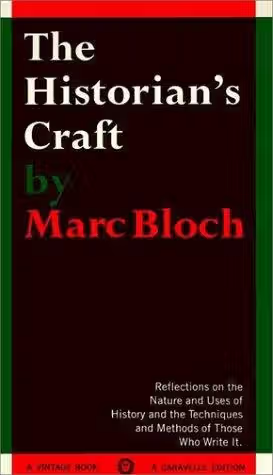
Bloch, M. (1964). The Historian's Craft (P. Putnam, Trans.; introduction by J. R. Strayer). Vintage. (Originally published in French as Apologie pour l'histoire ou Métier d'historien, 1949; first English edition, Knopf, 1953.)
Chapter Summary
The Vintage paperback (224 pages according to the publisher) has an introduction by Joseph Strayer, an introduction section listed in the contents before Chapter I, and five chapters. Bloch wrote the book in 1941 and 1942 and did not finish it; the fifth chapter, the last in the contents, has no subsections listed. The section titles below are those of the publisher's table of contents.
Introduction
The publisher describes the book as a classic discussion of the techniques of historical observation, analysis and criticism and of historical causation, and frames it around two questions: what is the value of history, and what is its use? The contents list the introduction without sections.
Chapter I: History, Men and Time
The longest list of sections in the book, seven in all, sets out the ground: The Choice of the Historian; History and Men; Historical Time; The Idol of Origins; The Boundaries between Past and Present; Understanding the Present by the Past; and Understanding the Past by the Present. The chapter deals with what history studies, the time in which it works, and the relation between present and past. The publisher notes Bloch's argument that history is a whole: no period and no topic can be understood except in relation to other periods and topics.
Chapter II: Historical Observation
Three sections: General Characteristics of Historical Observation; Evidence; and The Transmission of Evidence. The chapter considers how historians come to know the past through traces. The publisher adds that Bloch holds written records are not enough, and that a historian should draw on maps, place-names, ancient tools, aerial surveys, folklore and whatever else is available.
Chapter III: Historical Criticism
Three sections: An Outline of the History of the Critical Method; In Pursuit of Fraud and Error; and Toward a Logic of Critical Method. The chapter covers the testing of sources, including the detection of forgery and error. Google Books' list of frequent terms in the book includes "forgeries" and "Donation of Constantine", which fits this subject.
Chapter IV: Historical Analysis
Three sections: Judging or Understanding?; From the Diversity of Human Functions to the Unity of Consciences; and Nomenclature. The chapter turns from establishing evidence to explaining it, and the title of its first section poses the question of whether the historian's task is to judge or to understand.
Chapter V: Historical Causation
The last chapter takes up causation in history, which the publisher describes as the "reestablishment" of historical causation in assessing events. The contents list no sections for it.
Key Concepts
- History as a whole: no period or topic can be understood except in relation to others.
- Historical time: a section of Chapter I, on the time in which historians work.
- The idol of origins: the title of a section of Chapter I.
- Understanding the present by the past, and the past by the present: the two final sections of Chapter I.
- Evidence and its transmission: the subjects of Chapter II.
- Critical method: the testing of sources, with forgery and error as a focus in Chapter III.
- Judging or understanding: the question that opens Chapter IV.
- Nomenclature: the vocabulary of historical analysis, the last section of Chapter IV.
- Causation: the subject of Chapter V.
Critical Analysis
Strengths
- Wide view of sources. The publisher stresses that Bloch argues written records are not enough and points to maps, place-names, tools, aerial surveys and folklore.
- Theory joined to practice. According to the publisher, Bloch puts his theories into practice, drawing on his experience serving in the First World War and on his years of study and reflection.
- A wider, more human history. The publisher describes the book as arguing constantly for a "wider, more human history", a history of how and why people live and work together.
- Clear five-part structure. The chapters move from time and the choice of subject, to observation, criticism, analysis and causation, in an order that parallels the research process.
- Written for non-specialists too. According to the Wikipedia article on the book, which cites the Manchester University Press edition, the approach is aimed at interested readers and not only at professional historians.
Limitations
- Unfinished and reflective. The book was left incomplete at Bloch's death in 1944, and the final chapter has no listed subsections. It is a set of reflections, as the full English title says (Reflections on the Nature and Uses of History and the Techniques and Methods of Those Who Write It), rather than a manual of techniques.
- A mid-twentieth-century book. It was written in 1941–42 and first appeared in English in 1953, so debates on historical writing since then are not part of it; the frequent terms listed by Google Books (feudal, charters, Pirenne, Fustel de Coulanges, François Simiand) point to a European, largely medieval and French set of examples and references.
- Translation. The English text is Peter Putnam's translation, which Google Books lists as a reprint of the 1953 Vintage edition; readers who need Bloch's own wording should consult the French original.
Where It Fits in the Course
Bloch is the classic reflective essay in this historical methods course. Arnold's History: A Very Short Introduction and Tosh's The Pursuit of History are modern introductions: Arnold asks briefly how knowledge of the past is produced, and Tosh covers evidence, interpretation and archival work with newer approaches. Both work well beside Bloch. Carr's What Is History? is another classic set of lectures, on the selection and interpretation of facts, and, set beside Bloch, shows two twentieth-century statements of what historians do. White's Metahistory and Iggers, Wang and Mukherjee's A Global History of Modern Historiography come later in the reading: White on the narrative choices behind nineteenth-century historical writing, and Iggers and colleagues as a comparative history of historical writing beyond the West.
How to Use This Book
The book needs no formal prerequisites, though readers who have written a research essay will recognise the problems it discusses. It suits undergraduates in a historiography or methods course and beginning graduate students in any field of history.
A practical plan: read Strayer's introduction and Bloch's introduction for the setting and purpose; read Chapter I slowly, since its sections on time and on present and past frame the rest; and read Chapters II and III as a pair, on observation and criticism of sources. Chapter IV is useful for discussions of judging versus understanding, and Chapter V is best read as the unfinished close of the argument. Pair each chapter with a modern introduction, such as Arnold or Tosh, to see which of Bloch's problems are still central.