01 / Reading Guide
Reading Guide
Citation
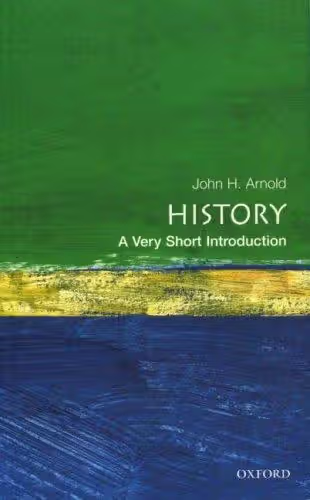
Arnold, J. H. (2000). History: A Very Short Introduction. Oxford University Press. Very Short Introductions.
Chapter Summary
The book is about 125 pages of text in seven chapters, followed by references, a short essay on further reading and an index. It is less a survey of schools of thought than an essay that keeps returning to a few archival stories (a murder recorded by the medieval Inquisition, the troubles of a seventeenth-century settler, the testimony of a woman born into slavery) to show how historians work. The author, a medievalist who became Professor of History at Birkbeck, University of London, writes in the first person and addresses the reader directly.
Chapter 1: Questions about murder and history
The book opens with a true story: in 1301, in the Pyrenees, a man hurried to the town of Pamiers with news that led, through the registers of the Inquisition, to the record of a murder kept secret for years. Arnold uses this episode to raise the questions that the rest of the book pursues: what the source is, what other stories could be told from it (a history of crime, of heresy, of French politics, of literacy), why readers find it interesting, and why historians cannot ever get the past entirely "right".
Chapter 2: From the tails of dolphins to the tower of politics
The first of two historical chapters traces history-writing from antiquity to the Renaissance: Herodotus, with his digressions into customs and marvels, set against Thucydides' concentration on recent politics and the state; Christian chronicles organized around the ages of the world and the wheel of fortune; medieval chroniclers who aimed at objectivity but inherited their sources' biases; and Renaissance writers such as Jean Bodin who made history a method for educating rulers in war and government.
Chapter 3: "How it really was": truth, archives, and the love of old things
This chapter runs from the humanists and antiquarians (Lorenzo Valla, William Camden, cabinets of curiosities) through Enlightenment historians such as Voltaire, Hume and Gibbon to Leopold von Ranke, whose phrase about showing the past "how it really was" serves as both starting point and destination. Arnold presents modern historiography as the meeting of the antiquarians' documentary detail with philosophical history, and closes this historical part of the book with Ranke, leaving later developments to the thematic chapters.
Chapter 4: Voices and silences
Moving from the history of history to practice, the chapter explains what archives are (systematized repositories cared for by professionals, not mere storehouses) and how historians read documents: their types, their spelling and language, and what they leave out. It begins to reconstruct the story of George Burdett, a seventeenth-century figure in colonial New England, and ends with the point that sources never tell all, so that historians must work with silences as well as voices.
Chapter 5: Journeys of a thousand miles
Here Arnold asks how a single life connects to larger histories. Starting from Burdett, the chapter moves out to the English Civil War and surveys the ways historians have widened their subjects to social and cultural history, drawing on figures such as Eric Hobsbawm. It ends with an image of individual lives as ripples that interact to form the patterns of history.
Chapter 6: The killing of cats; or, is the past a foreign country?
The chapter weighs two views of the past: that people have always been much the same (Arnold cites David Hume) or that the past is a foreign country where things are done differently (L. P. Hartley). Robert Darnton's "Great Cat Massacre", an episode in eighteenth-century Paris printing shops, is the test case for the history of mentalities, together with the Annales school and Fernand Braudel's The Mediterranean. Arnold also discusses how words such as "feudalism" or "civil war" can mislead.
Chapter 7: The telling of truth
The final chapter centres on Sojourner Truth, born into slavery in New York around 1797, and the competing reports of her speech at Akron, Ohio, including the refrain "Ar'n't I a woman?". Arnold uses them to show how historians judge between accounts while still telling their readers about the alternatives, how social and feminist history widened the subject, and why history matters, offering reasons that begin with enjoyment and include history as "something with which to think".
Key Concepts
Chapters 1–3: What History Has Been
- Historiography: the writing of history and the study of how it has been written, which the book follows from Herodotus to Ranke.
- Antiquarianism: early modern collecting and documentary scholarship whose attention to detail, Arnold argues, fed into modern historical method.
- "How it really was": Ranke's ideal of describing the past from the archives without moralizing, used as the reference point for modern historiography.
Chapters 4–5: Working with Sources
- Archive: an organized repository of documents whose creation and cataloguing shape what historians can find.
- Silences: what the sources do not record, which historians must recognize instead of filling with unmarked guesses.
- Scale: the movement from a single life to wider social, political and cultural contexts.
Chapters 6–7: Interpretation and Truth
- Mentalités: the history of shared attitudes and ways of thinking associated with the Annales historians.
- The past as a foreign country: the question of how far people in the past thought and acted differently from us.
- Competing accounts: weighing different versions of an event while being open about the judgement made.
Critical Analysis
Strengths
- Method shown through cases. Each idea is tied to a concrete source: the Inquisition register, Burdett's quarrels, the cat massacre, Sojourner Truth's speech. The publisher's description and the endorsements it quotes (from Dorothy Porter of Birkbeck and the journalist Neal Ascherson) stress this construction around "a few glittering fragments of the past".
- History of history and practice in one book. Two chapters give a compact history of historical writing from the Greeks to Ranke, and the remaining chapters turn to archives, scale, interpretation and truth, so a beginner meets both the tradition and the craft.
- Honest about uncertainty. The book repeatedly insists that every account has gaps and that guesses must be marked as guesses, a useful model for students' own essays.
- Very readable. The tone is personal and lively, and the further-reading essay recommends accessible starting points (it notes, for instance, that Herodotus is more fun to read than Thucydides).
Limitations
- Selective by design. The historical chapters stop with Ranke; twentieth-century movements appear only within the thematic chapters, and Arnold says himself that his synthesis of over two thousand years must leave much out. Students need a longer methods text for schools and debates.
- Western and medieval-to-early-modern in its examples. The cases come mainly from medieval Europe, early modern England and New England, and nineteenth-century America; non-Western historiography hardly appears.
- First published in 2000. Developments of the last two decades, such as digital archives and global history, are not covered.
Where It Fits in the Course
Arnold is the gentlest way into a course on historical methods, and works well in the first week. E. H. Carr's What Is History?, also short, is a different kind of book: a single historian's argued position from 1961 on facts, causation and progress. Reading Arnold first gives the background to appreciate what Carr is arguing against; reading Carr after Arnold shows how one strong thesis can be built and attacked. John Tosh's The Pursuit of History is a fuller textbook on sources, approaches and the uses of history, the natural next step when Arnold's brevity runs out.
Marc Bloch's The Historian's Craft is the classic reflection by a founder of the Annales school, whose approach Arnold introduces in Chapter 6. Hayden White's Metahistory and Iggers, Wang and Mukherjee's A Global History of Modern Historiography are much more demanding: White on the narrative forms of nineteenth-century historians, and Iggers and his co-authors on historiography beyond Europe, which fills the gap left by Arnold's Western examples.
How to Use This Book
No previous study of history or theory is needed; the book suits new history undergraduates, students of other disciplines taking a history module, and sixth-formers thinking about a history degree.
- Read it in one or two sittings before or at the start of a methods course.
- Core chapters: Chapters 1, 4 and 7 carry the central argument about sources, silences and truth; Chapters 2–3 give historical background that can be read more quickly.
- Use the cases as models. After Chapter 4, take one document set for a seminar and ask Arnold's questions: who produced it, for what purpose, what it omits and what other stories it could support.
- Revisit Chapter 6 when a course asks you to explain past beliefs, and Chapter 7 when writing an essay that has to choose between conflicting accounts.
- Follow the further-reading essay for the next step on each theme, and pair the book with Tosh for detail and Carr for argument.