01 / Reading Guide
Reading Guide
Citation
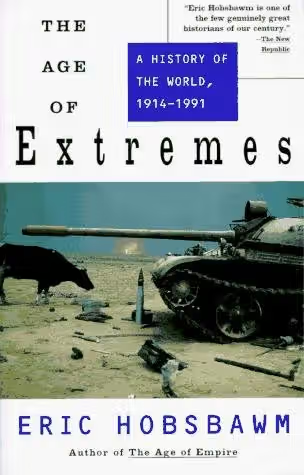
Hobsbawm, E. (1996). The Age of Extremes: A History of the World, 1914–1991. Vintage.
Chapter Summary
The first American Vintage edition has 19 chapters in three parts, preceded by a preface and an opening overview chapter, "The Century: A Bird's Eye View", and followed by references, further reading and an index. The library catalogue gives xii and 627 pages plus 32 pages of plates. Hobsbawm calls the period 1914 to 1991 the "short twentieth century"; the publisher gives the divisions of the three parts as 1914–1950, 1950–1973 and 1973–1991. The notes below follow the chapter titles from the catalogue contents list and describe the content only as far as the titles and the published descriptions and reviews show.
Part I, The Age of Catastrophe: Chapters 1–7
The part opens with Chapter 1, The Age of Total War. The reviewer Alex Callinicos describes the period 1914–45 as the years in which the long European peace of the nineteenth century descended into war, revolution, fascism and depression, and he treats the Russian Revolution and its fate as the main theme running through the whole book; Chapter 2, The World Revolution, is the chapter whose title points to revolution on a world scale. Chapter 3, Into the Economic Abyss, and Chapter 4, The Fall of Liberalism, have titles that point to the economic collapse and the retreat of liberal politics. Chapter 5, Against the Common Enemy, and Chapter 6, The Arts 1914–1945, follow, and Chapter 7, End of Empires, closes the part with the fate of the imperial order.
Part II, The Golden Age: Chapters 8–13
Chapter 8, Cold War, opens the second part. Callinicos notes that Hobsbawm treats the era after 1945 as welded into a single pattern by the Cold War. Chapter 9, The Golden Years, and Chapter 10, The Social Revolution 1945–1990, have titles that point to the long postwar boom and the social transformation of the period; Callinicos says Hobsbawm is admirably clear about the enormous economic, social and cultural transformations wrought by capitalism on a world scale during the long boom of the 1950s and 1960s. Chapter 11, Cultural Revolution, Chapter 12, The Third World, and Chapter 13, "Real Socialism", complete the part, with titles that point to cultural change, the Third World and the Soviet-type states.
Part III, The Landslide: Chapters 14–19
Chapter 14, The Crisis Decades, takes up the period of economic crisis after the golden age, which Callinicos reports Hobsbawm compares to the depression of the 1930s. Chapter 15, Third World and Revolution, and Chapter 16, End of Socialism, pair the revolutions of the developing world with the collapse of the Soviet system. Chapter 17, The Avant-Garde Dies: The Arts after 1950, and Chapter 18, Sorcerers and Apprentices: The Natural Sciences, treat the arts and sciences of the later century. Chapter 19, Towards the Millennium, looks forward; Callinicos reports that the book closes on a pessimistic note about a possible future in "darkness".
Key Concepts
- The short twentieth century: the period from 1914 to 1991, framed by the First World War and the collapse of the Soviet Union.
- Age of Catastrophe, Golden Age, Landslide: the three-part periodisation of 1914–1950, 1950–1973 and 1973–1991 given in the publisher's description.
- Total war: the title of Chapter 1, with the two world wars described by the publisher as sweeping away millions of lives and entire systems of government.
- The Cold War as organising pattern: the period after 1945 treated as a single international configuration.
- Real socialism and its end: Chapters 13 and 16 follow the Soviet-type systems from their establishment to their collapse.
- The Third World: a subject given two chapters (12 and 15), with decolonisation and revolution.
- Culture and the arts: Hobsbawm gives separate chapters to the arts before and after the middle of the century, and to the natural sciences.
Critical Analysis
Strengths
- A global frame in one volume. The publisher stresses the scope: two world wars, communism's rise and fall, urbanisation, mass literacy, and a shift of the driving forces of history from Europe to its former colonies.
- Ranges beyond politics. Separate chapters on the arts, the natural sciences and cultural revolution, as well as the Third World, show the intention to treat more than diplomacy and war.
- Clear periodisation. The three parts give a student a usable map of the century, and the publisher names the dates.
- Part of a recognised series. The book is the fourth in the author's account of the modern world after The Age of Revolution, The Age of Capital and The Age of Empire, so it can be read as a continuation of that account.
- Strong reception. The publisher quotes The New Republic praising the book's interpretation of an age of economic transformation, mass slaughter and social upheaval, and Callinicos, a critic, grants that the account of the transformations of the long boom is admirably clear.
Limitations
- A personal, Marxist interpretation. Callinicos, writing from the left in Socialist Review (November 1994), argues that Hobsbawm's own political history disables him on the October Revolution and Stalinism, and that the book offers no clear account of what went wrong. Readers should treat it as an interpretation rather than a neutral summary.
- Hedged argument and haste. The same review finds a "frenzy of equivocation" in which bold assertions are hedged, signs of haste, some repetition, and a bibliography he called incomplete in the 1994 edition.
- Large scale means compression. Covering the whole world from 1914 to 1991 in about 600 pages leaves limited room for regional detail, which must come from other books.
- Ends in 1991. The narrative stops with the Soviet collapse and a forecast of an uncertain future, so later developments are not covered.
Where It Fits in the Course
In the twentieth-century history course, Hobsbawm is the one interpretive world history of the century. Duiker's Contemporary World History and Keylor's The Twentieth Century World and Beyond are survey textbooks that cover similar ground in a more conventional form, with Keylor focused on international relations; they suit a first course and can be used alongside Hobsbawm for narrative detail. Mazower's Dark Continent is an interpretive history of twentieth-century Europe as a contest between liberal democracy, fascism and communism, and pairs naturally with Hobsbawm's Parts I and II for a European focus.
Westad's The Global Cold War and McMahon's The Cold War: A Very Short Introduction go deeper on the period of Chapters 8, 12 and 15, the first from a global perspective, the second as a short account that can be read before Part II.
How to Use This Book
A general knowledge of modern history helps, because the chapter titles show that the book is organised by theme (the economy, the arts, the Third World) within each period rather than as a continuous narrative; it is not a first narrative of the century. It suits undergraduates who already have a survey course behind them and general readers who want a single argument about the century.
A practical plan: read the opening overview and Part I as a unit; read Part II selectively, taking Chapters 8, 9, 10 and 13 for the political and economic core and the remaining chapters as needed; and read Part III with Chapters 14 and 16 for the end of the golden age and of Soviet socialism. The chapters on the arts and sciences (6, 17, 18) can be set aside in a politically focused course. Pair the book with a conventional textbook for narrative, and a critical review such as Callinicos's to see where Hobsbawm's interpretation is contested.