01 / Reading Guide
Reading Guide
Citation
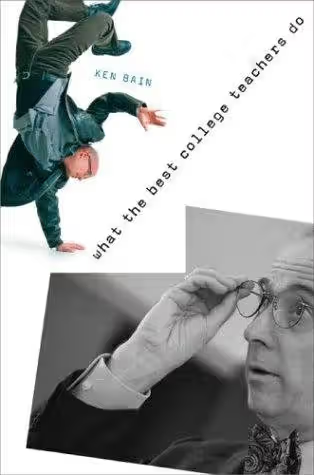
Bain, K. (2004). What the Best College Teachers Do. Harvard University Press.
Chapter Summary
The book is short, about 224 pages, and has not been revised since its 2004 publication. It reports the results of a study, carried out over some fifteen years, of college and university teachers in the United States whose students learned exceptionally well. The publisher describes nearly one hundred teachers in many fields and institutions; reviewers give other figures (63 in Teacher Magazine, about 60 in the APA Newsletter on Teaching Philosophy), so the exact count depends on how the core sample is defined. An introduction explains how the teachers were chosen, six chapters each answer one question about what they do, and an epilogue asks what others can learn from them. A closing section, "How the Study Was Conducted", describes the method, followed by notes and an index.
The publisher sums up the main finding as "it's not what teachers do, it's what they understand": the best teachers are distinguished less by technique than by how they understand their subjects and human learning, and by two convictions, that teaching matters and that students can learn. Reviewers note that Bain lets the teachers speak for themselves, and that the study found no pattern in personality, manner or dress among successful teachers.
Introduction: Defining the Best
Explains what "best" means in the study and how the teachers were chosen. According to the review in Teacher Magazine, they were identified through the judgements of students and colleagues and by examining their students' work.
What Do They Know about How We Learn?
The best teachers know their subjects deeply, including the history and controversies of their disciplines, and understand learning as the construction of knowledge rather than its reception. Laura Levi Altstaedter's review stresses their attention to students' existing mental models, which must sometimes be challenged before deeper understanding is possible, and their awareness of their own thinking.
How Do They Prepare to Teach?
How the best teachers plan their courses and sessions. Richard Elwes's review quotes Bain's observation that exceptional teachers treat lectures and other elements of teaching as serious intellectual endeavours, as demanding as their research; Altstaedter adds that their instruction is built around broad goals for students' intellectual and personal development.
What Do They Expect of Their Students?
High expectations, communicated with confidence that students can meet them. Altstaedter singles out Bain's discussion of stereotypes and their effect on students' performance, and Publishers Weekly notes his use of research suggesting that students respond to high demands combined with opportunities to revise work before it is graded.
How Do They Conduct Class?
The longest chapter (pages 98–134), on what happens in class. Reviewers connect the book's best-known idea with classroom practice: the "natural critical learning environment", in which students meet the skills and information they are learning inside questions they find fascinating and learn to reason from evidence and examine their own thinking. Elwes quotes Bain's finding that the most significant classroom skill was the ability to speak in ways that stimulate thought.
How Do They Treat Their Students?
Trust and respect. The review in the International Journal of Teaching and Learning in Higher Education notes that the best teachers trust their students, decline the position of power they could take, and create a setting where students take part without fear of mistakes.
How Do They Evaluate Their Students and Themselves?
Altstaedter reports that the best teachers use assessment to help students learn rather than only to rate or rank them, and share their criteria with students. Elwes adds that they confront their own shortcomings, unlike teachers who see no problems in their teaching.
Epilogue: What Can We Learn from Them?
Turns the findings toward readers, consistent with the book's premise that good teaching can be learned.
Key Concepts
Introduction and first three chapters: understanding and preparation
- Defining the best: identifying outstanding teachers through students, colleagues and evidence from students' work.
- Learning as construction: knowledge is constructed rather than received, from existing mental models that teaching may need to challenge.
- Teaching as intellectual work: preparing teaching with the seriousness given to research.
- High expectations: demanding goals communicated with confidence in students' ability to reach them.
Last three chapters and epilogue: classroom, relationships and evaluation
- Natural critical learning environment: fascinating questions and authentic tasks in which students practise reasoning from evidence.
- Trust and respect: treating students as capable partners and sharing control of learning with them.
- Assessment for learning: evaluation used to help students improve, with criteria shared in advance.
- Self-evaluation by teachers: willingness to confront one's own shortcomings and improve.
Critical Analysis
Strengths
- Readable and free of jargon. Richard Elwes, in a 2015 review, found it far more readable than most writing on pedagogy; Benjamin Pacini (Inside Higher Ed, quoted by the publisher) calls it easy to read and full of practical ideas.
- Grounded in observation. The conclusions come from a long study of real teachers across disciplines, from medical schools to undergraduate departments, and the teachers' own words carry much of the book. The method is described in a separate closing section.
- About thinking, not tips. Altstaedter notes that the book's aim is to prompt reflection rather than to list techniques, and its finding that personality and style do not explain excellence is encouraging for teachers of every temperament.
- Lasting influence. James Lang, writing in the Chronicle of Higher Education nine years after publication, still called it the most inspiring and thought-provoking work in the field.
Limitations
- A study of exemplars only. The book describes what outstanding teachers have in common; without a comparison group it cannot show which practices cause better learning, and reviewers report the sample size inconsistently (from about three dozen to nearly one hundred).
- United States, early 2000s. All the teachers worked at American institutions, and the book predates online and hybrid teaching and much later research on learning.
- Inspiration more than procedure. Readers looking for step-by-step methods for designing a course will need other books.
Where It Fits in the Course
In the higher-education list, Bain is the portrait of excellent teaching: it describes how the best teachers think about their subjects, students and learning. Lovett and colleagues' How Learning Works supplies the research-based principles and strategies that explain why such practices work, and is the natural next book when designing specific activities. James Lang's Small Teaching turns learning research into small classroom changes and cites Bain in its final chapter.
Biggs, Tang and Kennedy's Teaching for Quality Learning at University offers a full framework for course design built on constructive alignment, and Stephanie Marshall's Handbook for Teaching and Learning in Higher Education is a broad edited handbook on teaching, assessment and student support. American Higher Education in the Twenty-First Century, edited by Bastedo, Altbach and Gumport, studies higher education as an institution and is not about classroom teaching.
How to Use This Book
The book is for anyone who teaches in higher education, from graduate teaching assistants and new lecturers to experienced faculty and educational developers; one reviewer finds it relevant to school teachers too. No background is needed.
A practical reading plan:
- Read it whole. At about 220 pages it can be read in a few sittings, and the chapters build a single picture.
- Core chapters: the chapters on how the best teachers prepare and how they conduct class are the most directly usable; the chapter on evaluation pairs naturally with any course on assessment.
- Method: read the introduction and the closing section on how the study was conducted, so that the claims can be weighed as findings from a study of exemplars.
Use the six chapter questions as a reflection exercise: answer each for your own course, and compare the answers with Bain's teachers. Then turn to How Learning Works or Small Teaching to choose concrete strategies, and revisit Bain's epilogue when reviewing a course at the end of a term. Bain's later What the Best College Students Do approaches the same questions from the students' side.