01 / Reading Guide
Reading Guide
Citation
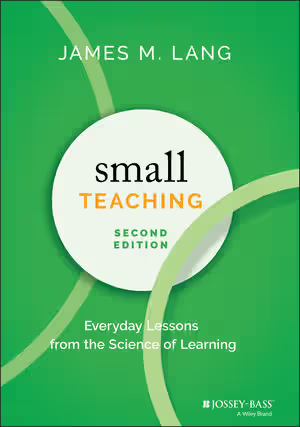
Lang, J. M. (2021). Small Teaching: Everyday Lessons from the Science of Learning (2nd ed.). Jossey-Bass.
Chapter Summary
The second edition runs to 288 pages. After an introduction to the idea of small teaching, nine chapters are grouped into three parts (Knowledge, Understanding, Inspiration) and followed by a conclusion, a list of works cited and an index. The index shows that each chapter follows the same pattern: an introduction, a section "In Theory", several "Models" (concrete classroom or online activities), a set of "Principles" for adapting them, "Quick Tips" and a conclusion.
Introduction: Small Teaching
The introduction presents the premise stated by the publisher: research on learning can improve teaching if it is translated into small changes, many of which fit in a single class period. According to the index, it describes the forms small teaching takes (brief activities, one-time interventions, and modest changes to course design or student communication) and the principles behind them. This edition has a new preface and updated examples and research.
Part I: Knowledge. Chapter 1: Predicting
The chapter argues for asking students to predict, pretest or try a problem before they have been taught. Its opening pages describe a lab experiment on word pairs in which unsuccessful predictions still improved later recall, a classroom study in which short pretests were followed by better exam performance on the pretested topics, and an online tutoring study using pause-predict-ponder film clips. The index lists models such as polling predictions, activating prior knowledge and closing predictions.
Part I: Knowledge. Chapter 2: Retrieving
This chapter is about retrieval practice, the testing effect, and ways to build it into courses. Indexed models include opening and closing questions, online retrieval (frequent quizzing and reading checks) and a "retrieving syllabus".
Part I: Knowledge. Chapter 3: Interleaving
The chapter distinguishes interleaving from spacing and discusses spaced versus massed learning. Models listed in the index are cumulative exams, cumulative quizzes, mixing practice within class, and online learning environments.
Part II: Understanding. Chapter 4: Connecting
Part II opens with a short introduction that, according to the index, discusses active learning and the flipped classroom. Chapter 4 then treats learning as making connections. Indexed models are connection notebooks, concept maps and a Minute Thesis exercise, along with providing a framework for students.
Part II: Understanding. Chapter 5: Practicing
The chapter discusses practice and Langer's theory of mindful learning. Its models concern assessments, small teaching opportunities, and feedback, and its principles include making time for in-class practice and spacing practice sessions.
Part II: Understanding. Chapter 6: Explaining
Here students explain material to themselves and to others. The index lists self-explanation, peer instruction, creating teaching materials and expanding the audience beyond the instructor.
Part III: Inspiration. Chapter 7: Belonging
The first chapter of Part III concerns students' sense of belonging. The index shows discussion of cognitive belonging, praise, and growth and fixed mindsets, with models such as discussion boards, normalizing help-seeking, providing high structure and valuing students' assets.
Part III: Inspiration. Chapter 8: Motivating
The chapter covers extrinsic and intrinsic motivation, emotions and purpose. Models include opening class with stories or wonder, invoking purpose, sharing enthusiasm, paying attention to every student and using warmer language.
Part III: Inspiration. Chapter 9: Learning
The final chapter has the usual theory section, quick tips and a conclusion. According to the index it also includes a section of learning resources on teaching (books, book series, podcasts, web resources and the OneHE community).
Conclusion: Beginning
The short conclusion (pages 237 to 239) closes the book.
Key Concepts
Part I: Knowledge
- Prediction and pretesting: attempting answers before instruction, even incorrectly, to prepare for learning.
- Retrieval practice: recalling information from memory (the testing effect) rather than rereading.
- Interleaving and spacing: mixing topics and distributing study over time.
Part II: Understanding
- Connection-making: linking new material to existing knowledge, as in concept maps.
- Mindful learning: Langer's theory, discussed in the chapter on practicing.
- Self-explanation and peer instruction: explaining to oneself or to others as a way to learn.
Part III: Inspiration
- Cognitive belonging and mindset: students' sense of fitting in and beliefs about intelligence.
- Intrinsic and extrinsic motivation: the sources of students' drive, with purpose and emotion.
Critical Analysis
Strengths
- A predictable, reusable structure. Every chapter has the same sections, and the index lists the models and principles by name, so an instructor can locate an activity for a particular purpose quickly.
- Research is tied to concrete practice. In the sample chapter, each claim is introduced through named experiments with figures (for example 67 percent versus 55 percent recall in the word-pair study), and is followed by classroom models.
- A deliberate scale. The publisher stresses simple interventions that can be integrated into existing techniques, which suits instructors who cannot redesign a course.
- Updated and wide-ranging. The second edition adds a preface, new examples and techniques, updated research and resources, and the index shows models for online settings as well as face-to-face classes. Examples come from many disciplines.
Limitations
- Small changes by design. The book offers incremental changes, not a framework for designing a whole course, so readers who want one will need a separate book on course design.
- Evidence summarized through selected studies. The sample chapter builds each argument from a few illustrative studies rather than a systematic review; readers wanting more should follow the works cited (about eight pages).
- Aimed at the individual instructor. According to the publisher, the interventions are brief activities, one-time interventions and small changes to course design or student communication, so institutional or curricular change is outside its scope.
Where It Fits in the Course
In the higher-education list, Small Teaching is the shortest route from research on learning to something to try next week. Lovett and colleagues' How Learning Works organizes research into principles with scenarios and strategies, and Lang's index cites it; reading the two together pairs a principle-based overview with action-sized activities. Bain's What the Best College Teachers Do is a study of exceptional teachers, which Lang cites in his final chapter, and is closer to a view of teaching as a whole than to a toolkit.
Marshall's Handbook for Teaching and Learning in Higher Education covers teaching, assessment, student support and disciplinary teaching, and Biggs, Tang and Kennedy's Teaching for Quality Learning at University offers a single framework for course design, so both are broader companions. American Higher Education in the Twenty-First Century treats higher education as a field of study and is not a teaching guide.
How to Use This Book
No background in cognitive psychology is needed; the publisher describes the book for faculty in any discipline, and for administrators, K-12 teachers and teacher trainers as well. It suits faculty, graduate teaching assistants, adjuncts and teaching-center staff.
A practical plan: read the introduction and Part I first, since predicting, retrieving and interleaving are the quickest techniques to try and each chapter includes short models. Choose one or two models from each chapter and try them within a single class period before adding more, using the "Quick Tips" at the end of each chapter as a checklist. Read Part II when planning how students practice, connect and explain material, and Part III for community, belonging and motivation, which matter in any course. Use Chapter 9 and the works cited to find further reading, and pair the book with a broader text on course design when planning a new course.