01 / Reading Guide
Reading Guide
Citation
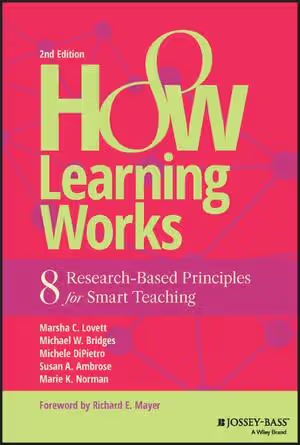
Lovett, M. C., Bridges, M. W., DiPietro, M., Ambrose, S. A., & Norman, M. K. (2023). How Learning Works: Eight Research-Based Principles for Smart Teaching (2nd ed.). Jossey-Bass.
Chapter Summary
The second edition (published by Wiley's Jossey-Bass imprint in 2023, 336 pages) in the publisher's words incorporates newer research, offers a wider range of strategies and adds a new principle, bringing the total to eight. The front matter includes Richard E. Mayer's foreword to the first edition and a preface to the second; an introduction, "Bridging Learning Research and Teaching Practice", precedes eight chapters, each titled as a question. A conclusion turns the principles on instructors themselves, and ten short appendices explain specific tools. The publisher counts 150 strategies, says the examples reflect a diverse set of teaching environments and learner populations, and presents the book as a help in adapting teaching to online and hybrid formats.
The sample Chapter 1 shows the book's chapter pattern: two short stories told by instructors facing a problem; "What Is Going On in These Two Stories?"; "What Principle of Learning Is at Work Here?", which states the principle; a review of what the research says; "What Strategies Does the Research Suggest?"; and a summary.
Chapter 1: Why Do Students' Identities and Stages of Development Matter for Learning?
The first principle: students differ in identity, developmental stage and personal history, and these differences shape how they experience the learning environment. The chapter opens with a class discussion that collapses into conflict and a course met by a "wall of silence". It reviews research on identity characteristics, social identity development and intellectual development, distinguishes equity from equal treatment, and rejects learning styles as a basis for teaching, noting that matching instruction to learning styles has virtually no evidence behind it. Its strategies address students' identities and developmental stages and include a section on margin, power and load, the balance between the demands on students and the resources they have.
Chapter 2: How Does Students' Prior Knowledge Affect Their Learning?
What students already know can help or hinder new learning. The index shows the chapter's attention to inaccurate prior knowledge and how to correct it, and to ways of finding out what students already know, such as brainstorming.
Chapter 3: How Does the Way Students Organize Knowledge Affect Their Learning?
How students connect what they know affects how well they can retrieve and use it. The chapter contrasts the knowledge organisations of experts and novices and suggests ways to help students build richer structures; concept maps are explained in an appendix.
Chapter 4: What Factors Motivate Students to Learn?
Motivation as shaped by the value students place on a goal and their expectations of success. The index points to kinds of value (attainment, intrinsic, instrumental), efficacy expectancies and attributions.
Chapter 5: How Do Students Develop Mastery?
Mastery requires acquiring component skills, practising their integration and knowing when to apply them. The chapter discusses the "expert blind spot" (experts' difficulty in seeing steps that have become automatic), cognitive load and transfer to new contexts.
Chapter 6: What Kinds of Practice and Feedback Enhance Learning?
How practice and feedback should be designed so that they improve learning. The index lists deliberate practice, instructional scaffolding, interleaved practice, the "doer effect" and formative feedback.
Chapter 7: Why Does Course Climate Matter for Student Learning?
The climate of a course affects learning. The chapter describes climates on a range from explicitly marginalising to explicitly centralising, and discusses belonging, stereotype threat and inclusive course content.
Chapter 8: How Do Students Become Self-Directed Learners?
Becoming a self-directed learner depends on metacognition, the processes by which students monitor and control their own learning; the index also lists self-assessment and growth mindset. Exam wrappers are among the tools discussed and have their own appendix.
Conclusion and Appendices A–J
The conclusion, "Applying the Eight Principles to Ourselves", treats instructors as learners of teaching. The appendices are practical: instructor self-assessments and reflections, ground rules for discussion, student self-assessments, concept maps, rubrics, learner checklists, learning objectives, active learning strategies, reader responses and peer reviews, and exam wrappers.
Key Concepts
Chapters 1–3: who students are and what they know
- Individual differences: identity, development and experience shape how each student experiences a course.
- Equity: giving students what they need to reach comparable outcomes, rather than identical treatment.
- Prior knowledge: what students bring with them, which must be activated, checked for accuracy and corrected where needed.
- Knowledge organisation: the structure in which knowledge is held; experts' structures are richer and better connected than novices'.
Chapters 4–6: motivation, mastery and practice
- Value and expectancy: students are motivated when they value a goal and expect to be able to reach it.
- Expert blind spot: an instructor's difficulty in seeing the component skills that experts perform automatically.
- Transfer: applying skills learned in one context to another.
- Deliberate practice and feedback: focused practice combined with feedback that guides the next attempt.
Chapters 7–8: climate and self-direction
- Course climate: the environment of a course, which can marginalise or include students, explicitly or implicitly.
- Stereotype threat: the risk that awareness of a negative stereotype about one's group harms performance.
- Metacognition: the processes by which learners monitor and control their own learning.
Critical Analysis
Strengths
- A compact synthesis. Eight principles, each stated briefly, organise research from cognitive and developmental psychology, education and other fields into a framework that an instructor can remember and use to diagnose problems.
- Problem-first structure. Chapters start from realistic teaching stories and work back to the principle and the research, which makes the book easy to use when a specific problem arises in a course.
- Practical tools. The publisher counts 150 strategies, and the ten appendices explain tools such as rubrics, learning objectives and exam wrappers well enough to adopt them directly.
- Updated for inclusion and new settings. The sample chapter shows the edition's attention to identity, equity and inclusion, and the publisher stresses diverse teaching environments and adaptation to online and hybrid teaching.
Limitations
- Breadth over depth. Each principle receives a single chapter of about twenty to thirty pages, so the research is summarised rather than examined; readers who want the underlying studies must follow the references.
- Centred on United States higher education. The stories and the equity discussion are set in American colleges, and some of the research the authors cite notes that quantitative educational research in the United States has largely left race out of account. Readers elsewhere will need to adapt the context.
- Principles, not course design. The book explains how learning works and what to do about particular problems; it does not offer a method for designing a whole course or programme.
Where It Fits in the Course
In the higher-education list, this is the principle-based introduction to the research on learning. Ken Bain's What the Best College Teachers Do is a study of exceptional teachers built from observation and interviews; it is about how good teachers think, while How Learning Works explains the learning mechanisms behind what they do. Read Bain for the larger picture and this book for diagnosis and strategies. James Lang's Small Teaching turns similar research into brief classroom activities and cites How Learning Works; the two pair naturally.
Stephanie Marshall's Handbook for Teaching and Learning in Higher Education is a broad edited handbook covering teaching, assessment, student support and the disciplines, and Biggs, Tang and Kennedy's Teaching for Quality Learning at University supplies what this book does not: a full framework for course design built on constructive alignment. American Higher Education in the Twenty-First Century, edited by Bastedo, Altbach and Gumport, treats higher education as a field of study and is not a teaching guide.
How to Use This Book
The book is written for college and university instructors: new faculty, graduate teaching assistants, and experienced teachers reviewing a course. No background in psychology is needed, and it also serves teaching-centre staff and participants in teaching certificates.
A practical reading plan:
- Start: read the introduction and Chapter 1, which sets out the book's stance on student differences and the pattern the chapters follow.
- Core: read Chapters 2–8 in order once. Chapters 2, 5 and 6 (prior knowledge, mastery, practice and feedback) bear most directly on how assignments and classes are designed.
- Diagnose: afterwards, use the chapters as a reference. When a problem appears, such as silence, poor transfer or weak study habits, find the matching question, read the stories and pick one or two strategies.
- Tools: adopt an appendix tool directly; exam wrappers (Appendix J) and rubrics (Appendix E) are easy places to start.
Read the conclusion last and use its suggestion to apply the principles to one's own development as a teacher. Pair the book with Lang for ready-made activities and with Biggs, Tang and Kennedy when redesigning a whole course.