01 / Reading Guide
Reading Guide
Citation
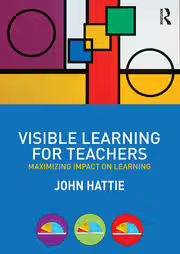
Hattie, J. (2012). Visible Learning for Teachers: Maximizing Impact on Learning. Routledge.
Chapter Summary
The book is the practical follow-up to Hattie's Visible Learning (published in November 2008), a synthesis of meta-analyses of influences on school achievement. Routledge describes it as written for students, pre-service and in-service teachers, explaining how to apply the principles of the earlier work in any classroom, and notes that the evidence base now runs to more than 900 meta-analyses. It has a preface, an introductory chapter and three parts (nine chapters in all), followed by six appendices. Each part offers checklists of observable practices, and the book includes exercises and case studies.
Chapter 1: Visible Learning Inside
The opening chapter introduces the idea of visible learning that the rest of the book turns into classroom practice, and sets up the question it pursues: how teachers can know and increase their impact on learning.
Part A: The Source of Ideas and the Role of Teachers
Chapter 2: The Source of the Ideas
An explanation of the research behind the book: meta-analysis, the effect size as a common measure, and how to read the rankings of influences. Christine Bainbridge, reviewing the book for Cult of Pedagogy (2016), describes an exercise in this part of the book in which readers guess whether each of thirty influences has a high, medium or low effect before checking the answers at the back of the book; grade retention, for example, turns out to have a negative effect.
Chapter 3: Teachers: The Major Players in the Education Process
Hattie argues for the power of teachers and describes what distinguishes expert teachers. According to Bainbridge's summary, they can identify the most important ways to represent their subject, create a good classroom climate for learning, monitor learning and give feedback, believe that all students can reach the success criteria, and influence both surface and deep outcomes.
Part B: The Lessons
Chapters 4–5: Preparing the Lesson; Starting the Lesson
Part B follows a lesson from start to finish. Bainbridge calls it the core of the book: it takes teachers through planning a lesson by choosing success criteria and a means of formative assessment, without prescribing a curriculum or a particular lesson format. Chapter 4 deals with preparation and Chapter 5 with how a lesson begins.
Chapters 6–7: During the Lesson – Learning; During the Lesson – Feedback
Two chapters on what happens while learning is under way. Chapter 6 concerns the learning itself and Chapter 7 feedback, which the publisher lists, together with interpreting learning during the lesson, as part of the step-by-step guidance the book offers.
Chapter 8: End of the Lesson
The close of the lesson and the follow-up afterwards: interpreting the results of formative assessment and deciding on next steps, including corrective action when learning has not occurred.
Part C: Mind Frames
Chapter 9: Mind Frames of Teachers, School Leaders, and Systems
The book ends with eight "mind frames" for teachers and leaders. As summarized by Bainbridge, they hold that the fundamental task is to evaluate the effect of one's teaching; that success and failure in learning depend on what the teacher did or did not do; that one should talk more about learning than teaching; that assessment is feedback about the teacher's impact; that teaching should be dialogue rather than monologue; that one should welcome challenge rather than settle for "doing one's best"; that developing positive relationships is part of the role; and that everyone should be informed about the language of learning. The book closes with the injunction to "know thy impact".
Appendices
Six appendices: the Visible Learning checklist for schools, a list of the 800 meta-analyses, a list of influences on achievement, rankings and effect sizes for the influences used in the exercises, a guide to calculating effect sizes, and a student evaluation of teaching scale.
Key Concepts
Chapter 1 and Part A: Evidence and teachers
- Visible learning and visible teaching: the principles of the earlier research synthesis, which this book applies to the classroom.
- Meta-analysis and effect size: the methods behind the book's rankings, combining many studies into a common measure of impact.
- Expert teachers: the qualities that the book's evidence links to large effects on learning.
Part B: The lesson
- Success criteria: explicit statements of what successful learning in a lesson looks like.
- Formative assessment: evidence gathered during learning to guide the next steps.
- Feedback: information about progress, the subject of a whole chapter.
Part C and appendices: Mind frames and tools
- Mind frames: the beliefs about teaching and evaluation that the book asks teachers and leaders to adopt.
- "Know thy impact": the book's summary injunction to evaluate the effect of one's teaching.
- Checklists: lists of observable practices for teachers and schools, gathered in Appendix A.
Critical Analysis
Strengths
- From research to practice. The book's structure follows the work of a teacher, from preparing a lesson to following it up, rather than the order of the research. Bainbridge notes that it does not impose a curriculum or lesson template but takes teachers through a way of thinking about evidence of learning.
- Tools for self-evaluation. Checklists in each part, exercises, a guide to calculating effect sizes and a student evaluation scale give teachers practical means to measure their own impact, the book's central aim.
- Challenges assumptions. The exercise on guessing effect sizes confronts readers with evidence that may contradict their beliefs, as in the case of grade retention.
- Accessible framing of a large research base. The publisher stresses that the book presents concise summaries of the research for a teacher audience, and Bainbridge, while warning that it is not light reading, judges the effort worthwhile.
Limitations
- Contested statistical foundations. The book builds on the method of Visible Learning, which has been sharply criticized. Pierre-Jérôme Bergeron, a statistician writing in the McGill Journal of Education (2017), argues that averaging effect sizes across very different meta-analyses produces figures with no clear meaning, and that Cohen's d cannot serve as a universal measure of impact. Rankings and thresholds of effect size should therefore be read with caution.
- Demanding for a practical guide. Bainbridge warns that the book is not light reading, and the appendices of meta-analyses and effect sizes presuppose some patience with numbers.
- Strong claims about teacher responsibility. Mind frames such as attributing success and failure to what the teacher did or did not do are presented as beliefs to adopt; readers should weigh them against the role of factors outside the classroom.
- Updated since. The publisher's own note that the evidence base grew from 800 to more than 900 meta-analyses shows that the figures are a snapshot of a growing research base.
Where It Fits in the Course
In this teacher development course, Hattie represents the evidence-based, outcome-focused view of professional growth. Most course mates approach development through reflection. Stephen Brookfield's Becoming a Critically Reflective Teacher is an accessible guide to checking one's assumptions against evidence from students, colleagues, research and experience; it pairs well with Hattie's mind frames and adds a habit of questioning one's own assumptions. Maura Sellars's Reflective Practice for Teachers is a beginner's guide that works topic by topic through classroom issues.
Donald Schön's The Reflective Practitioner argues that professional competence cannot be reduced to applying research-based techniques, a direct counterweight to Hattie's emphasis on research rankings; reading the two together is a good way to debate what evidence can and cannot tell a teacher. Cochran-Smith and Lytle's Inquiry as Stance treats teachers as researchers of their own practice, close to Hattie's call to evaluate one's own impact but with a different view of what counts as knowledge. Parker Palmer's The Courage to Teach concentrates on the teacher's inner life, a different emphasis from Hattie's focus on measurable impact.
How to Use This Book
The book suits student teachers, practising teachers and school leaders who want to use research evidence to examine their own practice. No statistical training is required, but some understanding of effect sizes helps, and Appendix E explains how to calculate them.
A practical reading plan:
- Start with Chapter 1 and Chapter 3 for the central argument about teachers' impact; read Chapter 2 for the method, and do the effect-size exercise before looking at the answers.
- Core: Part B (Chapters 4–8), ideally while teaching, applying one chapter at a time to real lessons: write success criteria, plan formative assessment, collect evidence and decide next steps.
- Then Chapter 9 on mind frames, and Appendix A's checklist for a school or team discussion.
Read Bergeron's critique, or another methodological commentary, alongside Chapter 2, so that the rankings are treated as prompts for inquiry rather than settled answers. The habit the book most wants to build is collecting evidence of one's own students' learning; use Appendix E to calculate effect sizes for your own classes and compare them with the book's figures with appropriate caution.