01 / Reading Guide
Reading Guide
Citation
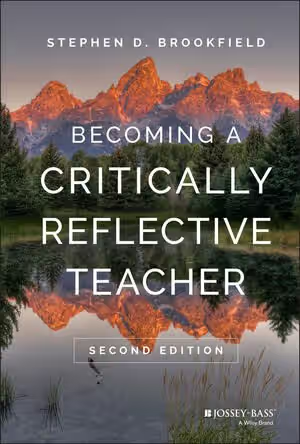
Brookfield, S. D. (2017). Becoming a Critically Reflective Teacher (2nd ed.). Jossey-Bass.
Chapter Summary
The second edition (Jossey-Bass, 2017, about 300 pages) has fourteen chapters, a bibliography and an index. The publisher describes it as fully revised, with new chapters on critical reflection and social media, teaching race and racism, leadership, and team teaching, and with every chapter updated for online and face-to-face teaching, large lectures and small groups. Brookfield writes in the first person and draws on more than forty-five years of teaching; the sample first chapter is full of episodes from his own practice, including misjudgements.
The book moves from definition (Chapters 1–3) through the method of the four lenses (Chapters 4–10) to applications and risks (Chapters 11–14).
Chapter 1: What Is Critically Reflective Teaching?
Defines critical reflection as the sustained and intentional process of identifying and checking the accuracy and validity of one's teaching assumptions. It distinguishes paradigmatic assumptions (basic categories taken as fact), prescriptive assumptions (what ought to happen) and causal assumptions (how things work, the easiest to uncover). It introduces the four lenses for examining them, and argues that reflection becomes critical, rather than merely technical, when it focuses on power and hegemony, in the tradition of critical theory.
Chapters 2–3: Uncovering Assumptions of Power; Uncovering Hegemonic Assumptions
The two purposes of critical reflection, each given a chapter. The first concerns how wider structures of power shape classrooms and what counts as a justifiable use of teacher power; the sample chapter's example is the author's early belief that his classroom was his own domain, when syllabus and examinations largely controlled it. The second concerns hegemonic assumptions, those teachers embrace as being in their interest but which harm them, such as treating overwork and exhaustion as signs of commitment.
Chapters 4–5: The Four Lenses of Critical Reflection; Clarifying the Benefits of Critical Reflection
Chapter 4 sets out the method: examining practice through students' eyes, colleagues' perceptions, personal experience, and theory and research, consistently and regularly rather than once. Chapter 5 makes the case for why the effort is worthwhile.
Chapters 6–10: Seeing Ourselves through Students' Eyes; Learning from Colleagues' Perceptions; Team Teaching as Critical Reflection; Using Personal Experience; Learning from Theory
One chapter for each lens, with team teaching (new in this edition) added as a second chapter on colleagues. The index shows the practical tools involved, among them the Critical Incident Questionnaire (CIQ) for gathering students' responses, and structured protocols for critical conversations with colleagues. The theory chapter draws on critical theorists whom the index lists, such as Gramsci, Foucault and Marcuse.
Chapters 11–12: Incorporating Social Media and Back-Channel Communication; Applying Critical Reflection to Teaching Race and Racism
New applications: using back-channel tools, through which students comment while a class is under way, as a further source of evidence about their experience; and examining assumptions when teaching about race and racism, with discussion exercises such as Circle of Voices and Chalk Talk.
Chapters 13–14: Negotiating the Risks of Critical Reflection; Practicing Critically Reflective Leadership
Chapter 13 addresses what critical reflection can cost: the index names impostorship, "cultural suicide" and lost innocence. Chapter 14, new in this edition, extends the approach to leadership, with exercises such as the Appreciative Pause and the Clearness Committee.
Key Concepts
Chapters 1–5: the framework
- Critical reflection: the sustained, intentional checking of the assumptions behind one's teaching.
- Paradigmatic, prescriptive and causal assumptions: three kinds of assumption, from the deepest and hardest to see to the most easily tested.
- Power and hegemony: the focus that makes reflection critical; hegemonic assumptions seem to serve teachers but work against their interests.
- The four lenses: students' eyes, colleagues' perceptions, personal experience, and theory and research.
Chapters 6–14: tools and applications
- Critical Incident Questionnaire: an instrument for collecting students' responses, used to see teaching through students' eyes.
- Team teaching as reflection: teaching with colleagues so that practice is constantly seen from another perspective.
- Back-channel communication: real-time student comments used as evidence about the class.
- Risks of reflection: impostorship, cultural suicide and lost innocence.
Critical Analysis
Strengths
- A clear, usable method. The four lenses and the three types of assumption give readers a structure they can apply to their own teaching immediately; the first chapter illustrates both with the author's own assumptions, explicit and implicit.
- Honest and personal. Brookfield's examples include his mistakes, such as handing first-time American students control of a curriculum they did not want, and his work-related collapses while writing about hegemony. This makes the argument concrete and models the self-scrutiny it recommends.
- Practical tools. The index points to tested instruments and exercises (the Critical Incident Questionnaire, Chalk Talk, Circle of Voices, conversation protocols), so the book is a working manual as well as an argument.
- Updated scope. New chapters on social media, race and racism, team teaching and leadership bring the second edition into current concerns.
Limitations
- Rooted in one theoretical tradition. The distinction between technical and critical reflection depends on critical theory's concern with power and hegemony; readers who see reflection mainly as improving technique may find the framing contestable.
- Adult and higher education perspective. The examples come largely from the author's work with adults and in colleges and universities; school teachers will need to translate them.
- Personal voice over systematic evidence. The sample chapter argues from the author's experience and from theory rather than from studies of whether critical reflection improves students' learning; readers wanting that kind of evidence will need other sources.
Where It Fits in the Course
In the teacher-development list, Brookfield is the practical introduction to critical reflection. Donald Schön's The Reflective Practitioner is the classic study that introduced reflection-in-action and reflection-on-action, and supplies the theory of reflective professional practice that Brookfield turns into a method with a sharper focus on power. Maura Sellars's Reflective Practice for Teachers is a guide for student and early-career school teachers that works topic by topic, and suits readers who want a gentler start in a school setting.
Marilyn Cochran-Smith and Susan Lytle's Inquiry as Stance treats teachers as researchers of their own practice and is the scholarly next step for readers who want to turn reflection into systematic inquiry. Parker Palmer's The Courage to Teach explores the teacher's inner life, a complement to Brookfield's emphasis on evidence and power, and John Hattie's Visible Learning for Teachers offers an evidence-based, outcome-focused view of professional growth against which Brookfield's approach can be debated.
How to Use This Book
The book is for teachers at any stage, especially in colleges, universities and adult education, and for those running teaching programmes or professional development. No prior study is needed; experience of teaching, or of being taught, gives the examples something to connect with.
A practical reading plan:
- Core: Chapters 1–4, which define critical reflection, its two purposes and the four lenses.
- Lenses: Chapters 6–10, read one lens at a time while trying its tools; start with Chapter 6 and a Critical Incident Questionnaire in your own class.
- Applications: Chapters 11–14 according to need; Chapter 13 on risks is worth reading by anyone about to question established practice in a department.
Keep a log of your assumptions sorted into the three types, and check one each week through a different lens. Read Schön alongside Chapters 1–4 for the background theory of reflective practice, and Cochran-Smith and Lytle afterwards if you want to turn reflection into practitioner research.