01 / Reading Guide
Reading Guide
Citation
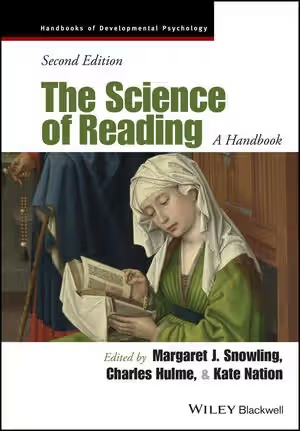
Snowling, M. J., Hulme, C., & Nation, K. (Eds.). (2022). The Science of Reading: A Handbook (2nd ed.). Wiley-Blackwell.
Chapter Summary
The second edition has 24 chapters in six parts (608 pages in the publisher's count), with a glossary and an index. It belongs to the Wiley Blackwell Handbooks of Developmental Psychology series. Each chapter is a review by a different specialist or team, and the first chapter, by Charles Perfetti and Anne Helder, opens Part I as an overview of progress in the field. The publisher states that the second edition is extensively revised and adds two entirely new chapters, on co-occurrence and complexity.
Part I, Chapter 1: Progress in Reading Science: Word Identification, Comprehension, and Universal Perspectives
Perfetti and Helder organise the field around the Reading Systems Framework, which links a word-identification system, a comprehension system and knowledge systems, with the lexicon at the centre. The chapter reviews three advances: the word-identification system in skilled alphabetic reading, comprehension while reading, and a more universal science of reading across writing systems. It closes with brief reflections on teaching reading.
Part I, Word Recognition (Chapters 2–5)
The rest of Part I follows Chapter 1. Chapter 2, "Models of Word Reading: What Have We Learned?" (Seidenberg, Farry-Thorn and Zevin), reviews models of how words are read. Chapters 3 to 5 are the three-part treatment of word recognition: "Visual and Orthographic Processing" (Grainger), "Phonological Coding in Reading" (Brysbaert) and "Morphological Processing" (Rastle).
Part II, Learning to Read and Spell (Chapters 6–10)
This part moves from skilled reading to development. It covers "The Foundations of Literacy" (Hamilton and Hayiou-Thomas), "Learning to Read Words" (Castles and Nation), "Learning to Spell Words" (Kemp and Treiman), "Individual Differences in Learning to Read Words" (Compton and colleagues) and "Teaching Children to Read" (Savage). The last chapter is the part most directly about instruction.
Part III, Reading Comprehension (Chapters 11–14)
Four chapters on comprehension: "Reading Comprehension I: Discourse" (van den Broek and Kendeou), "Reading Comprehension II: Sentence Processing" (Liversedge, Zang and Liang), "Modeling the Development of Reading Comprehension" (Lervåg and Melby-Lervåg) and "Children's Reading Comprehension Difficulties" (Cain).
Part IV, Reading in Different Languages (Chapters 15–17)
Three chapters on writing systems: "Reading and Reading Disorders in Alphabetic Orthographies" (Caravolas), "Reading and Reading Disorders in Chinese" (McBride and colleagues) and "Reading the Akshara Writing System" (Nag).
Part V, Disorders of Reading (Chapters 18–21)
This part covers "Acquired Disorders of Reading and Writing" (Woollams, Lambon Ralph and Patterson), "Developmental Dyslexia" (Wagner, Zirps and Wood), "Comorbidity of Reading Disorders" (Moll) and "Learning to Read with a Language or Hearing Impairment" (Adlof and colleagues).
Part VI, Biological and Social Correlates of Reading (Chapters 22–24)
The closing part turns to causes and correlates: "The Genetics of Dyslexia: Learning from the Past to Shape the Future" (Paracchini), "Genetic and Environmental Influences on Learning to Read" (Little and Hart) and "The Neurobiology of Literacy" (Yeatman).
Key Concepts
Chapter 1 and Part I: skilled reading and word recognition
- Reading Systems Framework: the chapter 1 model linking word identification, comprehension and knowledge systems through the lexicon.
- Orthographic and phonological processing: the visual and sound-based routes into word recognition, treated in Chapters 3 and 4.
- Morphological processing: how readers use word structure (Chapter 5).
Parts II–III: learning to read and comprehension
- Learning to spell and individual differences: development and variation in word-level skills.
- Discourse and sentence processing: the two views of comprehension in Chapters 11 and 12.
- Simple View of Reading: a framework in which word reading and language comprehension together support reading comprehension, which Chapter 1 discusses.
Parts IV–VI: languages, disorders and biology
- Orthographic differences: alphabetic, Chinese and akshara systems, each given its own chapter.
- Developmental dyslexia and comorbidity: reading difficulty and the conditions that co-occur with it.
- Acquired reading disorders: difficulties following brain injury or disease.
- Genetic, environmental and neurobiological influences: the closing part.
Critical Analysis
Strengths
- Coverage laid out by part. The six parts move through word recognition, learning to read and spell, comprehension, reading in different languages, disorders and biological and social correlates. A reader can enter at the part that matches an interest and still see how it connects to the rest.
- Cross-linguistic reach. Part IV gives separate chapters to alphabetic systems, Chinese and akshara. Chapter 1 itself argues for a more universal science of reading rather than one based mainly on English.
- Specialist authorship. Every chapter is written by researchers in the topic, and the publisher says the volume presents critical appraisals of models of word recognition and evidence-based research on reading intervention.
- Update to the field. The publisher lists additions to the second edition, including new chapters on co-occurrence and complexity and updated material on, for example, preschool development of reading and language and comorbidities of dyslexia.
Limitations
- A research handbook, not an instructional text. The intended readers, according to the publisher, are advanced students, researchers and specialist educators. The chapter on teaching children to read is one chapter among 24, and the book does not set out classroom lesson procedures.
- Prior knowledge assumed. Chapters are reviews for readers who already know the basic terms; the first chapter, for example, moves through eye-movement models, interactive-activation and dual-route models of word reading, and neuroimaging findings within its first dozen pages.
- Uneven applicability. Parts V and VI concern disorders, genetics and neurobiology, which may be remote from the concerns of a classroom teacher.
Where It Fits in the Course
This handbook is the research-level book of the literacy list. Kate Cain's Reading Development and Difficulties is an introduction for students with no background in reading research, and Morag Stuart and Rhona Stainthorp's Reading Development and Teaching is an evidence-based introduction organised around the Simple View of Reading and linked to teaching methods. Gail Tompkins's Literacy for the 21st Century is a teacher-education textbook on classroom practice. Mark Seidenberg's Language at the Speed of Sight is an account of the science of reading for a general audience, and Jeanne Chall's Learning to Read: The Great Debate is a landmark 1967 study of competing instructional approaches.
A reasonable order is Cain or Stuart and Stainthorp first, Seidenberg's book for a general account, and then the handbook for the detailed research behind these books. Chall's study gives the historical background to the debates, and Tompkins is the place to look when the question is what to do in a classroom.
How to Use This Book
The handbook suits graduate students in literacy education, developmental psychology and speech and language science, as well as researchers and specialist teachers. It assumes familiarity with ideas such as phonological awareness and decoding.
A practical plan:
- Start with Chapter 1 for an overview of the field and its framework.
- Core for educators: Part II (learning to read and spell, including teaching children to read), the comprehension chapters of Part III and the chapters on developmental dyslexia and comprehension difficulties.
- Core for researchers: Part I on word recognition and, for cross-linguistic work, Part IV.
- Optional: Part VI on genetics and neurobiology, and the acquired disorders chapter, unless those are your topic.
- Use the glossary and references. The glossary helps with terminology, and each chapter's references lead to the primary studies.