01 / Reading Guide
Reading Guide
Citation
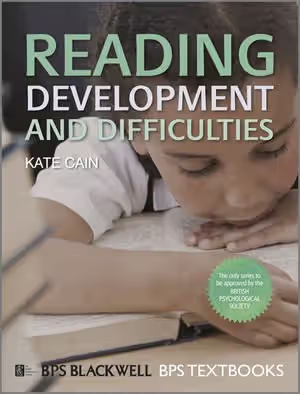
Cain, K. (2010). Reading Development and Difficulties. Wiley-Blackwell. BPS Textbooks in Psychology.
Chapter Summary
The book is a 272-page textbook in the British Psychological Society's textbook series, with ten chapters, a bibliography and a glossary. Chapter 1 opens with a list of key terms and a chapter outline, and every chapter ends with a key-point summary, annotated further reading and a list of definitions. The structure follows the Simple View of Reading, which separates word reading from comprehension: the two skills are treated in separate chapters for skilled adult readers, for development and for difficulties, before chapters on teaching and assessment and a concluding evaluation of the framework.
Chapter 1: Introduction to the study of reading
The chapter shows, through a short passage about a visit to a great-aunt, how many skills even simple reading involves, then explains why the book divides reading into word reading and comprehension. It compares alphabetic, logographic and syllabic writing systems, notes that written English uses 26 letters for 44 sounds without one-to-one correspondence, and argues that writing is not simply speech written down. The last part introduces research designs (cross-sectional, longitudinal, reading-age match and training studies) and why correlation alone cannot establish what causes reading success or failure.
Chapter 2: Skilled word reading
Covers how word reading is assessed and what makes some words easier to read than others, then compares models of skilled word recognition; the index shows these include the dual-route cascade model and the connectionist "triangle" model.
Chapter 3: The skilled comprehender
Asks what readers forget and remember from a text, explains local and global coherence (the links within and across sentences, including those made by inference), and presents models of text representation such as the construction-integration model.
Chapter 4: Learning to read words
Describes the different ways children can read words, the skills and knowledge that support word reading development, phases of development, and what drives progress from one phase to the next.
Chapter 5: The development of reading comprehension
Examines how word reading, listening comprehension and reading comprehension relate, the skills and knowledge that support comprehension (vocabulary, grammar, inference, comprehension monitoring and knowledge of text structure appear in the index), and how comprehension develops over time.
Chapter 6: Developmental dyslexia
Sets out definitions and characteristics of dyslexia, compares theories (phonological deficit theories alongside sensory accounts such as the magnocellular and cerebellar theories), asks whether there are subtypes, and follows dyslexia across the lifespan, from precursors in at-risk families to compensation and consequences.
Chapter 7: Reading comprehension difficulties
Turns to children who read words adequately but understand poorly: what poor comprehension is, where and why discourse comprehension fails, and the consequences for wider learning. This is the author's own research field.
Chapters 8–9: Instruction and intervention; The assessment of reading
Chapter 8 reviews teaching and intervention for word reading and for comprehension and support for reading development more generally, including home instruction. Chapter 9 explains why assessment matters (purposes, reliability and validity) and how to choose what, when and how to assess in word reading and in comprehension.
Chapter 10: The Simple View of Reading: A framework for the study of reading development and reading difficulties
The conclusion summarises the framework, applies it to development and to difficulties, evaluates it, and draws out implications.
Key Concepts
Chapters 1–3: Studying reading; the skilled reader
- Simple View of Reading: a framework, due to Gough and Tunmer, that treats reading as depending on two components, word reading (decoding) and comprehension; it organises the book.
- Orthography: the writing system of a language; alphabetic systems vary in how consistently letters map onto sounds, and English is inconsistent.
- Reading-age match design: comparing poor readers with younger children at the same reading level, which can rule out one direction of cause.
- Local and global coherence: the connections a reader builds between neighbouring sentences and across a whole text.
Chapters 4–5: Development
- Phases of word reading: a developmental sequence that the index shows includes full and consolidated alphabetic phases.
- Phonological awareness: the ability to reflect on and manipulate the sounds of spoken words, associated with progress in early word reading.
- Inference: going beyond what a text states to link its parts or connect it with general knowledge.
Chapters 6–7: Difficulties
- Developmental dyslexia: an impairment in the development of word reading and spelling.
- Poor comprehenders: children whose word reading is adequate but whose understanding of text is weak.
Chapters 8–10: Teaching, assessment and the framework
- Reliability and validity: whether a reading test measures consistently and measures what it claims to measure.
- Formative and summative assessment: assessment to guide teaching versus assessment to report attainment.
Critical Analysis
Strengths
- Word reading and comprehension in one book. The publisher presents this as the book's distinguishing aim: research on decoding and on comprehension is often treated separately, and the parallel chapter structure makes the contrast between the two easy to follow.
- Method made explicit. Chapter 1 explains, with worked examples, what each research design can and cannot show, so readers can judge later claims about causes of reading difficulties.
- Built for study. Key-point summaries, annotated further reading and definitions at the end of every chapter, plus a glossary, suit students revising for examinations.
- Comprehension difficulties given full weight. A whole chapter on poor comprehenders, the author's research specialism, balances the larger literature on dyslexia.
Limitations
- Date. Published in 2010, it predates more recent research and later changes in policy and assessment.
- Psychology rather than classroom practice. Teaching appears mainly in Chapter 8; trainee teachers looking for lesson-level guidance will need a practice-oriented book.
- English and alphabetic focus. Chapter 1 discusses other writing systems, but reading in nonalphabetic scripts is mostly left to the further-reading list.
Where It Fits in the Course
Cain is a compact, psychology-based introduction and a good first text for students who need the research foundations. Morag Stuart and Rhona Stainthorp's Reading Development and Teaching is organised around the same Simple View of Reading but links it more directly to teaching methods and assessment in classrooms; the two read well as a pair, Cain for the research and Stuart and Stainthorp for its classroom implications. Mark Seidenberg's Language at the Speed of Sight covers similar science for a general audience with a sharper argument about reading instruction.
For depth afterwards, The Science of Reading: A Handbook, edited by Snowling, Hulme and Nation, offers specialist reviews of the same topics, and Cain's own further-reading lists cite the earlier edition. Jeanne Chall's Learning to Read: The Great Debate is a historical study of the instruction debate, and Tompkins, Rodgers and Rodgers's Literacy for the 21st Century is a teacher-education text on teaching reading and writing in elementary classrooms, the most practical book in the list.
How to Use This Book
The publisher addresses the book to psychology students and also to education and speech and language therapy students with little background in the psychology of reading. Chapter 1 explains the research designs that the later chapters rely on, so no prior training in research methods is assumed.
A suggested route:
- Start with Chapter 1 and Chapter 10. The first introduces the framework and the research designs; reading the brief concluding chapter early shows where the argument is going.
- Follow one strand at a time. Read Chapters 2, 4 and 6 for word reading (skilled reading, development, dyslexia), then Chapters 3, 5 and 7 for comprehension. This makes the parallel structure work for you.
- Practitioners: Chapters 8 and 9 on intervention and assessment are essential, but read them after the relevant development chapters, since they assume that material.
- Psychology students: spend time on the models in Chapters 2 and 3 and the theories of dyslexia in Chapter 6, which are the most demanding sections.
Use the definitions lists and glossary to build a personal vocabulary, and the key-point summaries for revision. The annotated further reading is a good starting point for essays. Because the book dates from 2010, check recent work, for example in the handbook mentioned above, before writing about current debates or assessment practice.