01 / Reading Guide
Reading Guide
Citation
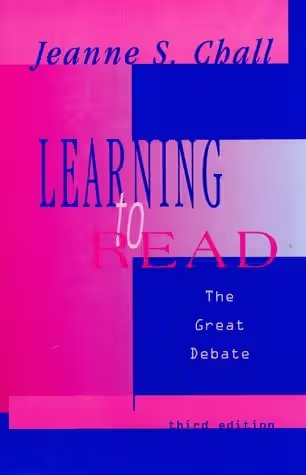
Chall, J. S. (1967). Learning to Read: The Great Debate. McGraw-Hill. (Updated editions: 1983; Harcourt Brace, 1996.)
Chapter Summary
This is a research synthesis from 1967 by Jeanne S. Chall, a reading researcher who spent most of her career at the Harvard Graduate School of Education and later founded the Harvard Reading Laboratory. It is now read chiefly as a historical source on the dispute over how beginning reading should be taught.
The controversy over beginning reading
The book was written in response to the public concern over why many children were not learning to read well, a concern made prominent by Rudolf Flesch's Why Johnny Can't Read (1955). Flesch had argued that reading professionals ignored their own research. Chall set out to examine the research and the classroom practice behind the competing approaches.
Two families of method
The debate is framed as a contest between approaches that emphasise meaning from the start and approaches that emphasise the code, that is, the relationship between letters and sounds. The book compares these approaches, including the widely used reading programs of the day, and looks at what research and classroom evidence showed about children taught with each.
The evidence examined
The book draws on several kinds of evidence: earlier experimental and classroom research on beginning reading, analysis of the reading programs that schools used, and observation of practice. Chall's reputation among peers rested on the care with which she handled research, even when her conclusions were controversial.
Conclusions about early instruction
Chall concluded that direct, systematic instruction in the code gave better results for beginning readers than approaches that treated it as secondary. Her conclusions were unpopular when she first presented them. They later gained wide acceptance in the literacy community, and major textbook publishers reacted to the book by placing more phonics earlier in their reading series.
Later editions
The book was updated in 1983, and a third edition appeared in 1996 with further research supporting its conclusions. Readers should check which edition their library holds, since the updated editions add material that the 1967 text lacks.
Key Concepts
The debate
- Meaning-emphasis approaches: methods that stress understanding and whole-word reading from the beginning of instruction.
- Code-emphasis approaches: methods that stress teaching the relationship between letters and sounds, including systematic phonics.
- Reading research and practice: the book is concerned with what research can tell teachers, and with how practice and evidence relate.
The author's wider work
- Systematic, direct instruction: Chall maintained throughout her career that explicit, ordered teaching of reading was supported by research.
- Stages of reading development: her later book Stages of Reading Development (1983) developed a staged account of how readers grow; it is a separate work from this one.
Critical Analysis
Strengths
- A foundational account. The book became a classic soon after publication and shaped how the phonics dispute was understood. Readers who want to know where today's argument began will find it here.
- Respect for evidence. Contemporary and later commentators describe Chall as meticulous in research even when her views were unwelcome, and the book is valued for treating a heated public question through systematic review.
- Revised with new research. The 1983 and 1996 updates added newer findings that strengthened the conclusions, so the book reaches beyond its original date.
Limitations
- Dated. It reports research from before 1967 and in its original form says nothing about later findings from cognitive science, dyslexia research or neuroscience; readers must turn to more recent books for those.
- A historical, not practical, text. It is not a manual for teaching reading, and it compares methods in general terms rather than supplying lesson procedures.
- Context of its time. The vocabulary and the programs it discusses are those of the 1960s, so some prior knowledge of the history of reading instruction helps.
Where It Fits in the Course
Chall is the earliest and most historical book on this course list. Mark Seidenberg's Language at the Speed of Sight takes the phonics argument forward for general readers with modern cognitive science and is a natural next step. Kate Cain's Reading Development and Difficulties and Stuart and Stainthorp's Reading Development and Teaching are student-level introductions that set out the current research on word recognition and comprehension, and the latter links that research to teaching methods.
The Science of Reading: A Handbook, edited by Snowling, Hulme and Nation, brings together specialist reviews that show how far research has developed since Chall. Tompkins, Rodgers and Rodgers's Literacy for the 21st Century is a teacher-education textbook, which gives the classroom procedures that Chall's synthesis does not.
How to Use This Book
The book suits graduate students and researchers in literacy, reading instruction and the history of education, and teacher educators who want students to see the origins of the phonics debate. It assumes familiarity with the vocabulary of reading research and some experience reading empirical studies.
A practical plan:
- Read for history. Place the book in the sequence from Flesch in 1955, through Chall in 1967, to the science-of-reading arguments of today.
- Start with a modern text. A reader new to the field gains most by first reading Cain or Stuart and Stainthorp, then Chall.
- Compare with Seidenberg. Reading the two together shows what has stayed the same in the debate and what the newer science has added.
- Choose the edition deliberately. Use the 1996 edition for the updated conclusions, and the original for the 1960s position.
- Read critically. Ask which claims rest on research available in 1967 and which still stand against later evidence.