01 / Reading Guide
Reading Guide
Citation
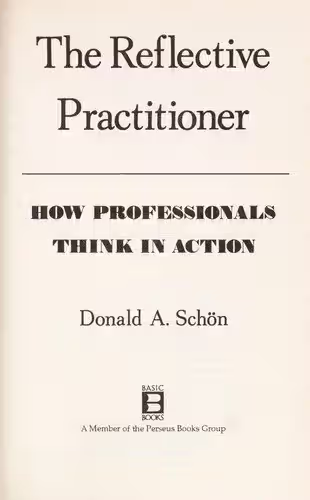
Schön, D. A. (1983). The Reflective Practitioner: How Professionals Think in Action. Basic Books.
Chapter Summary
The book has ten chapters in three parts, running to about 380 pages. It examines how professionals work, drawing on several professions. The publisher's description names five: engineering, architecture, management, psychotherapy and town planning. Its aim is to show how "reflection-in-action" works and how it might be fostered in future professionals. The argument moves from a critique of the dominant model of professional knowledge (Part I), through a series of professional settings and a comparison across them (Part II), to a closing discussion of what follows for the professions and their place in society (Part III).
Part I, Chapter 1: The Crisis of Confidence in Professional Knowledge
The opening chapter sets the problem: the title points to a loss of confidence in professional knowledge. It is the framing for everything that follows and should be read first.
Part I, Chapter 2: From Technical Rationality to Reflection-in-Action
Here the book contrasts two accounts of professional competence. Technical rationality is the model the title moves away from; reflection-in-action is the alternative that the rest of the book develops. These two terms are the book's central vocabulary.
Part II, Chapter 3: Design as a Reflective Conversation with the Situation
The first professional setting takes design as its subject. The title gives the chapter's central image: the practitioner's work as a conversation with the situation, in which the situation responds to what the practitioner does.
Part II, Chapter 4: Psychotherapy: The Patient as a Universe of One
The second setting is psychotherapy. The subtitle, "the patient as a universe of one", points to the individual patient as the unit of attention.
Part II, Chapter 5: The Structure of Reflection-in-Action
Following the design and psychotherapy chapters, this chapter turns to the structure of reflection-in-action itself.
Part II, Chapter 6: Reflective Practice in the Science-Based Professions
This chapter takes up professions that rest on science and examines what reflective practice looks like within them.
Part II, Chapter 7: Town Planning: Limits to Reflection-in-Action
The town-planning chapter is the one explicitly about limits. Its title announces that reflection-in-action meets constraints in this setting.
Part II, Chapter 8: The Art of Managing: Reflection-in-Action within an Organizational Learning System
The management chapter places reflection-in-action within an organizational learning system, so the setting is the organization as well as the individual manager.
Part II, Chapter 9: Patterns and Limits of Reflection-in-Action across the Professions
The last chapter of Part II looks across the professions, setting out patterns in reflection-in-action and its limits.
Part III, Chapter 10: Conclusion: Implications for the Professions and Their Place in Society
The final chapter turns to consequences, for the professions and for the position they hold in society.
Key Concepts
Part I: The critique
- Technical rationality: the dominant model against which Schön argues, in which professional practice is the application of established knowledge.
- Crisis of confidence in professional knowledge: the problem the book starts from.
- Reflection-in-action: the book's central alternative account of how skilled practitioners think while they act.
Part II: Settings and comparison
- Reflective conversation with the situation: the chapter 3 image of design as a back-and-forth with the problem.
- Structure of reflection-in-action: the chapter 5 attempt to describe how such reflection is organised.
- Organizational learning system: the setting for reflection-in-action in the management chapter.
- Limits of reflection-in-action: the theme of Chapters 7 and 9.
Part III: Consequences
- Professions and their place in society: the closing question about what the argument implies for professional education and the standing of the professions.
Critical Analysis
Strengths
- A claim about practice built from cases. Each chapter in Part II takes a specific professional setting. The publisher describes the book as showing "precisely how" reflection-in-action works, and the structure supports this, since the concept is developed across five professions rather than asserted in the abstract.
- A critique and an alternative in a single volume. The first two chapters set up and then replace the model of technical rationality, so the reader sees what is being rejected as well as what is proposed.
- It states its limits. Chapters 7 and 9 are titled around the limits of reflection-in-action, which means the author tests the idea instead of only praising it.
- Reception from practitioner fields. The publisher quotes Judith deNeufville in the American Planning Association Journal, who called it an important contribution to planning theory and practice, and the Harvard Business Review, which said it clarifies the struggle between art and science in the manager's thought process.
Limitations
- Teaching is not among the professions examined. The five professions in the publisher's description do not include teaching, so a teacher must transfer the argument to the classroom unaided; a book on teacher reflection, such as the ones listed with it, will supply the classroom detail.
- Dated settings. The book was first published in 1983, so its professional and organizational settings are those of that period.
- An analysis, not a manual. The publisher describes the aim as showing how reflection-in-action works and how it might be fostered, and the table of contents contains no chapter of techniques or exercises; readers who want a method must build it from the cases.
Where It Fits in the Course
Among the teacher-development books on this list, Schön is the theoretical source. Stephen Brookfield's Becoming a Critically Reflective Teacher and Maura Sellars's Reflective Practice for Teachers are accessible guides that show teachers how to make reflection a habit; they apply the reflective idea to the classroom, which Schön does not do. Marilyn Cochran-Smith and Susan Lytle's Inquiry as Stance develops practitioner research as a professional stance, and John Hattie's Visible Learning for Teachers focuses on evaluating the impact of teaching with evidence. Parker Palmer's The Courage to Teach treats the teacher's inner life.
A sensible order is to read one of the accessible guides first for the practice of reflection, then Schön for the argument behind it, and then the practitioner-research or evidence-focused books to see how reflection becomes inquiry or measurement.
How to Use This Book
Schön's book suits graduate students, teacher educators, mentors and researchers who use the language of reflective practice and want to read its source, and readers in other professions who are interested in how professional judgement works. No specialist background is needed beyond comfort with sustained theoretical prose.
A practical plan:
- Core: Part I (Chapters 1–2), which sets out the critique and the central concepts, then Chapter 9 and the conclusion, which draw the cases together.
- Choose a case: From Chapters 3–8, read the setting closest to your own work first, such as design, the management chapter for organizational questions, or the town-planning chapter for the limits of the idea. The remaining cases can be sampled afterwards.
- Use the limits: Read the two chapters on limits (7 and 9) critically alongside any claim that teachers should simply "reflect more".
- Alongside: Keep a short practice journal and, for each case, note which feature of the situation the practitioner responded to; this translates the argument into your own setting.