01 / Reading Guide
Reading Guide
Citation
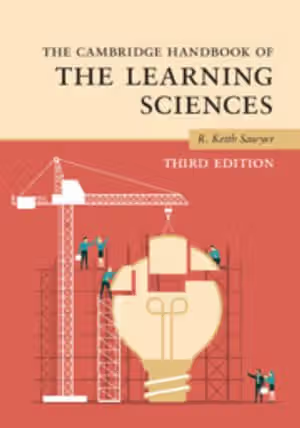
Sawyer, R. K. (Ed.). (2022). The Cambridge Handbook of the Learning Sciences (3rd ed.). Cambridge University Press.
Chapter Summary
The third edition is a 33-chapter edited handbook of about 740 pages. An opening chapter by the editor is followed by six parts, each made up of single-topic review chapters by different author teams. The publisher presents it as an introduction to the learning sciences, an interdisciplinary field drawing on educational psychology, cognitive science, computer science and anthropology.
Chapter 1: An Introduction to the Learning Sciences
The editor's own opening chapter introduces the field before the six parts begin. It is the only chapter outside the parts and the natural place to start.
Chapters 2–8, Part I (Foundations): Foundations of the Learning Sciences; Scaffolding; Project-Based Learning; Metacognition and Self-Regulated Learning; A History of Conceptual Change Research; Learning in Activity; Cognitive Apprenticeship
The first part gathers the field's core ideas about how learning happens and how it can be supported. Nathan and Sawyer open with the foundations, and the later chapters take up a set of named constructs and instructional designs: scaffolding (Tabak and Reiser), project-based learning (Krajcik and Shin), metacognition and self-regulation (Winne and Azevedo), conceptual change (diSessa), learning as activity (Engeström) and cognitive apprenticeship (Collins and Kapur).
Chapters 9–13, Part II (Methodologies): Design-Based Research; Analyzing Collaboration; Microgenetic Methods; A Learning Sciences Perspective on the Design and Use of Assessment in Education; Learning Analytics and Educational Data Mining
This part is about how learning-sciences studies are done. It covers design-based research (Barab), the analysis of group interaction (Enyedy and Stevens), fine-grained microgenetic study of change over short periods (Sherin and Chinn), assessment (Pellegrino) and the data-driven methods of learning analytics and educational data mining (Baker and Siemens).
Chapters 14–18, Part III (Grounding Technology in the Learning Sciences): Video Games and Learning; Embodiment and Embodied Design; Tangible and Full-Body Interfaces in Learning; Augmented Reality in the Learning Sciences; Mobile Learning
The technology part concentrates on games (Steinkuehler and Squire), embodied learning and design (Abrahamson and Lindgren), tangible and full-body interfaces (Pares and Eisenberg), augmented reality (Schneider and Radu) and mobile learning (Pea and Sharples).
Chapters 19–22, Part IV (Learning Together): Knowledge Building and Knowledge Creation; Computer-Supported Collaborative Learning; Arguing to Learn; Informal Learning in Museums
Four chapters on social learning: knowledge building (Scardamalia and Bereiter), computer-supported collaborative learning (Stahl, Koschmann and Suthers), argumentation as a route to learning (Andriessen and Baker) and learning in museums (Pierroux, Knutson and Crowley). The museum chapter is the one that explicitly takes up an informal setting.
Chapters 23–28, Part V (Learning Disciplinary Knowledge): Research in Mathematics Education; Science Education and the Learning Sciences; Complex Systems and the Learning Sciences; Learning History; Learning to Be Literate; Arts Education and the Learning Sciences
Each chapter takes a school subject or domain: mathematics (Sfard and Cobb), science (Songer and Kali), complex systems (Jacobson and Wilensky), history (Carretero and Perez-Manjarrez), literacy (Smagorinsky and Mayer) and the arts (Halverson and Sheridan).
Chapters 29–33, Part VI (Moving Learning Sciences Research into the Classroom): Learning as a Cultural Process; Designing for Meaningful Learning; Advances in Teacher Learning Research in the Learning Sciences; Learning Sciences and Policy; The Learning Sciences in the 2020s: Implications for Schools and Beyond
The closing part turns to practice: culture and learning (Nasir, Rosebery, Warren and Lee), designing for meaningful learning (Renninger and Järvelä), teacher learning (Fishman, Chan and Davis), policy (Penuel, Spillane and Sun) and, in a final chapter by Sawyer, the implications of the field for schools and beyond.
Key Concepts
Chapter 1 and Part I: Foundations
- Learning sciences: the interdisciplinary field the handbook introduces, which the publisher describes as drawing on educational psychology, cognitive science, computer science and anthropology.
- Scaffolding: temporary support for learners, treated in its own chapter.
- Metacognition and self-regulated learning: learners monitoring and directing their own learning.
- Conceptual change: how learners' understanding of a topic is restructured, traced through a history of research.
- Cognitive apprenticeship: an instructional model in which expert practice is made visible to learners.
Part II: Methodologies
- Design-based research: studying learning by designing and refining an intervention in a real setting.
- Microgenetic methods: close study of how understanding changes over short intervals.
- Learning analytics and educational data mining: the use of learner data to study and support learning.
Parts III–IV: Technology and Learning Together
- Embodied design and tangible interfaces: learning through the body, movement and physical objects.
- Computer-supported collaborative learning (CSCL): how technology supports groups learning together.
- Knowledge building: the knowledge-creation approach of Scardamalia and Bereiter.
- Informal learning: learning in museums and other settings beyond the classroom.
Parts V–VI: Domains and Practice
- Disciplinary learning: how mathematics, science, history, literacy and the arts are learned.
- Learning as a cultural process: the cultural dimension of learning and design.
- Teacher learning and policy: the chapters that link research to teachers and to education systems.
Critical Analysis
Strengths
- Breadth in a stable structure. Every part has the same form: four to seven chapters by specialists, each between roughly seventeen and twenty-nine pages. A reader can sample a single topic without having to read the neighbouring chapters.
- Methods are a distinct part. Five chapters (Part II) are devoted to methodology, including design-based research and learning analytics, so the book can serve a student who must design a study as well as one who wants a survey of findings.
- Technology and non-school settings are both covered. Part III treats games, embodiment, tangible interfaces, augmented reality and mobile learning, and Part IV includes a chapter on museums. The publisher states that the chapters illustrate productive learning environments inside and outside school.
- A revised edition. The publisher calls this a significantly revised third edition, first published in 2006, with new overviews by leading scholars. The final chapters look ahead to the 2020s.
Limitations
- A handbook, not a textbook. The chapters are research reviews by different authors for graduate students, researchers, designers and policymakers, according to the publisher. There is no single running argument, and the chapters do not build on each other the way a textbook sequence would.
- Uneven weight on schooling topics. Part V gives one chapter to each of six domains; a reader whose interest is, for example, early childhood or higher education will find no chapter named for it in the table of contents.
- Length and prerequisites. At about 740 pages with 33 contributions, the book is not meant to be read straight through, and the reader needs prior familiarity with learning theory and empirical research to profit from most chapters.
Where It Fits in the Course
Among the educational-technology books on this list, the handbook is the research-level survey. Richard Mayer's Multimedia Learning builds a single cognitive theory of learning from words and pictures, while Clark and Mayer's e-Learning and the Science of Instruction turns evidence into design principles for practitioners. The handbook is wider than either: it places cognitive accounts beside sociocultural, embodied, collaborative and policy perspectives.
Tony Bates's Teaching in a Digital Age and Hughes and Roblyer's Integrating Educational Technology into Teaching are books for people who must plan courses and lessons now; Neil Selwyn's Education and Technology: Key Issues and Debates is a short critical introduction to the social and political questions around digital education. Read those first if the aim is classroom practice or a critical orientation. Return to the handbook when choosing a research topic or method, or when a specific chapter's topic (scaffolding, CSCL, learning analytics) needs a scholarly overview.
How to Use This Book
The handbook suits graduate students, researchers, software designers and policymakers who already know the basics of learning theory and can read empirical studies. It is best used as a reference and reading list, not read cover to cover.
A practical plan:
- Start with Chapter 1 and the first chapter of Part I (Foundations of the Learning Sciences), then read the closing chapter on the 2020s to see where the field is heading.
- Choose by purpose. Researchers planning a study should go to Part II next. Technology designers should read Part III and the CSCL and knowledge-building chapters in Part IV. Subject-matter specialists should go straight to the relevant chapter in Part V. Anyone interested in implementation should read Part VI.
- Follow the citations. Each chapter is a review, so use its references to find the original studies on the topic.
- Combine with a narrower book. Pair the relevant chapter with a more focused text, such as Mayer's monograph for multimedia design, when a method or principle needs applying in detail.