01 / Reading Guide
Reading Guide
Citation
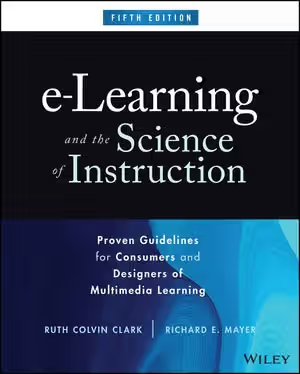
Clark, R. C., & Mayer, R. E. (2023). e-Learning and the Science of Instruction: Proven Guidelines for Consumers and Designers of Multimedia Learning (5th ed.). Wiley.
Chapter Summary
The fifth edition has 21 chapters in six parts, a glossary, references and indexes, and runs to 512 pages. The publisher describes it as a guide for practitioners who design, develop and select digital instruction and training materials, giving evidence-based guidelines rather than general design advice. The publisher says this edition covers video-based instruction, digital games and immersive virtual reality. Each chapter from 2 to 20 ends with a section titled "What We Don't Know".
Part I, Chapter 1: e-Learning: Promise and Pitfalls
Chapter 1 defines e-learning as digital instruction meant to support work-relevant knowledge and skills, distinguishes synchronous from asynchronous delivery, and lists six common formats (tutorials, virtual classrooms, video lessons, games, simulations, and emerging immersive virtual reality). It notes the pandemic's boost to e-learning, and concludes from decades of media-comparison research that learning depends less on the delivery medium than on the multimedia elements and instructional methods used. The chapter then sets out five promises and four pitfalls, three architectures of instruction, and a comparison with the first edition written twenty years earlier.
Part I, Chapters 2–3: How People Learn from e-Courses; Evidence-Based Practice
Chapter 2 gives the learning-science base: how people learn, how to guide cognitive processing, core goals for instructional design, and how e-lessons affect learning. Chapter 3 explains evidence-based practice, including what to look for in experimental comparisons, boundary conditions, meta-analysis, the limits of experimental research and where to find relevant research.
Part II, Chapters 4–9: Applying the Multimedia, Contiguity, Signaling, Modality, Redundancy and Coherence Principles
This part treats visuals and words. Chapter 4 recommends words and graphics rather than words alone; Chapter 5 aligns words with corresponding graphics, in space and in time; Chapter 6 uses verbal and visual cues to direct attention; Chapter 7 presents words as audio narration rather than on-screen text and states the boundary conditions; Chapter 8 asks when to add text to narration; and Chapter 9 warns that extra material can hurt learning, covering extraneous words, graphics and audio.
Part III, Chapters 10–12: Engagement in e-Learning; Leveraging Examples in e-Learning; Does Practice Make Perfect?
Part III is on skill building. Chapter 10 distinguishes behavioral from psychological engagement and describes activities that promote generative processing. Chapter 11 covers example-based instruction and how to optimize worked examples. Chapter 12 sets out seven principles for practice, including feedback, distributed and mixed practice, increasing challenge and scaffolding.
Part IV, Chapters 13–14: Organizing Instruction: Applying the Segmenting and Pretraining Principles; Who's in Control?: Guidelines for e-Learning Navigation
These chapters address how to organize content. Chapter 13 covers segmenting and pretraining and managing essential overload; Chapter 14 weighs learner control against program control and gives four principles for learner control.
Part V, Chapters 15–16: Applying the Personalization Principle; Online Collaborative Learning
Chapter 15 covers conversational style, polite wording, a friendly human voice, on-screen agents and the use of personalization in video lessons. Chapter 16 treats computer-supported collaborative learning through five principles, including interdependence in tasks, group size, synchronous versus asynchronous collaboration, social presence and scripts.
Part VI, Chapters 17–21: e-Learning to Build Thinking Skills; Designing Effective Instructional Video; Learning with Computer Games; Immersive Virtual Reality for Instruction; Applying the Multimedia Guidelines
Part VI covers special applications: thinking skills, instructional video (eight principles), computer games, and immersive virtual reality. Chapter 21 asks how strong the evidence for the multimedia principles is, provides e-learning guidelines checklists, and discusses trends and the future of multimedia instructional design research.
Key Concepts
Part I: Foundations
- Synchronous and asynchronous e-learning: live instructor-led online sessions versus self-paced lessons.
- Evidence-based practice: choosing design methods on the basis of experimental comparisons, boundary conditions and meta-analyses.
Part II: Visuals and Words
- Multimedia, contiguity, signaling, modality, redundancy and coherence principles: the six guidelines for combining graphics, text and audio.
- Boundary conditions: the circumstances in which a principle, such as the modality principle, does not apply.
Part III: Skill Building
- Generative processing: learner activity that goes beyond viewing, promoted by engagement activities.
- Worked examples and practice: examples and practice designed according to explicit principles.
Parts IV–VI: Organization, Social Cues and Special Applications
- Segmenting and pretraining: breaking lessons into parts and preparing learners before the main content.
- Learner control: how far learners should choose their path through a program.
- Personalization: conversational style, polite wording, a friendly voice and on-screen agents.
- Immersive virtual reality: 3D instruction with three levels of immersion, discussed in Chapter 20.
Critical Analysis
Strengths
- Guideline format. The chapters of Part II each center on a named principle and give its psychological reasons and the evidence for it, and Chapter 7 adds boundary conditions. Every chapter from 2 to 20 ends by saying what is not known, and Chapter 21 gathers the guidelines in checklists.
- Coverage of current formats. The contents show chapters on video, games and virtual reality as well as slides-and-narration lessons, and Chapter 1 addresses the pandemic's effect on e-learning.
- Evidence and its limits stated openly. Chapter 3 teaches readers to judge experimental comparisons, and the repeated "What We Don't Know" sections discourage over-reading the research.
- Authors with research and practice backgrounds. The publisher describes Mayer as a researcher on cognition, instruction and technology and Clark as a consultant who bridges research and practice.
Limitations
- Workplace-training orientation. Chapter 1 defines e-learning as instruction supporting work-relevant performance, and Chapter 17 asks for job-relevant thinking skills, so readers in schools or universities will need to adapt some examples.
- Evidence mainly from controlled comparisons. The guidelines draw on experimental comparisons, which Chapter 3 itself says have limits; readers should not treat them as universal rules.
- Design, not critique. The table of contents has no chapter on the social, political or commercial context of educational technology, which is the focus of another book in the list.
- Length. At 512 pages in 21 chapters, readers with a specific project may need to select chapters.
Where It Fits in the Course
In the educational-technology list, this book is the practitioner's design guide. Mayer's own Multimedia Learning is described as a research monograph on the cognitive theory and experimental evidence behind the design principles, and is the place to read the theory in detail; Clark and Mayer applies the same principles to e-learning projects, with checklists. Hughes and Roblyer's Integrating Educational Technology into Teaching is a planning-oriented textbook for teacher preparation, and Bates's Teaching in a Digital Age is an open textbook on designing teaching in a digital environment.
For a critical perspective, Selwyn's Education and Technology: Key Issues and Debates examines the social, political and commercial questions behind educational technology rather than how to design materials. The Cambridge Handbook of the Learning Sciences is a research handbook for the wider field of learning with technology. Clark and Mayer is a good first book for readers who need to build or evaluate materials, with Mayer's monograph and Selwyn as follow-ups.
How to Use This Book
The publisher presents the book for students and practitioners who design, develop or select e-learning. No formal prerequisites are needed, and some experience of building or taking an online course makes the examples more concrete.
A practical plan: read Chapters 1 to 3 for the definitions and the evidence framework. Then read Part II (Chapters 4 to 9) as the core, since it contains the multimedia principles most other chapters refer back to. Choose from Parts III to VI according to the project: Chapters 10 to 12 for practice and examples, Chapters 13 and 14 for structure and navigation, Chapter 16 for online collaboration, Chapter 18 for video, and Chapters 19 and 20 only if games or virtual reality are in view. Finish with Chapter 21 and use its checklists to review a draft course. Readers working outside corporate training should check each guideline against their own learners.