01 / Reading Guide
Reading Guide
Citation
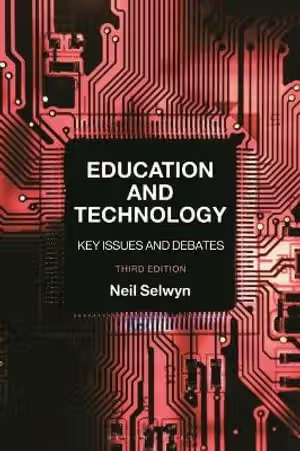
Selwyn, N. (2022). Education and Technology: Key Issues and Debates (3rd ed.). Bloomsbury Academic.
Chapter Summary
The third edition is a short book of about 220 to 230 pages: a preface and a section on how to use the book, eight chapters, a glossary, references and an index. The publisher describes it as thoroughly revised. Two chapters are new, on artificial intelligence and "big data"-driven automation of education and on the future(s) of education and technology, and the edition adds sections on "post-digital" perspectives, personalised learning, digital labour and the need for sustainable forms of digital education. The publisher frames the book around questions such as what can be learned from the history of technology in education, whether digital technology makes education more individualised, and whether it will eventually replace the school, the university and the teacher. Expanded study questions and annotated further reading support the chapters, the glossary of key terms is new, and a companion website links to bonus chapters and audio recordings.
The approach is critical and social rather than technical. Selwyn looks at the people, practices, processes and structures behind the growing use of technology in education, and connects recent technical developments with changes in educational practice, policy and theory over several decades.
Chapter 1: What Do We Mean by 'Education' and 'Technology'?
The opening chapter defines the two terms of the title. Starting with definitions signals the book's method: before asking what technology does to education, it asks what is meant by each.
Chapter 2: Making Sense of Technology and Educational Change
The conceptual chapter on how to think about the relationship between technology and change in education.
Chapter 3: A Short History of Education and Technology
A historical chapter, answering the publisher's question about what can be learned from earlier uses of technology in education.
Chapters 4–6: Technology and Learning; Technology and Educational Institutions; Technology and Teachers
Three chapters that examine technology at three levels: the learner, the institution (schools, colleges and universities) and the teacher. By their titles, these chapters correspond to the publisher's questions about whether technology makes education more individualised and whether it will replace the school, the university and the teacher.
Chapter 7: Artificial Intelligence and the Automation of Education
New in this edition: trends in AI and data-driven automation, and what they imply for education.
Chapter 8: Education and Technology: Looking to the Future
The second new chapter, on possible futures for education and technology, including the sustainability of digital education. The publisher describes the book as asking readers to reflect on the directions and controversies of education in a "(post)digital" age.
Key Concepts
Chapters 1–3: framing
- Social as well as technical: treating educational technology as a matter of people, practices and institutions, not only devices and software.
- Technology and educational change: the question of how far, and in what ways, technology changes education.
- History of educational technology: earlier claims and uses as a guide to judging present ones.
- Post-digital perspectives: a way of thinking about digital technology in education that this edition adds, reflected in the publisher's phrase "(post)digital age".
Chapters 4–8: debates
- Personalised learning: claims that digital technology can individualise education.
- Digital labour: the work that digital systems create or reorganise.
- Automation: the use of AI and large data sets to take over educational tasks.
- Sustainability: the need for digital education that can be sustained in the future.
Critical Analysis
Strengths
- A critical counterweight. The book addresses questions that the publisher calls "fundamental but often unvoiced", and focuses on the social, political and institutional side of educational technology. It is a useful corrective to texts that assume technology improves learning.
- Structured for study. A section on how to use the book, study questions, annotated further reading and a new glossary make it suitable as a course text, and the companion website adds bonus chapters and audio.
- Current coverage. The new chapters on AI and automation and on the future, and the sections on personalised learning and sustainability, bring the third edition into current debates.
- Brevity. At around 220 pages the whole book can be read in a few weeks alongside other course reading.
Limitations
- Not a practical guide. The book does not explain how to teach with particular tools or design instructional materials; readers who need that must use other books in the course.
- Overview rather than evidence review. In eight short chapters each debate is introduced rather than examined in detail; the annotated further reading points to fuller treatments.
- Fast-moving subject. The AI chapter in particular reflects developments up to about 2021, and readers will need to update it with recent work.
Where It Fits in the Course
In the educational-technology list, Selwyn is the critical, sociological introduction. Joan Hughes and Margaret Roblyer's Integrating Educational Technology into Teaching is its practical opposite: a teacher-preparation textbook on planning technology use in school classrooms. Reading the two together, one on how to integrate technology and one on whether and why, gives a balanced start. Tony Bates's Teaching in a Digital Age, an open textbook on designing teaching and choosing media and delivery modes, is the natural next step for anyone teaching in further or higher education.
Ruth Clark and Richard Mayer's e-Learning and the Science of Instruction and Mayer's Multimedia Learning cover evidence-based principles for designing multimedia instruction, a cognitive and experimental approach quite different from Selwyn's social one. The Cambridge Handbook of the Learning Sciences is a research handbook for the wider field of learning with technology. Selwyn is best read first or alongside these, as a source of questions to put to their claims.
How to Use This Book
The book is for students of education, trainee teachers and anyone working with educational technology who wants to think about it critically; it assumes no technical background. Start with the preface and the section on how to use the book.
A practical reading plan:
- Core: Chapters 1–3 in order, since the definitions, the framing of change and the history underpin the later debates.
- Debates: Chapters 4–6 can be read in any order or matched to course topics (learning, institutions, teachers).
- Current issues: Chapters 7 and 8 on AI, automation and the future are the best starting points for essays and seminar debate.
Work through the study questions, and use the annotated further reading to follow a debate in more depth. A useful exercise is to take one claim from a practical text in the course, such as a promise of personalised learning, and examine it with the questions Selwyn raises. Check the companion website for the bonus chapters and audio recordings.