01 / Reading Guide
Reading Guide
Citation
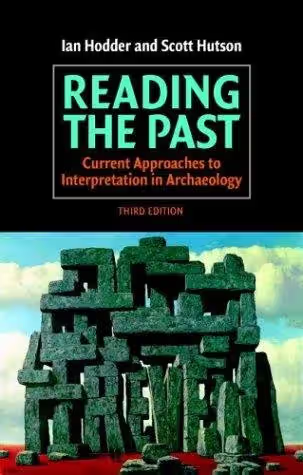
Hodder, I., & Hutson, S. (2003). Reading the Past: Current Approaches to Interpretation in Archaeology (3rd ed.). Cambridge University Press.
Chapter Summary
The book has ten chapters, a bibliography of some thirty-six pages and an index. First published in 1986 and revised in 1991, it was substantially reworked for this edition: the preface says the authors removed some chapters, added new ones and completely revised others, because the earlier text no longer discussed the contemporary theoretical field. The cover blurb adds that two completely new chapters were included. What follows is based on the contents list and section headings, and on the three prefaces.
Chapter 1: The Problem
Sections on cultural meanings and context, individuals and agents, and historical context. The opening chapter sets out the position from which the whole book is written, which the third-edition preface describes as "a commitment to meaning, agency and history".
Chapter 2: Processual and Systems Approaches
A review of the materialist, systems-theoretic school: the question of whether culture is to be understood materially, agency, history and time, behavioural archaeology, cognitive processual archaeology (measuring and predicting mind), and neo-evolutionary archaeology and mind.
Chapter 3: Structuralist, Post-Structuralist and Semiotic Archaeologies
Formal analysis and generative grammars, structuralist analysis and its critique, post-structuralism, the problem of verification, and a concluding section on the importance of structuralist archaeology.
Chapter 4: Marxism and Ideology
Marxist archaeology, then ideology, and the question of ideology and power.
Chapter 5: Agency and Practice
Practice and structuration, resistance, and agency. The chapter takes up agency directly.
Chapter 6: Embodied Archaeology
Materiality and malleability, the move from an archaeology of the body to embodiment, and the limits of the body.
Chapter 7: Archaeology and History
The history of the long term, historical theory and method with a section on Collingwood, and some examples, followed by a conclusion and critique.
Chapter 8: Contextual Archaeology
The longest and most developed chapter, with ten section headings. It moves from meaning and understanding, through meaning in archaeology, reading material culture and context, to similarities and differences, relevant dimensions of variation and the definition of context, and ends with explanation and description and critical hermeneutics.
Chapter 9: Post-Processual Archaeology
Variability and materiality, process and structure, historical meaning content (the ideal and the material), and archaeology and society.
Chapter 10: Conclusion: Archaeology as Archaeology
Testing interpretations, and archaeology and its distinctive role. The title echoes the first-edition preface, which says archaeology is neither "historical" nor "anthropological", and not even science or art, but has "an independent personality" with distinctive qualities to contribute.
Key Concepts
Chapters 1–3
- Cultural meaning and context: the starting point of the book's own position (Chapter 1).
- Processual and systems approaches: the school against which interpretive archaeology develops its argument (Chapter 2).
- Structuralism, post-structuralism and semiotics: formal analysis, generative grammars and the question of verification (Chapter 3).
Chapters 4–7
- Ideology and power: the Marxist section of Chapter 4.
- Practice, structuration, resistance and agency: Chapter 5.
- Embodiment: the shift from an archaeology of the body to embodiment, Chapter 6.
- Long-term history: the historical approach of Chapter 7.
Chapters 8–10
- Contextual archaeology and critical hermeneutics: the book's own proposal, developed in Chapter 8.
- Post-processual archaeology: Chapter 9.
- Testing interpretations: the closing issue of Chapter 10.
Critical Analysis
Strengths
- A clear, declared position. The third-edition preface says plainly that the book comments on theory "from a particular point of view" based on meaning, agency and history, so the reader knows what the review of other approaches is measured against.
- Broad coverage of approaches. In ten chapters it takes in processual and systems archaeology, structuralism and semiotics, Marxism, agency, embodiment and history; the preface lists post-structuralism, agency theory, neo-evolutionary theory and phenomenology among the areas added.
- Aimed at a stated audience. The preface says the book has "always catered to a rather hybrid audience" and was rewritten for undergraduates in archaeology and anthropology, as a "relatively short and understandable account", while also contributing to specialist debate, with examples for students in different parts of the world.
- A usable reference apparatus. There is a bibliography of about thirty-six pages and, in the longer chapters, detailed section headings that make the argument easy to navigate.
Limitations
- A perspective, not a neutral survey. By the authors' own description it reviews the debates from a particular position, so other approaches are presented through that lens. A student wanting a balanced school-by-school textbook should pair it with another source.
- Scope choices. The first-edition preface says the coverage of ecological or palaeoeconomic approaches is limited, because the majority of such work lies outside the volume's scope. Whether that remains true in the third edition cannot be confirmed from the front matter alone.
- Theory-focused. The book is about interpretation and theory, not field methods or scientific techniques.
- Assumes background. Previous exposure to archaeological or social theory is the sensible prerequisite, since the book discusses processual archaeology and its debates as familiar ground.
Where It Fits in the Course
Among the archaeology books on the list, this one is a theory text with a viewpoint. The broad introductions are the place to start: Renfrew, Bahn and DeMarrais's Archaeology: Theories, Methods and Practice, Durrani and Fagan's In the Beginning, and Bahn's Archaeology: A Very Short Introduction. For a neutral map of the theoretical schools, Johnson's Archaeological Theory: An Introduction is the natural companion, and Trigger's A History of Archaeological Thought supplies the long historical frame within which the approaches discussed here emerged.
Hodder and Hutson is therefore best read after one introductory text and one overview of theory, when the student is ready to see an argument for a particular way of reading material culture rather than a catalogue of options.
How to Use This Book
It is meant for undergraduates and graduate students in archaeology or anthropology who already have some theory. A good order is to read Chapter 1 for the authors' position, skim Chapters 2–4 as the review of processual, structuralist and Marxist approaches, and spend most time on Chapters 5–9, where agency, embodiment, history, context and post-processual archaeology are developed. Chapter 8 deserves a slow reading with a case study of your own beside it. Return to Chapter 10 last to see how the authors think interpretations should be tested.
While reading, keep a running comparison table of how each approach treats meaning, the individual and time, and use the bibliography to go to the original works cited.