01 / Reading Guide
Reading Guide
Citation
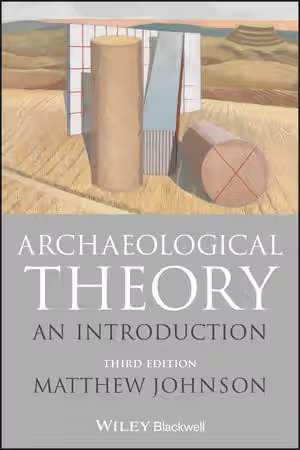
Johnson, M. (2019). Archaeological Theory: An Introduction (3rd ed.). Wiley-Blackwell.
Chapter Summary
The third edition has fourteen chapters of about 400 pages in all, a preface titled "The Contradictions of Theory", and, at the back, a selective glossary, a further-reading section, a bibliography and an index. The publisher describes the approach as a roadmap to the schools of archaeological theory, covering the foundations of each, the relations between them and what distinguishes them. The sample chapter shows that the book proceeds historically, starting with the 1960s and then moving to reactions against the movement that began there.
Chapter 1: Common Sense is Not Enough
An argument that archaeologists cannot do without theory. Theory is defined provisionally as "the order we put facts in", and the chapter separates "why" questions (theory) from "how" questions (method) while admitting that the two blur. It offers four reasons: archaeologists must justify what they do, must be able to judge one interpretation against another (the ley-line debate is the worked case), must be explicit about their assumptions, and in any case already use theory, even when a site report claims to be neutral. A recurring dialogue with a sceptical undergraduate voices the usual objections. The chapter closes by explaining the plan: the New Archaeology first, then the questions it raised about science and anthropology, then the reactions to it.
Chapters 2–5: The "New Archaeology"; Archaeology as a Science; Middle-range Theory, Ethnoarchaeology and Material Culture Studies; Culture and Process
The first block takes up the New Archaeology and the questions about "science" and "anthropology" that, according to Chapter 1, it left open. Chapter 1 also flags that the relation between theory and method will be debated again in Chapter 4, where middle-range theory (the link between particular facts and general theory) appears alongside ethnoarchaeology and material culture studies. Chapter 5 pairs culture with process.
Chapters 6–7: Thoughts and Ideologies; Postprocessual and Interpretative Archaeologies
These chapters turn to the reaction against the New Archaeology. The titles point to ideas and ideology as an object of study and then to postprocessual and interpretative approaches. The publisher lists the origins of the New and "post-processual" archaeologies among the topics the book explains.
Chapter 8: The Material Turn
New in the third edition, according to the publisher, which also mentions expanded coverage of materiality.
Chapters 9–11: Archaeology, Gender, and Identity; Archaeology and Cultural Evolution; Archaeology and Darwinian Evolution
A gender and identity chapter is followed by two chapters on evolutionary approaches, one on cultural evolution and one on Darwinian evolution. The publisher notes expanded coverage of evolutionary theory and of scholars from diverse backgrounds and specialisations. The sample chapter anticipates that Chapter 9 will show archaeological practice itself to be bound up with gendered ideas of what is valuable.
Chapters 12–14: Archaeology and History; Archaeology, Politics, and Culture; Conclusion: The Future of Theory
The last block places archaeology beside history, then politics and culture, a chapter the publisher lists as new or revised, and ends with a conclusion on the future of theory. Chapter 1 promises that the definition of theory will be revisited in this final chapter.
Key Concepts
Chapters 1–5
- Theory as "the order we put facts in": the working definition from Chapter 1, used to argue that no archaeological statement is free of theory.
- Theory and method: the contested boundary between "why" and "how" questions, said to return in Chapter 4.
- New Archaeology: the movement of the 1960s that opens the historical narrative and organises the first block of chapters.
- Middle-range theory, ethnoarchaeology, material culture studies: the topics named in the title of Chapter 4.
Chapters 6–11
- Postprocessual and interpretative archaeologies: the reaction to the New Archaeology treated in Chapter 7.
- The material turn: the subject of Chapter 8, with the publisher also naming materiality, agency and epistemology among the issues covered.
- Cultural and Darwinian evolution: two evolutionary approaches given a chapter each in Chapters 10 and 11.
Chapters 12–14
- Archaeology and history: the relation between the two disciplines (Chapter 12).
- Politics and culture in archaeology: the focus of Chapter 13.
Critical Analysis
Strengths
- Built for newcomers to theory. The publisher stresses informal prose, examples, cartoons and dialogues, and the sample chapter delivers this: the imagined student who finds theory sterile gets answers in plain language. The book is aimed at readers who "shy away" from theory.
- Theory is shown to matter in practice. Chapter 1 does not wait to define schools of thought; it shows theoretical assumptions inside a seemingly neutral passage of site description and inside the ley-line controversy, which makes the rest of the book easier to motivate.
- A historical frame that explains the disputes. Placing each school in the cultural and political context it came from, as the publisher promises and the sample chapter argues for, lets readers see why positions form and what they react against, rather than memorising labels.
- Current coverage. The third edition adds new and revised chapters on the material turn and on politics, and an expanded glossary and bibliography with updated reading suggestions.
Limitations
- Needs some archaeological background. The sample chapter mentions stratigraphy, Harris matrices and seriation in passing, so readers who have not met these will do better with a general introduction first.
- An author with a position. The sample is openly argumentative ("I would argue"), and the account of the New Archaeology as the foundation of everything after it is Johnson's own. Readers should check it against other histories of the field.
- Long way round to some topics. The author warns that long passages on neighbouring disciplines may look irrelevant to practising archaeologists; readers wanting only the current debates will find the first five chapters a detour.
Where It Fits in the Course
Within the archaeology list, Johnson is the book to read after a general introduction and before the more specialised works. Colin Renfrew and Paul Bahn's Archaeology: Theories, Methods and Practice and Nadia Durrani and Brian Fagan's In the Beginning cover methods and theory together; Paul Bahn's Archaeology: A Very Short Introduction is a brief first look. None of them concentrates on the intellectual history of interpretation the way Johnson does.
For more depth after Johnson, Bruce Trigger's A History of Archaeological Thought is a worldwide history from medieval antiquarianism to the present, and Ian Hodder and Scott Hutson's Reading the Past is a theoretical work on reading material remains as meaningful, with a sustained argument for contextual and interpretive archaeology. Johnson's Chapters 6–8 give a map of the territory that those books examine in detail.
How to Use This Book
Johnson suits second- or third-year students in archaeology and anthropology taking a first theory course, and graduate students from neighbouring fields who need orientation. A little prior archaeology helps.
A practical plan:
- Core: Chapter 1, then Chapters 2–5 in order. The sample chapter insists that this material is foundational for understanding where current positions come from, and that the questions the New Archaeology raised remain central to practice.
- Then follow the course: Chapters 6–7 for the reaction to the New Archaeology; Chapter 8 for materiality; Chapters 9–11 selectively, depending on whether the course stresses gender and identity or evolutionary approaches; Chapters 12–13 when the course turns to history, politics and heritage.
- Finish with Chapter 14, then reread the definition of theory in Chapter 1 to see how it has shifted.
- Alongside: test each position against a real interpretation from the course or an excavation report, and use the further-reading section to sample primary texts once the overview is clear. The glossary is selective, so keep a running list of terms of your own.