01 / Reading Guide
Reading Guide
Citation
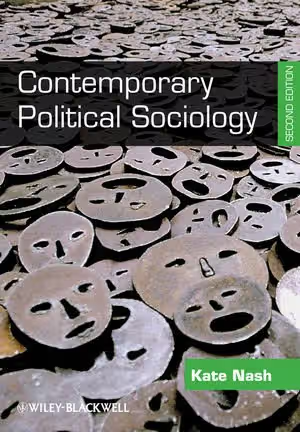
Nash, K. (2010). Contemporary Political Sociology: Globalization, Politics, and Power (2nd ed.). Wiley-Blackwell.
Chapter Summary
The book has five chapters, a glossary, a reference list and an index, in 304 pages (the publisher's count). It is organised around one argument: that political sociology has moved away from state-centred, class-based models of politics towards an understanding of politics as a possibility in all social relations, and that "cultural politics" is the best way to describe the contest over identities and social structures. The publisher says the second edition adds material on global governance, human rights, global social movements and global media, a new discussion of democracy and democratisation, and a clearer statement of what is at stake in choosing between cosmopolitanism, imperialism and nationalism.
Chapter 1: Changing Definitions of Politics and Power
The chapter opens with the election of Barack Obama to show why politics cannot be separated from culture. It then reviews the traditions of political sociology under four headings: the Marxist tradition (including neo-Marxism and three models of the state: instrumental, arbiter and functionalist), the Weberian tradition (with elite theorists and pluralism), the Durkheimian tradition (with neo-Durkheimian work) and Foucauldian definitions of power (the analytics of power and governmentality). A final section, "Cultural Politics", sets out the book's own stance and ends with a preview of Chapters 2 to 5.
Chapter 2: Politics in a Small World
Three sections: "Explaining Globalization", "State Transformation and Imperialism" and "We are the World?". The chapter treats globalisation as the most dramatic challenge to models in which politics happens inside the nation-state, and asks how states and the idea of "society" change as flows of goods, information and authority cross borders.
Chapter 3: Social Movements
The sections are "Resource Mobilization Theory and Beyond", "New Social Movement Theory: Conflict and Culture", "Toward a Synthesis: the Definition of 'Social Movement'" and "Global Social Movements". As previewed in Chapter 1, social movements are presented as the way social actors challenge meanings and create new collective identities, shifting attention from social systems to cultural politics.
Chapter 4: Citizenship
The longest chapter, in five sections: "T. H. Marshall: Citizenship, Social Class, and the Nation-State", "Citizenship, Wealth, and Poverty", "Citizenship, Sex, and Sexuality", "Citizenship, Racialization, and Ethnicity" and "Post-National Citizenship?". It links citizenship to the claims of movements about identity and difference and to the question of who holds citizenship rights in an age of migration.
Chapter 5: Globalization and Democracy
Four sections: "Democracy in Crisis: Political Parties and Elections", "Democracy, Human Rights, and International Political Institutions", "Global Civil Society" and "Democracy and Cultural Politics". The chapter asks whether democratising international institutions is a response to the crisis of democracy at the national level, and what the cultural politics of social movements means for democratic legitimacy.
Key Concepts
Chapter 1: Changing Definitions of Politics and Power
- Political sociology as study of state and society: the older definition, which the chapter argues has concentrated on how society shapes the state.
- Three Marxist models of the state: instrumental, arbiter and functionalist.
- Analytics of power and governmentality: Foucault's approach and the work it inspired.
- Cultural politics: the "politics of politics", that is, how what counts as political is itself made visible and contested.
Chapters 2 and 3: Globalisation and social movements
- Methodological nationalism: the treatment of societies as contained within state borders, which the book argues globalisation makes unsustainable.
- Resource mobilisation and new social movement theory: the two main approaches in Chapter 3.
- Global social movements: movements that act both from below and through international organisations.
Chapters 4 and 5: Citizenship and democracy
- Marshall's account of citizenship: citizenship rights in relation to class and the nation-state.
- Post-national citizenship: citizenship detached from the territorial nation-state.
- Global civil society: a topic in the democracy chapter.
- Recognition and redistribution: the debate that Chapter 1 previews for the citizenship chapter.
Critical Analysis
Strengths
- A clear organising argument. Chapter 1 states the thesis, surveys the classical traditions in labelled sections and previews each later chapter, so the book reads as a single case rather than a catalogue.
- Theory is linked to topics. Each of the four later chapters takes one subject (globalisation, movements, citizenship, democracy) and builds on the traditions set out first. The sample chapter shows the Marxist, Weberian, Durkheimian and Foucauldian traditions each given their own section.
- Study aids. The contents show a glossary, numbered sections within each chapter and a closing preview in Chapter 1 of what each later chapter does.
Limitations
- Dated in places. The second edition dates from 2010 and the sample chapter opens with Obama's election, so developments after about 2010 are necessarily absent.
- A thesis-driven selection. Chapters follow the author's view that cultural politics is central. Topics such as state formation, war and revolution do not have chapters of their own.
- Short. Five chapters in roughly 235 pages of text (the glossary starts on page 237) means each topic is treated in compact form; readers who want a field survey or comparative-historical studies will need other books.
Where It Fits in the Course
Of the books listed with it, Orum and Dale's Political Sociology: Power and Participation in the Modern World is the closest relative: an introductory textbook that sets out the classical foundations in Marx, Weber and Durkheim, reviews later theories of power and the state, and applies them to citizenship, social movements, globalisation and democracy. Nash's book covers similar ground but organises it around a single argument about cultural politics, and the two make a useful pair. Elisabeth Clemens's What Is Political Sociology? is a short introduction to the field's central questions and is a lighter way in before Nash.
Charles Tilly's Coercion, Capital, and European States and Theda Skocpol's States and Social Revolutions are comparative-historical studies of states and revolutions, topics Nash treats less fully; Arlie Hochschild's Strangers in Their Own Land is an ethnographic study of political feeling in one American community that can be read alongside the cultural-politics chapters.
How to Use This Book
The book suits undergraduates taking a course in political sociology, globalisation or social movements. No prior political sociology is required, though a first course in sociology or politics helps with the vocabulary of Chapter 1.
A practical reading plan:
- Core: Chapter 1 in full, since it carries both the theoretical background and the argument. Take the Marxist, Weberian and Durkheimian sections quickly if the course has already covered them, and give time to the Foucauldian and cultural-politics sections.
- Choose by topic: Chapter 2 for globalisation, Chapter 3 for social movements, Chapters 4 and 5 for citizenship and democracy; they can be read separately after Chapter 1.
- Alongside the text: use the glossary for terms, and update the examples with recent material, since the book stops at 2010.
When reading Chapter 1, write down the one-sentence definition of power and politics that each tradition uses, then check how the later chapters apply or revise them.