01 / Reading Guide
Reading Guide
Citation
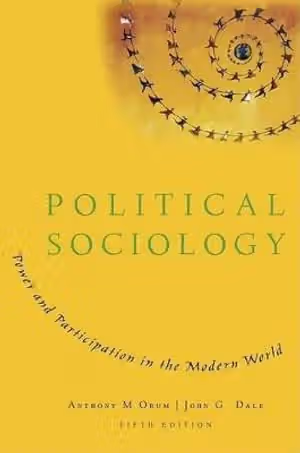
Orum, A. M., & Dale, J. G. (2008). Political Sociology: Power and Participation in the Modern World (5th ed.). Oxford University Press.
Chapter Summary
The fifth edition has thirteen chapters and a preface, in about 336 pages. It is the first edition with John G. Dale as coauthor. The publisher describes it as thoroughly revised and updated and as suited to upper-level undergraduate courses in political sociology. The chapters fall into three stretches: the classical theorists and their successors (2–5), forms of authority and the American case (6–8), and parties, movements, media and participation (9–13).
Chapter 1: Introduction
Sets out the book's basic terms: power and authority, and the role of institutions, networks and culture. It introduces the visions of society and politics offered by Marx, Weber, Durkheim, Tocqueville and Polanyi, and ends with pedagogical guidelines for using the book.
Chapter 2: On the Economy and Politics: Karl Marx and the Neo-Marxists
Presents "the essential Marx" on the economy and social stratification, substructure and superstructure, politics as a reflection of class struggle, the limits of state power, how capitalism and rule by capitalists are sustained, and revolution. It then turns to Lenin, Gramsci, the Frankfurt School and Poulantzas.
Chapter 3: On States and Societies: Max Weber and the Neo-Weberians
Covers Weber on the state, the power of the ruler, authority and its legitimacy, and contending social groups. The neo-Weberians are Bendix, Tilly and Skocpol.
Chapter 4: On Civil Society and Politics: Emile Durkheim and Alexis de Tocqueville
Takes Durkheim on society, states and politics, and Tocqueville on equality in America, the conditions for equality and the threats to democracy. The "neo-consensualists" are Lipset, Bellah, and Coleman and Putnam.
Chapter 5: On the Politics, Law, and Morality of Markets
Devoted to Karl Polanyi: fictitious commodities (land, labour and money), the claim that state action is inherent in market formation, the interwar years, the protectionist countermovement, and the argument that a global free market is impossible.
Chapter 6: Basic Forms of Political Authority
Begins with the classical Greek conceptions of types of rule, then describes modern types: democracy, totalitarianism and authoritarianism.
Chapter 7: Power and Authority in America
Examines the American state as a war-making and a welfare state, the power of business and corporations (the corporate community, the inner circle, multinationals), whether America has a ruling or dominant class, and economic and political equality.
Chapter 8: Power and Authority in the Metropolis
Traces the American metropolis from the industrial city to its decline and contemporary politics, reviews interpretations of the city (political pluralism, the city as growth machine, the creative class), and turns to global cities and urban experiments in China, South Korea and Taiwan.
Chapter 9: Political Parties
Covers the nature and birth of modern parties, variations among current and early patterns (including the urban political machine), the social bases of partisanship, and the past and future of parties in the United States.
Chapters 10–11: Social Movements: Basic Perspectives; Transnational Social Movements and Globalization
Chapter 10 compares collective behaviour with collective action and presents the resource mobilization paradigm, political process theory and identity politics. It includes a discussion of the 2008 presidential campaign. Chapter 11 takes up the multiple meanings of globalization and uses the Free Burma movement as a case of a transnational movement.
Chapter 12: The Mass Media
Reviews the history of the American mass media, the media as a vehicle of corporate capitalism, agenda-setting, the business of making the news, and the public's susceptibility to the media.
Chapter 13: Political Participation and the Pursuit of Democracy
Reviews democratic theory and participation, the rational-choice challenge (the free-rider problem and selective incentives), and rates and types of participation by social class, gender, race and ethnicity.
Key Concepts
Chapters 1–5: Theory
- Power and authority: the basic pair introduced in Chapter 1.
- Substructure and superstructure: the Marxist account of how economy relates to politics.
- Legitimacy: Weber's concern with why rule is accepted.
- Fictitious commodities: Polanyi's term for land, labour and money.
Chapters 6–9: Forms of rule
- Democracy, totalitarianism and authoritarianism: the three modern types of political rule.
- The growth machine: a reading of the city's political economy.
- Partisanship: examined by values and social bases.
Chapters 10–13: Participation
- Resource mobilization and political process: perspectives on social movements.
- Agenda-setting: the media's influence on political attention.
- Free-rider problem and selective incentives: the rational-choice challenge to participation.
Critical Analysis
Strengths
- A theory-first structure. Chapters 2–5 are organised by thinker and then by their successors, so theory is learned before application.
- Clear chapter outlines. The contents list shows many subheadings, including a short "essential" section for each classical figure, which helps in reviewing.
- Contemporary reach. Chapter 11's Free Burma case, Chapter 8's section on urban experiments in China, South Korea and Taiwan, and Chapter 10's use of the 2008 election show an effort to bring recent cases in.
Limitations
- United States emphasis. Chapters 7 (America), 8 (the metropolis in American history), 12 (the mass media in America) and the party case in Chapter 9 are mainly American, so the book is less comparative than the publisher's wording about the modern world suggests.
- The state beyond America is treated through theory. Outside the American chapters, the state appears mainly through the thinkers of Chapter 3; readers wanting a sustained account of state formation or revolutions should read Tilly or Skocpol directly.
- Dated cases. The 2008 election and the Free Burma campaign date the material, so use newer sources for the current situation.
Where It Fits in the Course
This is a theory-led textbook for the political sociology course. Elisabeth Clemens's What Is Political Sociology? is a short introduction that can be read first. Kate Nash's Contemporary Political Sociology presents the field through globalization, cultural politics and new social movements. Tilly's Coercion, Capital and European States and Skocpol's States and Social Revolutions develop the state-centred approach that Chapter 3 introduces. Hochschild's Strangers in Their Own Land is an ethnographic study of political feeling, class, race and regional identity that complements the participation and social-cleavage topics of Chapter 13.
How to Use This Book
The book suits upper-level undergraduates; an introductory sociology or politics course is helpful but not required.
A practical plan:
- Core: Chapter 1 and Chapters 2–4 in order; these supply the vocabulary used later.
- Then: Chapter 5 on Polanyi and Chapter 6 on forms of rule.
- Applications: Chapters 7–9 as American case studies; Chapters 10–13 on movements, media and participation can be taken in any order.
- Alongside: read a classical text by one of the theorists and test the neo-theorists against current events.