01 / Reading Guide
Reading Guide
Citation
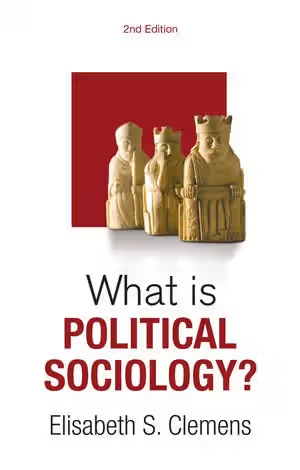
Clemens, E. S. (2024). What Is Political Sociology? (2nd ed.). Polity.
Chapter Summary
This is a concise book of about 224 pages in Polity's "What Is Sociology?" series, with an introduction and eight chapters. The publisher presents its guiding question as what is distinctive about political sociology when an entire discipline is already devoted to political science. The answer it gives is that a sociological perspective explains how political order emerges, is reproduced and is transformed, and that it widens the field of view to politics in the family, at work and in civic associations, and to the ways class, religion, age, race and gender shape participation and the distribution of power. The summaries below follow the contents and the publisher's description.
Introduction
Opens the book and states its approach. According to the publisher, the field works across historical and geographic settings from the intimate to the geopolitical, and needs an analytic toolkit of concepts of power, identities and inequalities, social closure, civil society and modes of political action.
Chapter 1: Power and Politics
The first chapter takes up power, the central concept in the publisher's list of tools, and its relation to politics.
Chapter 2: States, Empires, Nation-States
Concerned with the main forms of political order named by the publisher. The title places the nation-state alongside empires, rather than treating it as the only form of state.
Chapter 3: Regimes and Revolutions
Treats the formation of regimes and revolution, two of the processes the publisher lists, covering how political orders come into being and how they are overturned.
Chapter 4: Voice and Vote in Democratic Politics
Addresses the social bases of political participation, the topic the publisher highlights when it mentions how attributes such as class, religion, age, race and gender shape who participates.
Chapter 5: Bringing the State Back In
Returns to the state as an object of analysis. The publisher's description separately lists policy formation and feedbacks among the topics covered, so this is the likely place for the idea that policies feed back into later politics.
Chapter 6: Social Movements and Social Change
Takes up collective action outside conventional institutions and its role in change, one of the topics listed by the publisher.
Chapter 7: The Politics of Populism
A chapter devoted to populism, the only chapter title that names a specific form of politics.
Chapter 8: Transnationalism and the Future(s) of Political Order
Closes by looking beyond the national frame, in line with the publisher's reference to possibilities for new forms of digital and transnational politics.
Key Concepts
Introduction and Chapters 1–3
- Power: the first concept in the publisher's toolkit and the subject of Chapter 1.
- Social closure: the way groups restrict access to resources and positions, named in the publisher's description.
- Political order: the forms, reproduction and transformation of order, the book's central object.
- Regime formation and revolution: how orders are established and overturned (Chapter 3).
Chapters 4–6
- Political participation: voice and vote in democratic politics (Chapter 4).
- Civil society: one of the toolkit concepts named by the publisher.
- Policy feedbacks: policies shaping later politics, named alongside policy formation.
- Social movements: collective action and change (Chapter 6).
Chapters 7–8
- Populism: the subject of Chapter 7.
- Transnational and digital politics: possibilities discussed at the close of the book.
Critical Analysis
Strengths
- Short and focused. At about 224 pages, with eight chapters, the book is built as an orientation to the field rather than a full treatise, which suits a first encounter.
- Wide view of politics. The publisher stresses that political sociology covers politics in families, workplaces and civic associations, not only governments. This framing gives readers a reason to see why the field differs from political science.
- Coverage from classic to current. The contents run from states and empires through revolutions, democracy and movements to populism and digital and transnational politics.
- Endorsements from specialists. The publisher quotes Manali Desai (University of Cambridge) and Cedric de Leon (University of Massachusetts Amherst), who describe it as a timely synthesis of a large and contentious body of research and a resource for students and researchers at all levels.
Limitations
- Compression. A series volume covering the range above must treat each topic briefly; readers wanting depth on one process, such as revolutions or movements, will need the specialist studies.
- Detail not public. Only chapter titles and the publisher's blurb are available, so claims about examples, exercises or case countries cannot be made here.
Where It Fits in the Course
Within the political sociology course, this is the shortest orientation to the field. Kate Nash's Contemporary Political Sociology: Globalization, Politics and Power is a longer textbook presenting political sociology as the study of power and politics across social life, with the main theoretical traditions and current debates, and is the natural next step for a full course. The remaining books are works rather than textbooks.
Charles Tilly's Coercion, Capital and European States, A.D. 990–1992 is a comparative account of how European states were formed through war and the mixes of coercion and capital, related to Clemens's chapters on states and empires. Theda Skocpol's States and Social Revolutions is a comparative-historical analysis of the French, Russian and Chinese revolutions, relevant to Chapter 3 on regimes and revolutions; its argument that states may act autonomously also relates to the "bringing the state back in" theme of Chapter 5. Arlie Russell Hochschild's Strangers in Their Own Land is an ethnography of political feeling in a Louisiana community, which complements the populism and participation material of Chapters 4 and 7.
How to Use This Book
No background in sociology or political science is assumed. The book suits first- and second-year students starting a political sociology course, and readers from other disciplines who want to know what the field covers.
A practical plan:
- Read it straight through. At eight chapters it is short enough to read in a few sittings, and the early chapters on power, states and regimes supply concepts used later.
- Choose by topic when revising. For a course on democracy use Chapter 4; on change, Chapters 3 and 6; on current politics, Chapters 7 and 8.
- Pair with a full text. Use Nash's textbook for fuller coverage of theory, and one of the monographs (Tilly, Skocpol or Hochschild) to see how an argument is built on evidence.
- Check the edition. This is the second edition (2024); the publisher describes it as updated, including digital and transnational politics.