01 / Reading Guide
Reading Guide
Citation
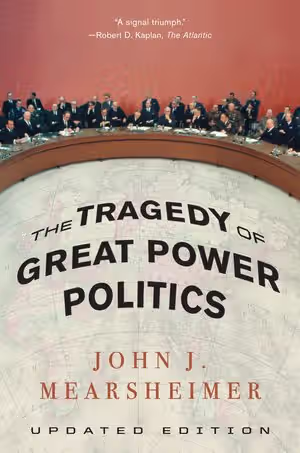
Mearsheimer, J. J. (2014). The Tragedy of Great Power Politics (Updated ed.). W. W. Norton & Company.
Chapter Summary
The updated edition runs to about 560 pages in ten chapters. The first edition appeared in 2001; the main change in the update is the final chapter, which is retitled "Can China Rise Peacefully?" in place of the 2001 edition's "Great Power Politics in the Twenty-first Century". Broadly, the chapters move from theory, through strategy and historical cases, to the causes of war and then to the present.
Context and Argument
The book states and defends offensive realism, a theory of international relations. The five assumptions usually listed for it are that the international system is anarchic, that great powers possess offensive military capabilities, that states cannot be sure of one another's intentions, that survival is their primary goal, and that they are rational actors. From these Mearsheimer argues that great powers constantly seek more power, that cooperation between them is hard, and that even security-seeking states are forced into competition. That is the "tragedy" of the title. The publisher describes the updated edition as taking on a question likely to dominate the twenty-first century, whether China can rise peacefully, and answering that it cannot.
Chapter 1: Introduction
Opens the book and presents its argument.
Chapter 2: Anarchy and the Struggle for Power
The theoretical heart of the book. It sets out the assumptions of offensive realism and shows how they lead states to seek power.
Chapter 3: Wealth and Power
Treats the relationship between economic resources and military power. In the book's account, great powers seek to maximise their share of the world's wealth because economic strength is the foundation of military strength.
Chapter 4: The Primacy of Land Power
Argues that a state's power rests chiefly on its land force, and that large bodies of water limit how far armies can project power. The "stopping power of water" is the reason the book gives for why no state can reach global hegemony.
Chapter 5: Strategies for Survival
What states do to survive: the strategies by which great powers gain power and deal with rivals. In the book's account, a great power's highest aim is regional hegemony, and a regional hegemon tries to stop others from achieving the same position in their regions.
Chapters 6–7: Great Powers in Action; The Offshore Balancers
The move from theory to the historical record. Chapter 6 is titled "Great Powers in Action", and Chapter 7 treats the offshore balancers. Examples in the book's argument include Britain, which stayed offshore from continental Europe while working to prevent any state from dominating it, and the United States, which had reached regional hegemony in its hemisphere by 1900.
Chapters 8–9: Balancing versus Buck-Passing; The Causes of Great Power War
Chapter 8 compares two ways in which threatened states respond to an aggressor, either by balancing against it directly or by passing the burden to others. Chapter 9 concerns the causes of great-power war; Mearsheimer treats the structure of power, or polarity, as a cause of war and sees unbalanced multipolarity, in which a potential hegemon exists, as the most dangerous arrangement.
Chapter 10: Can China Rise Peacefully?
The updated final chapter. It applies the theory to China and the United States, and the publisher presents it as the answer that justifies the new edition: a rising China will seek to dominate Asia, while the United States will go to great lengths to prevent it.
Key Concepts
Chapters 1–5: Theory
- Offensive realism: the theory that anarchy pushes great powers to maximise their power.
- Anarchy and uncertainty: the assumptions that no authority stands above states and that no state can be sure of another's intentions.
- Regional hegemony: the highest aim of great powers, who also try to prevent rivals from gaining it in other regions.
- Primacy of land power and the stopping power of water: the claims that land power is decisive and that oceans limit its projection.
Chapters 6–10: Application
- Offshore balancer: a power that stays out of a distant region and intervenes to prevent any state from dominating it.
- Balancing and buck-passing: two ways of responding to a threatening state.
- Polarity and war: the argument that the distribution of power among great powers shapes the risk of war.
Critical Analysis
Strengths
- A theory stated with explicit assumptions. The five assumptions are easy to list and test, so students can see what follows from what and where a disagreement begins.
- A clear order of exposition. The book proceeds from theory to historical cases, to explanation of war, to the present. The chapter titles make it easy to find the part that deals with a specific claim, such as buck-passing.
- Reception. Barry R. Posen, quoted by the publisher from The National Interest, called it a superb book that makes a significant contribution to understanding the behaviour of great powers. John A. Hall, reviewing it in the Canadian Journal of Sociology (2003), found its arguments strengthened by a tightness and coherence.
- An updated, policy-relevant ending. The 2014 edition's final chapter applies the theory to the rise of China, which makes the book a reference point in debates about United States–China relations.
Limitations
- Use of history. Charles Kupchan, reviewing the book in The International History Review (2003), called it an important and impressive book but was critical of how Mearsheimer uses history to support the theory and of his unwillingness to be more open to eclecticism.
- Cases of lasting peace. A review published by the Council on Foreign Relations argued that the rapprochement between Britain and the United States and the European Union cast doubt on the claim that destructive rivalry is unavoidable.
- Domestic politics set aside. Mearsheimer treats domestic politics as irrelevant; R. Harrison Wagner has argued that the book does not address whether democracy, trade or another mechanism could prevent states from fighting.
- Cause of war. Critics who use the bargaining model of war dispute the claim that polarity drives war, arguing that war is costly and that rational states need some other cause.
Where It Fits in the Course
The security studies list begins with textbooks, Contemporary Security Studies and Security Studies: An Introduction, and with International Security: A Very Short Introduction; any of them gives the debates in which offensive realism is one position. Mearsheimer's book is one of three theory books in the list. Waltz's Man, the State, and War organises explanations of war around three images and argues that the third, the structure of the international system, frames the others, and Mearsheimer's theory likewise locates the main cause of great-power competition in the structure of the international system.
Security: A New Framework for Analysis by Buzan, Wæver and de Wilde is the main alternative: it asks how issues come to be treated as security matters and extends the agenda beyond military threats, whereas Mearsheimer keeps the focus on great powers and military power. Reading the two together shows the debate between narrow and wide conceptions of security.
How to Use This Book
It is for advanced undergraduates and graduate students in international relations and security studies, and for readers who follow debates about United States and Chinese competition.
A practical plan:
- Core: Chapters 1, 2, 4 and 5 for the theory, then Chapter 9 for war.
- Historical cases: Chapters 6 and 7. Read them with a history of the periods they cover, and check each case against the assumptions listed in Chapter 2.
- The update: read Chapter 10 last and compare its claims with later work on China and with the critiques above.
- Compare: list the assumptions of offensive realism next to those in Waltz's Theory of International Politics and note where the conclusions diverge.