01 / Reading Guide
Reading Guide
Citation
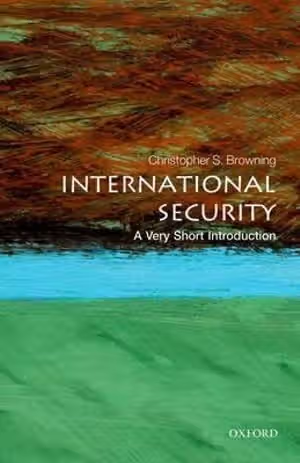
Browning, C. S. (2013). International Security: A Very Short Introduction. Oxford University Press.
Chapter Summary
A pocket-sized book of about 144 pages and nine chapters in Oxford's Very Short Introductions series. The publisher's description frames it around a question of priorities. War and peace, military strategy, nuclear proliferation and revisionist states remain central to discussions of international security, but climate change, migration, poverty, health and international terrorism have complicated the field. So what really matters: the traditional prioritization of state security, or the security needs of individuals, humanity and the biosphere? Using a broad range of international examples, Browning outlines the key debates about contemporary security challenges and the inherent difficulties of tackling them, and asks to what extent those debates are infused with questions of power, politics, justice, morality and responsibility. The chapter titles are listed below; the descriptions stay with what the titles and the publisher's summary make clear.
Chapter 1: Introduction
Opens the book with the central question above: whose security counts, and what counts as a security problem.
Chapter 2: A contested nature
The title indicates that the meaning of "security" itself is disputed. The publisher's contrast between a state-centred view and one that begins from individuals, humanity or the biosphere is the kind of dispute the title suggests.
Chapters 3–4: The problem of war; The United Nations
The traditional core of the subject. The third chapter addresses war as a problem for international security, and the fourth turns to the United Nations as the institution built to manage it.
Chapter 5: The changing nature of armed conflict
Considers how the character of armed conflict has changed, bringing the traditional concern with war up to date.
Chapters 6–7: Human security and development; Resources, climate change, and capitalism
These two chapters move to the non-military items the publisher lists: poverty, health and climate change. Chapter 6 joins human security with development, and Chapter 7 links resources and climate change with capitalism.
Chapter 8: Saviours or sinners?
The title poses a question about the moral standing of those who act in the name of international security. The publisher's remarks on justice, morality and responsibility indicate the kind of questions raised.
Chapter 9: The politics of fear and control
The closing chapter's title points to the politics through which insecurity is produced and managed, and to the publisher's concern with power and politics.
Key Concepts
Chapters 1–2: What security means
- State security versus other referents: the choice the publisher puts at the centre, between securing the state and securing individuals, humanity or the biosphere.
- A contested concept: security as an idea whose meaning is disputed, the subject of Chapter 2.
Chapters 3–5: War and its management
- War as a problem: the traditional preoccupation of security thinking.
- The United Nations: the institution examined in Chapter 4.
- Changing armed conflict: the shift in the character of wars discussed in Chapter 5.
Chapters 6–9: Wider agendas and politics
- Human security and development: the link between the security of individuals and the problem of poverty.
- Resources, climate change and capitalism: the economic and environmental sources of insecurity, treated in Chapter 7.
- The politics of fear and control: the final chapter's theme, showing how insecurity and responses to it are political.
Critical Analysis
Strengths
- A clear organizing question. The publisher builds the book on one question: whose security matters. That gives a very short book a spine and lets readers use it to sort the debates they meet elsewhere.
- Breadth in a small space. The nine chapters run from war and the United Nations to development, climate and fear, so a reader sees the traditional agenda and the wider one in a single short volume.
- Endorsed for teaching. Ray Takeyh, reviewing the book in Survival: Global Politics and Strategy, calls it accessible and well suited to courses in security studies, and also a useful introduction for citizens who want to know more about the risks they face and how their governments might respond.
- Moral and political questions kept in view. The publisher says the book asks how far the debates are infused with questions of power, politics, justice, morality and responsibility, not only how to measure threats.
Limitations
- Very short by design. At about 144 pages, each chapter can only outline a debate; a reader who wants theoretical detail, such as a systematic account of competing schools of thought, will need a textbook or the primary literature.
- Cases are not named in the contents. The publisher says the book uses a broad range of international examples, but the chapter titles do not show which cases appear, so readers who want depth on a particular conflict or institution should supplement it with case studies.
- Dated for the newest issues. Published in 2013, it cannot address later developments; the newest topics on the security agenda are better found in a recent textbook.
Where It Fits in the Course
Within the security studies list this is by far the shortest entry. Williams and McDonald's Security Studies: An Introduction is a large edited textbook with chapters by specialists on theories, concepts, institutions and contemporary challenges; Collins's Contemporary Security Studies is a comparable edited text. Browning's book is the one to read first, in a day or two, to see the shape of the field before committing to either.
For theory, Kenneth Waltz's Man, the State, and War offers a three-way classification of the causes of war; John Mearsheimer's The Tragedy of Great Power Politics sets out offensive realism; and Buzan, Wæver and de Wilde's Security: A New Framework for Analysis argues for widening the agenda while keeping it analytically coherent, through the concept of securitization. Each of these takes up, at greater length and difficulty, a position within the debate Browning outlines.
How to Use This Book
The book requires no background in international relations or security studies and suits first-year students, general readers and anyone about to take a security course.
- Core: read the whole book in order; it is short enough for a day or two. Chapters 1–2 set the question, Chapters 3–5 cover war and conflict, and Chapters 6–9 widen the lens.
- Selective reading: a student interested only in the non-traditional agenda can begin with Chapters 6–7, returning to Chapters 1–2 for the framing.
- Alongside the text: for each chapter write down whose security is being protected, from what, and by whom; then compare your answers with the referents the publisher names (the state, individuals, humanity, the biosphere).
- After the book: move to Williams and McDonald or to Collins for systematic coverage, and to Waltz, Mearsheimer or Buzan and colleagues for the theoretical positions.