01 / Reading Guide
Reading Guide
Citation
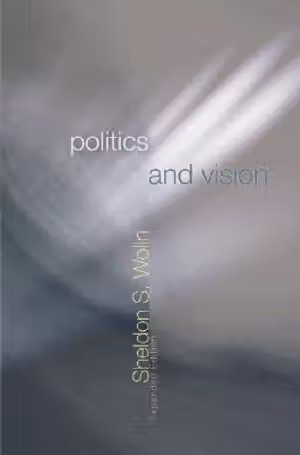
Wolin, S. S. (2006). Politics and Vision: Continuity and Innovation in Western Political Thought (Expanded ed.). Princeton University Press.
Chapter Summary
The expanded edition keeps the ten chapters of the 1960 original unchanged and adds seven chapters on modern and contemporary theorists. The text runs to about 600 pages, followed by roughly 130 pages of notes and an index.
Context and Argument
According to the publisher, Wolin wrote the book to challenge the idea that political analysis should be the neutral observation of objective reality. Political thinkers, he argues, also rely on creative vision: great theorists have shaped politics according to some vision of the Good that lies outside the existing political order, so that the history of theory is partly the story of changing assumptions about the Good. The new chapters add a further argument, that the United States has invented a new political form, "inverted totalitarianism", in which economic rather than political power dominates.
Chapter 1: Political Philosophy and Philosophy
The opening chapter distinguishes political philosophy from philosophy in general and asks what is distinctive about the political, setting up the terms of the chapters that follow.
Chapters 2–4: Plato: Political Philosophy versus Politics; The Age of Empire: Space and Community; The Early Christian Era: Time and Community
From Plato, through the transformations of political thought in the age of empire, to the early Christian era. The subtitles name the problems each chapter treats: the relation of philosophy to politics, and then community understood in terms of space and of time.
Chapters 5–6: Luther: The Theological and the Political; Calvin: The Political Education of Protestantism
Two chapters on the Reformation and its political consequences, one on each reformer.
Chapters 7–8: Machiavelli: Politics and the Economy of Violence; Hobbes: Political Society as a System of Rules
Two chapters on early modern thinkers, with subtitles pointing to violence and to rules as the central ideas.
Chapters 9–10: Liberalism and the Decline of Political Philosophy; The Age of Organization and the Sublimation of Politics
The original book ends with two chapters, one on liberalism and the decline of political philosophy and one on the age of organization, whose title speaks of a sublimation of politics.
Chapter 11: From Modern to Postmodern Power
A short bridge, about a dozen pages, that opens the new second part.
Chapters 12–13: Marx: Theorist of the Political Economy of the Proletariat or of Uncollapsed Capitalism?; Nietzsche: Pretotalitarian, Postmodern
The first two chapters of the second part. The subtitles put a question about Marx and a pair of labels on Nietzsche, indicating that Wolin takes a position on how each should be read.
Chapters 14–17: Liberalism and the Politics of Rationalism; Liberal Justice and Political Democracy; Power and Forms; Postmodern Democracy: Virtual or Fugitive?
The last four chapters. The publisher's description lists Rawls and the postmodernists among the theorists treated in the new chapters, and says they culminate in the argument about inverted totalitarianism. The final chapter asks whether postmodern democracy is virtual or fugitive.
Key Concepts
Part One (Chapters 1–10)
- The political: the subject whose distinctiveness Chapter 1 asks about, and the term that gives the book its organising question.
- Vision: the creative element in political theory that goes beyond neutral description.
- Political philosophy versus politics: the tension that the chapter on Plato takes as its theme.
- Sublimation of politics: the phrase in the title of Chapter 10, which concerns the age of organization.
Part Two (Chapters 11–17)
- From modern to postmodern power: the shift named in the title of the chapter that opens the second part.
- Inverted totalitarianism: the claim that economic power, not political power, dominates the contemporary United States.
- Virtual or fugitive democracy: the alternatives posed in the title of the final chapter on postmodern democracy.
Critical Analysis
Strengths
- A single question carried across two millennia. The chapter sequence follows one problem, the place of the political, from Plato through the Reformation and early modern thought to the age of organization, so that the thinkers read as a connected conversation rather than a set of separate summaries.
- Interpretive subtitles. Chapter subtitles, such as "Political Philosophy versus Politics", "Space and Community" and "Time and Community", state the angle from which each thinker is read, which helps a reader decide where to start.
- An expanded edition that extends the story. The second part carries the account to Marx, Nietzsche, Rawls and postmodern theory, and ends on the condition of democracy. Readers who want the history to reach the present can use it for that purpose.
- Scholarly apparatus. The notes occupy about 130 pages, so claims can be traced.
Limitations
- One author's interpretation. The book is an interpretive history organised around Wolin's own thesis about vision and the political, not a neutral survey. Readers should test his readings against the primary texts.
- Not a primer. It is an interpretive monograph of some 600 pages, so it works best for readers who already know the primary texts.
- Selective coverage. Only some thinkers have chapters named after them. A reader interested in someone not named in the contents list should check the index before assuming the book covers them in depth.
- Two parts written decades apart. The first ten chapters date from 1960 and the new chapters were added in the 2004 expanded edition, so they differ in time of writing and subject; the publisher says Part One was retained intact.
- Length. The book is long enough that it is better read in sections, alongside the texts, than straight through.
Where It Fits in the Course
This is the only single-author interpretive history in the political theory list; the other books are primary texts or a collection of essays. The Republic, The Prince, Leviathan and The Communist Manifesto correspond to the chapters on Plato, Machiavelli, Hobbes and Marx, and reading each one before its chapter gives the clearest test of Wolin's interpretation. For Politics, Second Treatise of Government, The Social Contract and On Liberty, whose authors fall within the period from Plato to Mill that the publisher says the original chapters cover, the index shows where they appear. The History of Political Philosophy edited by Strauss and Cropsey, a collection of essays by specialists, each giving a close reading of one thinker, offers a contrasting method: separate essays rather than a single thesis.
Democracy in America belongs with the final chapters, since Wolin's later chapters are about the condition of democracy in modern society, and Tocqueville's book is an earlier analysis of the same topic.
How to Use This Book
It is for upper-year undergraduates and graduate students who have already read some of the primary texts and want a sustained interpretation connecting them.
A practical plan:
- Start with Chapter 1, because the later chapters use the terms set there.
- Pair chapters with texts. Read the chapter on Plato after the Republic, the one on Machiavelli after The Prince, and the one on Hobbes after Leviathan.
- Use Part Two selectively. Read Marx and Nietzsche alongside your course texts, and finish with the last two chapters if your interest is democracy.
- Read critically. For each chapter, write down Wolin's central claim and one passage in the primary text that supports or complicates it.