01 / Reading Guide
Reading Guide
Citation
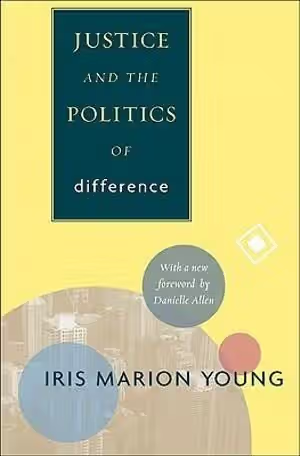
Young, I. M. (2011). Justice and the Politics of Difference. Princeton University Press. With a foreword by Danielle S. Allen. Originally published 1990.
Chapter Summary
The book challenges the prevailing reduction of social justice to distributive justice. Young examines basic concepts underlying most theories of justice, including impartiality, formal equality and the unitary moral subject, and takes as her starting point the experience and concerns of new social movements of marginalized groups. She replaces the distributive model with concepts of domination and oppression, and proposes that normative theory and public policy should undermine group-based oppression by affirming, rather than suppressing, social group difference. The 2011 edition adds a foreword by Danielle Allen that places the book in the later debates on social justice. There are eight chapters, an introduction and a short epilogue, in about 260 pages of text.
Introduction
The introduction sets out the project and the argument that the following chapters develop.
Chapter 1: Displacing the Distributive Paradigm
Young defines the distributive paradigm and argues that it presupposes and obscures institutional context. The chapter criticizes the overextension of the concept of distribution, in particular the talk of "distributing" power, and proposes to define injustice as domination and oppression.
Chapter 2: Five Faces of Oppression
The chapter presents oppression as a structural concept and discusses the concept of a social group. It then sets out the faces of oppression and ends by applying the criteria to groups.
Chapter 3: Insurgency and the Welfare Capitalist Society
Young analyzes the normative principles of the welfare capitalist society and its depoliticization, the ideological function of the distributive paradigm, and the administered society with its new forms of domination. She then treats insurgency and the repoliticization of public life, the struggle between recontainment and democracy, and democracy as a condition of social justice.
Chapter 4: The Ideal of Impartiality and the Civic Public
Drawing on a postmodernist critique of the logic of identity, the chapter argues that the ideal of impartiality denies difference and that impartiality is impossible. It finds the logic of identity in the ideal of the civic public, discusses the ideological functions of impartiality, and turns to participatory democracy and the idea of a heterogeneous public.
Chapter 5: The Scaling of Bodies and the Politics of Identity
The chapter considers how bodies are ranked in modern discourse and examines conscious acceptance combined with unconscious aversion, behavioral norms of respectability, xenophobia and abjection, and moral responsibility for unintended actions. It closes with justice and cultural revolution.
Chapter 6: Social Movements and the Politics of Difference
Young contrasts competing paradigms of liberation and argues for emancipation through the politics of difference, including reclaiming the meaning of difference. The chapter then turns to policy that responds to difference, and to the heterogeneous public and group representation.
Chapter 7: Affirmative Action and the Myth of Merit
The chapter takes affirmative action as a test case. It addresses the principle of nondiscrimination, the distributive paradigm in affirmative action debates, the myth of merit (including education and testing as performance proxies and the politics of qualifications), and the connection between oppression and the social division of labor. It ends with the democratic division of labor.
Chapter 8: City Life and Difference
Young discusses the opposition between individualism and community, the "Rousseauist dream" and the privileging of face-to-face relations, and the undesirable political consequences of the ideal of community. She proposes city life as a normative ideal, considers cities and social injustice, and ends with empowerment without autonomy.
Epilogue: International Justice
A short closing essay extends the discussion to the international scale.
Key Concepts
Chapters 1–2: Domination and Oppression
- Distributive paradigm: the view that social justice is about the distribution of goods, which Young argues obscures institutional context.
- Domination and oppression: the concepts she uses in place of distribution to define injustice.
- Five faces of oppression: the account in Chapter 2 of the different forms oppression takes, treated as structural.
- Social group: the concept of a social group, central to the politics of difference.
Chapters 3–4: Democracy and Impartiality
- Depoliticization and repoliticization: the tendency of welfare capitalism to remove issues from public debate, and the insurgent movements that restore them.
- Ideal of impartiality: criticized as denying difference and as impossible to attain.
- Heterogeneous public: the democratic public that includes differences instead of requiring a common perspective.
Chapters 5–8: Difference in Practice
- Politics of difference: affirming group difference as a source of emancipation.
- Group representation: the principle that groups should be represented in democratic publics.
- Myth of merit: the critique of merit and qualifications in the affirmative action debate.
- City life as normative ideal: a vision of urban life as an alternative to the ideal of community.
Critical Analysis
Strengths
- A clear target. The first chapter identifies the distributive paradigm as the object of criticism, and the rest of the book offers alternatives for the concepts it displaces: oppression for injustice, a heterogeneous public for impartiality, and city life for community.
- Critical reception. The book won the American Political Science Association's Victoria Schuck Award in 1991. Andrew Murphy in the Journal of Politics called it an extremely important book that challenges theorists of justice from Plato to Rawls, and Will Kymlicka in Canadian Philosophical Reviews judged that it opens many new vistas for theorists of justice.
- Concrete applications. Chapters 7 and 8 test the argument on affirmative action and urban life, so the theory is applied to debates that readers can recognize.
- Updated edition. The 2011 foreword by Danielle Allen explains how debates on social justice have changed since the first publication.
Limitations
- Assumes prior reading. The argument is built in reaction to the theories of justice that dominated after Rawls, so it is easiest for readers who know that literature.
- Theory first. Chapters 7 and 8 apply the argument to affirmative action and city life, but readers who want systematic empirical evidence on those subjects will need other sources.
- Dated context. The book first appeared in 1990, and its policy examples and debates are those of that period.
Where It Fits in the Course
Young is best read as a response to the books around her. Rawls's A Theory of Justice and Nozick's Anarchy, State, and Utopia are the major works whose style of theorizing about justice she questions. Will Kymlicka's Contemporary Political Philosophy is a critical survey of the main schools since Rawls, and Adam Swift's Political Philosophy: A Beginners' Guide for Students and Politicians introduces the central political values. Andrew Heywood's Political Ideologies surveys the ideologies one by one.
A sensible order is to read Swift or Kymlicka first to gain the vocabulary, then Rawls, and then Young. Reading her next to Rawls shows most clearly how a politics of difference contests the premises of a theory of distribution.
How to Use This Book
The book is for graduate students and advanced undergraduates with a grounding in Rawls and the main debates of contemporary political philosophy.
A practical plan:
- Core: Read the introduction and Chapters 1 and 2, which define the target and the key concepts of domination and oppression.
- Argument: Read Chapters 3 to 6 to follow the arguments on democracy, impartiality, bodies and social movements. The chapters can be read separately, but Chapter 6 is where the discussion of policy and group representation appears.
- Applications: Read Chapters 7 and 8 for the cases of affirmative action and city life, and use them as models for applying the argument.
- Context: Read Allen's foreword and the epilogue to see how the argument bears on later debates and on international justice.