01 / Reading Guide
Reading Guide
Citation
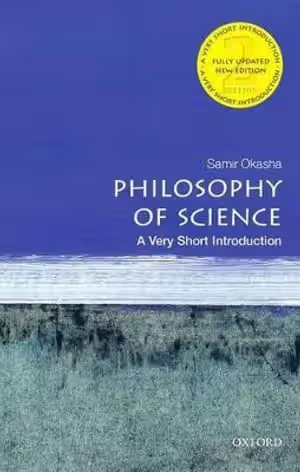
Okasha, S. (2016). Philosophy of Science: A Very Short Introduction (2nd ed.). Oxford University Press. Very Short Introductions 67.
Chapter Summary
The second edition (the first appeared in 2002) has seven chapters on about 130 pages, followed by further reading and an index. According to the publisher, the book moves from a concise overview of the history of science through scientific reasoning, causation and explanation to scientific change and the realism debate, and finishes with science today and the social and ethical questions it raises.
Chapter 1: What is science?
The opening chapter asks what distinguishes science from other activities and, in the publisher's description, starts with a concise overview of the history of science.
Chapter 2: Scientific inference
A chapter on the reasoning by which scientists move from evidence to conclusions. The contrast between deductive and inductive reasoning and Hume's problem of induction belong here, and the book also uses Bayesian vocabulary such as initial credence.
Chapter 3: Explanation in science
The chapter treats what it is for science to explain something. Carl Hempel's covering law model is the classic starting point, and the book discusses counter-examples to it, including the well-known case of a flagpole and its shadow, along with questions of causation.
Chapter 4: Realism and anti-realism
The debate over whether scientific theories should be taken as true descriptions of unobservable entities such as electrons, or only as accurate about what can be observed. The arguments on both sides include the argument that the success of science would otherwise be a miracle and the problem of the underdetermination of theory by data.
Chapter 5: Scientific change and scientific revolutions
The publisher describes this chapter as asking whether there is a discernible pattern in the way scientific ideas change over time. Thomas Kuhn's account of paradigms and revolutions, together with the charge that rival paradigms are incommensurable, is the obvious reference point.
Chapter 6: Philosophical problems in physics, biology and psychology
Three case studies apply the general themes to particular sciences: in physics, the dispute between Newton and Leibniz about absolute space; in biology, questions about classifying species; and in psychology, questions about the modularity of mind.
Chapter 7: Science and its critics
The closing chapter turns to science today and to the social and ethical questions surrounding it. It considers criticisms of science and of its authority. The book also discusses publicly contested topics such as intelligent design, sociobiology and evolutionary psychology.
Key Concepts
Chapters 1–2: What is science?; Scientific inference
- Demarcation: the problem of saying what separates science from non-science.
- Induction: reasoning from observed cases to general conclusions, which goes beyond what the evidence strictly entails.
- Problem of induction: Hume's challenge that inductive reasoning cannot be justified without assuming what it is meant to prove.
- Bayesian reasoning: treating degrees of belief as probabilities that are updated as evidence comes in.
Chapters 3–4: Explanation in science; Realism and anti-realism
- Covering law model: Hempel's view that to explain an event is to derive it from general laws together with particular facts.
- Scientific realism: the view that successful theories are approximately true, including what they say about unobservable things.
- Underdetermination: the claim that the available data are compatible with more than one theory.
Chapters 5–6: Scientific change; Problems in physics, biology and psychology
- Paradigm: in Kuhn's sense, the shared framework of theory, method and examples within which normal science works.
- Incommensurability: the claim that rival paradigms cannot be fully compared by a common standard.
- Absolute space: Newton's idea of space as an entity existing independently of the objects in it, which Leibniz rejected.
- Modularity of mind: the hypothesis that the mind contains specialised processing systems, discussed in Chapter 6's section on psychology.
Critical Analysis
Strengths
- Compact without being thin. Samuel Schindler, reviewing the second edition in Metascience (2017), called it an excellent entry point for anyone wanting an overview of the issues philosophers of science grapple with, and praised it for covering a wide and representative range of topics clearly in about 130 pages.
- Arguments shown through cases. The book works through standard examples rather than abstract summaries: the flagpole as a problem for the covering law model, the Newton–Leibniz dispute over space, ring species in biology, and visual illusions such as the Müller-Lyer illusion in the discussion of the mind. This suits readers with no philosophical background.
- Philosophy of particular sciences. Chapter 6 shows how the general debates play out in physics, biology and psychology, so that students meet the philosophy of particular sciences as well as the general debates. Okasha's own research is in philosophy of biology (his books include Evolution and the Levels of Selection and Evolution and Rationality).
- Wider readership. Jonathan Cowie's review in Concatenation recommended it to anyone whose professional life has a connection with science, in line with Schindler's praise of its accessible style.
Limitations
- Each topic gets only a chapter of about 15 to 24 pages. The format allows a fair statement of each debate but not a detailed reconstruction of the arguments, so the book cannot replace a textbook for essay work.
- Thematic rather than historical. Popper, the logical empiricists and Kuhn appear within the topics they bear on rather than in a chronological sequence, so students who need the history of twentieth-century philosophy of science in order will need a more historical book alongside.
- Few primary texts. The book is a guide to the debates; reading lists are gathered at the end rather than attached to each chapter, and students have to go to the original papers and monographs themselves.
Where It Fits in the Course
Okasha's book is the quickest overview in this course and works best as preparation for the others. Peter Godfrey-Smith's Theory and Reality covers much of the same ground at about two and a half times the length and follows the debates historically, from logical empiricism through Popper and Kuhn to the sociology of science, naturalism and Bayesianism; read Okasha first for the map and Godfrey-Smith for the arguments. Alan Chalmers's What Is This Thing Called Science? starts from the commonsense view that science is derived from the facts of experience and tests it through observation, experiment and induction before turning to accounts of method and theory change; it pairs well with Okasha's Chapters 2 and 5.
Rosenberg and McIntyre's Philosophy of Science: A Contemporary Introduction is a systematic textbook that connects the same problems with epistemology and metaphysics, and is the natural next step after Okasha for a full course. The two primary works on the list develop debates that Okasha introduces: Kuhn's The Structure of Scientific Revolutions is the source for Chapter 5, and van Fraassen's The Scientific Image, which argues for constructive empiricism, is a major anti-realist position of the kind Chapter 4 sets against realism.
How to Use This Book
The book suits first-year students, students of the sciences who want a philosophical framework, and general readers. It assumes no philosophy and no particular science.
- Before a course: read it straight through in a few sittings to get the map of the subject.
- Core for most courses: Chapters 2–5 (inference, explanation, realism, scientific change), which correspond to the main units of a typical philosophy of science course.
- Specialist interests: Chapter 6 for students of physics, biology or psychology; Chapter 7 for those interested in the public role of science.
- Alongside: pair each core chapter with a primary text from the further reading, for example Kuhn's Structure with Chapter 5, and use Godfrey-Smith or Rosenberg and McIntyre for the detailed arguments when writing essays.
Because the chapters are short, a good habit is to state each chapter's central argument in a paragraph of one's own and list the strongest objection the chapter mentions.