01 / Reading Guide
Reading Guide
Citation
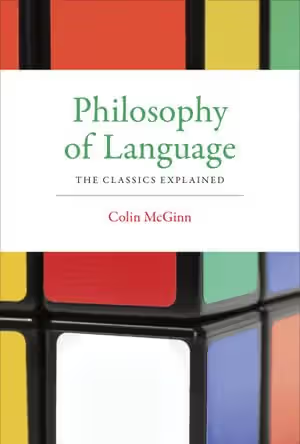
McGinn, C. (2016). Philosophy of Language: The Classics Explained. The MIT Press. (First published in hardcover, 2015.)
Chapter Summary
The book has ten chapters, each devoted to a single classic text, plus an appendix on Kripke's "A Puzzle about Belief", notes and an index, on about 215 pages. The preface explains that the chapters began as lectures at the University of Miami, transcribed by a student and then heavily revised by the author, who kept something of their spoken form; the result, in his words, mixes informality with careful formulation. The first chapter opens with a short statement of what the philosophy of language asks: how language hooks up with reality, whether all expressions refer in the same way, and how meaning relates to truth and to what speakers mean.
Chapter 1: Frege on Sense and Reference
The longest chapter (about 34 pages). After general background it moves through identity statements, the conception of sense, reference, ordinary and "extraordinary" (indirect) use, problems with Frege's theory, and the extension of the theory beyond singular terms.
Chapter 2: Kripke on Names
Kripke's critique of description theories of names: rigid designation, the epistemic objections, the causal chain theory, then objections to Kripke's critique and discussion of the social character of names, essential descriptions and impure descriptions.
Chapter 3: Russell on Definite Descriptions
Starting from the difference between indefinite and definite descriptions, the chapter compares three theories of definite descriptions, explains Russell's rejection of Meinong's ontology, sets out the details of the theory of descriptions, then turns to problems and to the distinction between primary and secondary occurrences.
Chapter 4: Donnellan's Distinction
Donnellan's distinction between referential and attributive uses of descriptions, related to denoting and referring and to truth-value gaps, followed by an evaluation of the distinction, a discussion of implication and implicature, and further objections to Russell.
Chapter 5: Kaplan on Demonstratives
Kaplan's theory of indexicals, built on the distinction between intension and extension: his two principles of indexicals, context of use versus conditions of evaluation, possible worlds and meaning, and the case of "today" and "yesterday".
Chapter 6: Evans on Understanding Demonstratives
Evans's Fregean alternative: the point of indexicality, sense and reference for indexicals, saying versus showing, "mock sense" and empty names, Evans's view of names, his treatment of "today" and "yesterday", and a closing comparison of character, content and information.
Chapter 7: Putnam on Semantic Externalism
The Twin Earth thought experiment about "water", the slogan that meanings are not in the head, and criticisms of Putnam.
Chapter 8: Tarski's Theory of Truth
Tarski's criteria for an acceptable definition of truth, a comparison with Aristotle and the redundancy theory, object language and metalanguage, how the T-sentences are derived, and the notion of satisfaction.
Chapter 9: Davidson's Semantics for Natural Language
Why Tarski's theory might serve as a theory of meaning, the difficulties of applying it to natural languages, truth theory as an empirical theory, and criticisms of Davidson's programme.
Chapter 10: Grice's Theory of Speaker Meaning
The relation between what speakers mean and what sentences mean, Grice's two types of meaning, his analysis of speaker meaning, and its consequences and criticisms.
Key Concepts
Chapters 1–3: Frege, Kripke, Russell
- Sense and reference: Frege's distinction between the object an expression stands for and the way it is presented, introduced to explain informative identity statements.
- Rigid designation: Kripke's idea that a name picks out the same individual in every possible world, used against description theories.
- Causal chain theory: the view that a name refers through a chain of uses going back to an initial naming.
- Primary and secondary occurrence: Russell's distinction between wide- and narrow-scope readings of a description.
Chapters 4–7: Descriptions in use, indexicals, externalism
- Referential versus attributive use: Donnellan's distinction between using a description to talk about a particular thing and using it to talk about whatever satisfies it.
- Context of use and conditions of evaluation: the two roles Kaplan distinguishes, one fixing what an indexical sentence says, the other the circumstances against which it is judged true or false.
- Semantic externalism: Putnam's view, argued through Twin Earth, that meaning is partly fixed by the environment rather than by what is in the speaker's head.
Chapters 8–10: Truth and meaning
- T-sentence: an instance of the schema "S is true if and only if p", which an adequate truth definition must entail.
- Satisfaction: the relation between open sentences and sequences of objects on which Tarski builds the definition of truth.
- Speaker meaning: what a speaker means by an utterance, which Grice analyses in terms of intentions directed at an audience.
Critical Analysis
Strengths
- Close, systematic exposition. The preface says the chapters go through the classic texts carefully and systematically, explaining everything from the ground up and aiming to make the material as simple as possible without sacrificing accuracy. The section headings show the method: chapters work through the components of a theory before turning to its problems.
- Written for students who struggle with the originals. The author describes the book as a student text for a typical undergraduate course, usable by graduate students with no background in the field and by students not specialising in philosophy.
- Covers indexicals and truth. Two chapters on demonstratives (Kaplan and Evans) and two on truth-theoretic semantics (Tarski and Davidson) treat topics that Morris's text-by-text introduction on this course does not give chapters of their own.
- Criticism to provoke thought. Most chapters contain a section of problems, objections or criticisms (for example 1.8, 2.6, 3.6, 7.4, 9.5 and 10.4); the preface explains that this evaluation is meant to stimulate students' thought and class discussion rather than to advance the professional debate.
Limitations
- Not a survey. The preface states plainly that there is no attempt at a general survey or complete coverage, and that the book does not deal with some of the more recent literature. Speech acts, rule-following and later Wittgenstein, for example, have no chapter.
- Designed as a companion. The author intends it to be used with an anthology of the classic texts (he names Nuccetelli and Seahy's Philosophy of Language: The Central Topics, and Martinich's The Philosophy of Language as an alternative); read on its own it loses much of its point.
- Spoken style. The lecture origin gives an informal, sometimes conversational tone, which by the author's own account trades some succinctness and precision for comprehensibility.
Where It Fits in the Course
McGinn is the most direct companion to the anthology on this list: A. P. Martinich and David Sosa's The Philosophy of Language collects the primary papers, and McGinn explains ten of the most central of them. Michael Morris's An Introduction to the Philosophy of Language shares the text-by-text approach and overlaps on Frege, Russell, Kripke, Davidson and Grice; Morris adds Locke, Quine, Austin, Kripke on rule-following and Wittgenstein, while McGinn adds Donnellan, Kaplan, Evans, Putnam and Tarski. Reading the two together gives wide coverage of the classic papers.
For problem-centred treatments, William Lycan's Philosophy of Language: A Contemporary Introduction and Alexander Miller's Philosophy of Language survey the debates and the later literature that McGinn deliberately leaves out; Miller in particular is more demanding and suits students who have finished McGinn. Davidson's Inquiries into Truth and Interpretation is the natural next step after Chapters 8 and 9.
How to Use This Book
The book assumes no previous philosophy of language. Basic logic, including quantifiers and the idea of a formal language, helps with the chapters on Russell, Tarski and Davidson.
- Read original and chapter together: read each classic paper first, or alongside, and use the chapter to work through it section by section.
- Core: Chapters 1–3 (Frege, Kripke, Russell) form the backbone of most courses; Chapter 4 continues the debate about descriptions.
- Modules: Chapters 5–6 form a unit on indexicals; Chapters 8–9 a unit on truth and meaning, best read in that order; Chapter 7 can follow the names chapters; Chapter 10 stands alone. The appendix on Kripke's belief puzzle is optional.
- Use the criticisms: the sections on problems, objections and criticisms make good seminar starting points and essay topics.
When a chapter becomes difficult, return to the relevant passage of the original: the book is designed to be read with the classic texts, not instead of them.