01 / Reading Guide
Reading Guide
Citation
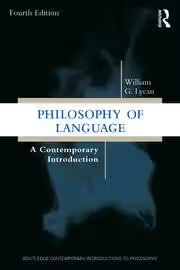
Lycan, W. G. (2026). Philosophy of Language: A Contemporary Introduction (4th ed.). Routledge.
Chapter Summary
The fourth edition has thirteen chapters in four parts, followed by a glossary, a bibliography and an index. It is a compact book: Routledge lists 262 pages and Google Books 300. The publisher says it introduces the main issues and theories of twenty-first-century philosophy of language, "focusing specifically on linguistic phenomena". The publisher lists chapter overviews and summaries, study questions, annotated further reading and a glossary. It also lists the changes in the fourth edition: a new section on the predicativist theory of proper names, an expanded section on inferentialist theories of meaning, a new section on dynamic ("update") theories of meaning, a separate section on varieties of presupposition and a new section on "applied" philosophy of language that lists eleven recent areas of research. The contents list does not show in which chapters these sections fall. The summaries below follow the chapter titles, the part titles and the publisher's description of each part; the contents list gives no sections within chapters.
Chapter 1: Introduction: meaning and reference
The opening chapter sets up the two notions of the book's first two parts, meaning and reference.
Part I: Reference and referring (Chapters 2–4)
Chapter 2: Definite descriptions. The publisher says Part I includes Russell's Theory of Descriptions "and its failings", Donnellan's distinction and problems of anaphora. Chapter 2 is the one titled for descriptions, but the contents list does not say how this material is divided among the Part I chapters.
Chapter 3: Proper names: the Description Theory. The chapter is on the view that a proper name is associated with a description. The publisher lists the Description Theory and Searle's Cluster Theory among the Part I topics.
Chapter 4: Proper names: Direct Reference and the Causal–Historical Theory. The second chapter on names presents the rival approaches: direct reference and the Causal–Historical Theory.
Part II: Theories of meaning (Chapters 5–8)
Chapter 5: "Use" theories; Chapter 6: Psychological theories: Grice's program. The publisher says Part II surveys the competing theories of linguistic meaning and compares their advantages and liabilities. The first two are theories of meaning in terms of use and in terms of psychological states, with Grice's programme named.
Chapter 7: Verificationism; Chapter 8: Truth-Condition theories. The next two chapters take up verificationism and theories that identify meaning with truth conditions.
Part III: Pragmatics and speech acts (Chapters 9–11)
Chapter 9: Semantic pragmatics; Chapter 10: Speech acts and illocutionary force; Chapter 11: Implicative relations. According to the publisher, this part introduces the basic concepts of linguistic pragmatics and includes an introduction to the Relevance approach to pragmatics. The titles name semantic pragmatics, speech acts and illocutionary force, and implicative relations.
Part IV: The expressive and the figurative (Chapters 12–13)
Chapter 12: Expressive language; Chapter 13: Metaphor. The last part examines forms of expressive language and what "metaphorical meaning" is and how most listeners readily grasp it.
Key Concepts
Part I: Reference
- Definite descriptions and the Theory of Descriptions: Russell's analysis of phrases such as "the so-and-so" and the objections to it.
- Donnellan's distinction and anaphora: further problems about how descriptions and pronouns refer.
- The Description Theory of proper names and the Cluster Theory: the view that names refer by way of descriptions, including Searle's version.
- Direct reference and the Causal–Historical Theory: rival accounts on which a name refers without a descriptive condition.
Part II: Meaning
- "Use" theories: accounts that tie meaning to the use of words.
- Grice's programme: meaning explained through psychological states of speakers.
- Verificationism: meaning tied to how a sentence could be verified.
- Truth-condition theories: meaning as the conditions under which a sentence is true.
Parts III–IV: Pragmatics and the figurative
- Pragmatics and the Relevance approach: how context and communication shape what is conveyed.
- Speech acts and illocutionary force: what speakers do in saying something.
- Implicative relations: what a sentence implies beyond what it says; the publisher also lists a separate section on varieties of presupposition as new to this edition.
- Expressive language and metaphor: forms of expressive language, and what "metaphorical meaning" is.
Critical Analysis
Strengths
- Each theory presented with its objections. The publisher says that Part II "compares their various advantages and liabilities", and Part I covers the failings of Russell's theory, so the book is organised around problems and objections rather than around authors.
- Pedagogical apparatus. Chapter overviews and summaries, clear supporting examples, study questions, annotated further reading and a glossary are listed, which is useful for a student preparing for a seminar.
- Coverage across the field. The four parts cover reference, meaning, pragmatics and the expressive and figurative, and the fourth edition adds predicativism, inferentialism, dynamic theories, varieties of presupposition and a survey of applied areas.
- Reception. The publisher quotes Paul Boghossian on the third edition, calling it "authoritative, pedagogically sensitive and superbly clear". This is a publisher-chosen excerpt about the previous edition.
Limitations
- Selective in its focus. The publisher says the book concentrates on linguistic phenomena, and the four parts treat reference, meaning, pragmatics and the figurative. The contents list names no chapter on the relation between language and thought.
- Compact coverage. At 262–300 pages, a survey spanning this many theories cannot reconstruct any single argument in detail, so students who want that will need the original papers or an anthology.
- Little independent evidence for the fourth edition. The only quoted praise concerns the third edition, so how the new sections work in teaching has not been assessed publicly.
Where It Fits in the Course
Lycan's book is a topic-by-topic introduction that presents each theory together with the objections raised against it. Michael Morris's An Introduction to the Philosophy of Language and Colin McGinn's Philosophy of Language: The Classics Explained are gentler first books built around classic texts: Morris takes one or two texts per chapter, and McGinn explains ten classic papers step by step and adds his own assessment. Alexander Miller's Philosophy of Language is a more demanding introduction that follows the analytic tradition from Frege and reconstructs central arguments in detail. Lycan is organised by problem and by theory rather than by author or text.
The advanced works in this course follow from specific parts. Donald Davidson's Inquiries into Truth and Interpretation develops a theory of meaning for a natural language in the form of a Tarskian theory of truth, a truth-conditional programme of the kind introduced in Lycan's Chapter 8. The Martinich and Sosa anthology The Philosophy of Language collects primary papers on meaning, reference, truth and communication and is the natural companion for reading the originals behind Parts I and II.
How to Use This Book
The book suits second- or third-year undergraduates who have had a first philosophy or logic course. The publisher presents it as an introduction, and the glossary and chapter overviews are meant to supply terms as they arise.
For a one-semester course, read the chapters in order, since Part I introduces Russell's analysis and the notion of reference that Part II assumes. Chapters 2–4 and 5–8 are the core for readers interested in semantics; Chapters 9–11 are the core for those interested in pragmatics. Part IV (Chapters 12–13) deals with expressive language and metaphor and can be read separately from the rest.
Read each chapter overview before the chapter, use the study questions as seminar preparation, and follow the annotated further reading to the original papers. Readers short of time can take Chapters 2, 3, 4, 8 and 10 as a route through the central arguments about descriptions, names, truth-conditional meaning and speech acts.