01 / Reading Guide
Reading Guide
Citation
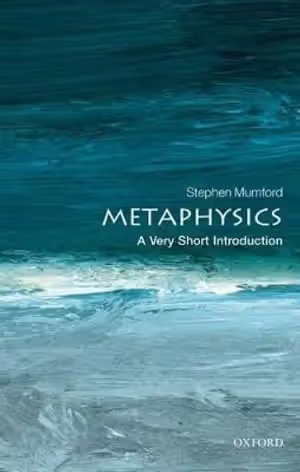
Mumford, S. (2012). Metaphysics: A Very Short Introduction. Oxford University Press.
Chapter Summary
The book is about 110 pages of text: a two-page introduction, ten chapters of ten to eleven pages each, a guide to further reading ("what should you read next?") and an index. Every chapter title is a simple question about something ordinary, such as a table, a circle, a change or a person. The introduction explains the book's unusual design: many introductions start by asking what metaphysics is and how its truths can be known, but because that question is among the hardest and most contentious, Mumford writes the book "back to front", doing metaphysics first and leaving the question of what it is to the final chapter. The publisher describes the topics as substance, properties, change, causes, possibility, time, personal identity, nothingness and emergentism.
Introduction: What is an introduction?
Metaphysics is introduced as one of the four traditional branches of philosophy, alongside ethics, logic and epistemology, and distinguished from popular associations with the mystical, the religious or the metaphysical poets. The aim is to show newcomers how philosophers actually understand and practise the subject.
Chapter 1: What is a table?
The opening chapter asks what it is to be a particular thing. A table bears properties but is neither identical with nor reducible to them, since some of them can change while it remains the same table. The chapter separates qualitative change from numerical sameness and concludes that particularity is an irreducible feature of reality.
Chapter 2: What is a circle?
What do circular things have in common? Mumford sets out Plato's view that properties exist in a separate realm, nominalism (the view that everything is a particular), which he argues cannot deal with resemblance and leads to an infinite regress, and Aristotle's immanent realism, on which circularity is a real feature of the world that exists only in its instances.
Chapter 3: Are wholes just sums of parts?
Using the contrast between a mobile phone and a pile of stones, the chapter separates integrated wholes (substances) from mere aggregates. A phone can do things, such as receive calls, that none of its parts can. The chapter weighs reductionism, on which the parts explain everything the whole does, against emergentism, on which wholes are more than the sums of their parts.
Chapter 4: What is a change?
Events and processes are distinguished, and change is analysed as gaining or losing a property, coming into or going out of existence, or variation within a property. The chapter contrasts endurantism, on which one subject bears incompatible properties at different times, with perdurantism, on which things have temporal parts, and raises the problem of how such parts connect when processes seem continuous and integrated.
Chapter 5: What is a cause?
Causation matters because without it nothing would affect anything else. Mumford considers counterfactual dependence theories and the testing of causal claims by methods such as randomised controlled trials, and identifies the central dispute as whether causes genuinely produce their effects or whether there is only a pattern of events without real connection.
Chapter 6: How does time pass?
The chapter asks whether there could be time without change and sets out two models: one explaining the passage of time through properties of pastness, presentness and perhaps futurity, the other treating events as standing only in relations of temporal order. It ends with open questions about whether time is a single line and whether it is finite.
Chapter 7: What is a person?
What makes a person a different kind of particular from a table? The chapter considers Locke's view that memory or psychological continuity makes personal identity, Descartes's view of the mind as a separable soul that could survive death, and bodily continuity, and notes that the answer may depend on whether we believe in souls.
Chapter 8: What is possible?
Are possibilities things, or mere fabrications of thought? Two accounts are compared: the possible worlds account, on which every possibility is actual at some other world, and David Armstrong's combinatorial theory, on which a possibility needs only the existence of the particular and property whose combination would constitute it.
Chapter 9: Is nothing something?
Philosophers are divided over absences and nothingness. The chapter asks whether things have negative properties as well as positive ones, discusses Bertrand Russell's acceptance of negative facts to explain negative truths, and sets this against the view that reality is wholly positive and nothingness is "all in our heads".
Chapter 10: What is metaphysics?
Only at the end does Mumford answer the question that other books begin with. Metaphysics tries to understand the fundamental nature of reality: it organises and systematises the specific truths that science discovers and describes their general features. Whereas scientific theories are tested by observation, metaphysical theories are accepted or rejected by reasoning.
Key Concepts
Introduction and Chapters 1–3: Particulars, properties, parts
- Numerical and qualitative sameness: a thing can change its qualities while remaining one and the same thing.
- Nominalism and realism about properties: whether only particulars exist, or properties are real, either in a separate realm (Plato) or in their instances (Aristotle).
- Substance versus aggregate: an integrated whole with its own capacities versus a mere collection of parts.
- Reductionism and emergentism: whether the parts fully explain the whole.
Chapters 4–6: Change, cause, time
- Endurantism and perdurantism: whether things persist as wholes through time or have temporal parts.
- Counterfactual dependence: if the cause had not occurred, the effect would not have occurred.
- Two models of time: time passing through properties of pastness, presentness and futurity, or a mere ordering of events.
Chapters 7–10: Persons, possibility, nothing, metaphysics
- Psychological and bodily continuity: rival criteria of personal identity over time.
- Possible worlds and combinatorialism: possibilities as other worlds, or as recombinations of actual particulars and properties.
- Negative facts: facts of absence that some, like Russell, accept to make negative truths true.
- Metaphysics and science: metaphysics generalises over scientific truths and proceeds by reasoning rather than observation.
Critical Analysis
Strengths
- Starts from the ordinary. Each chapter begins with a deceptively simple question about familiar things, and examples such as the table, the phone and the pile of stones make abstract distinctions concrete. The Times Higher Education Supplement found the book jargon-free without sacrificing rigour and complexity.
- Doing before defining. Leaving the question of what metaphysics is to the last chapter means readers have already practised the subject before facing its most contested methodological question, which makes that final discussion easier to follow.
- Wide coverage in little space. Ten core topics, from properties and parts to possibility and absence, are each given a compact, self-contained chapter.
- Clear oppositions. Most chapters are organised around a pair of rival positions (nominalism and realism, reductionism and emergentism, endurantism and perdurantism, production and regularity views of causation), which gives students a usable map of the field.
Limitations
- Very brief treatments. About ten pages per topic leaves room only for the main positions and the central objection to each; arguments are sketched rather than developed.
- Analytic focus. The book introduces metaphysics as practised in the analytic tradition and does not survey other traditions or the history of the subject in its own right.
- Some topics absent. Free will, God and the realism/anti-realism debate do not have chapters, so courses covering them will need other readings.
Where It Fits in the Course
In a metaphysics course this is the lightest of the introductions and works best as a first overview. Earl Conee and Theodore Sider's Riddles of Existence is also written for beginners and is built around puzzles, and it covers topics Mumford leaves out, such as fatalism, free will and God. Michael Loux and Thomas Crisp's Metaphysics: A Contemporary Introduction is a systematic textbook with chapter overviews and annotated reading, and Peter van Inwagen's Metaphysics argues for definite positions on large questions about the world as a whole; both are the natural next step once Mumford's chapters have made the questions familiar.
Particular chapters also prepare for the advanced texts. Chapter 8's comparison of possible worlds with combinatorialism is the right background for David Lewis's On the Plurality of Worlds, the full defence of the possible-worlds view, and for Saul Kripke's Naming and Necessity on necessity and names.
How to Use This Book
No previous philosophy is needed. Read the short introduction first, since it explains the book's design, and then read the chapters in order; the whole book can be read in a week. Each chapter can also be read on its own before a seminar on the same topic: Chapter 2 before universals, Chapter 4 before persistence, Chapter 5 before causation, Chapter 7 before personal identity. Chapters 1, 2, 5 and 8 are the core for most courses; Chapter 9 is optional but a good test of whether you can apply the methods of the earlier chapters to an unusual question.
For each chapter, write down the opening question, the rival answers and the strongest objection to each, then decide which you find more persuasive. Read Chapter 10 last, as intended, and check whether its account of metaphysics fits what the earlier chapters actually did. Use the further reading section to choose the next book for the topics you want to pursue.