01 / Reading Guide
Reading Guide
Citation
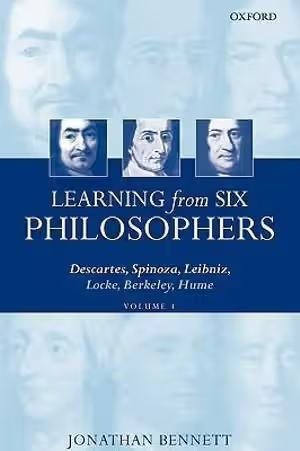
Bennett, J. (2003). Learning from Six Philosophers: Descartes, Spinoza, Leibniz, Locke, Berkeley, Hume (Vol. 1). Oxford University Press.
Chapter Summary
The two-volume work covers six philosophers; this first volume contains twenty-one chapters, almost all on Descartes, Spinoza and Leibniz, and runs to about 380 pages of text. Locke, Berkeley and Hume belong to Volume 2, with further chapters on Descartes, Leibniz and personal identity. The volume starts with Descartes's physics and metaphysics, moves to Spinoza and then Leibniz, and returns to Descartes's search for certainty in the final two chapters.
Chapter 1: Introduction
Explains and defends the "collegial" approach to philosophers of the past, in which one treats them as colleagues, collaborators, pupils and antagonists, and argues that an error by a great philosopher can be as instructive as a true insight.
Chapters 2–4: Cartesian and Aristotelian Physics; Matter and Space; Descartes's Physics
Chapter 2 sets Descartes's physics against Aristotelian ideas and notes its differences, such as having only one kind of basic thing, matter, and banishing teleology. Chapter 3 covers his thesis that materiality is extension, his rejection of a vacuum (and Locke's opposition), the concept of solidity, four views of space, and his account of motion. Chapter 4 explains why he must treat matter as infinitely divisible, describes the failure of his attempt to derive qualitative variety from structure and movement, and examines his loop theory of movement, his theory of collisions, and his theory of weight.
Chapters 5–6: Descartes's Dualisms; Descartes on Causation
Chapter 5 argues that Descartes's property dualism is too deep in his thought to be defended and examines his two arguments for substance dualism, one from the indivisibility of minds and one from conceivability, including Kripke's defence of a route from conceivability to actuality. Chapter 6 traces his view that a cause must resemble its effect, discusses the concept of a trope and the theory that causation is trope-transfer, and explains his treatments of body on body, body on mind, mind on body and mind on mind.
Chapters 7–10: Preparing to Approach Spinoza; One Extended Substance; Explaining the Parallelism; Explanatory Rationalism
Chapter 7 prepares for Spinoza by explaining in what way he was a dualist and a monist, his pantheism, his version of the ontological argument and his rejection of mind-body interaction. Chapter 8 examines his case for the claim that there is only one substance; chapter 9 turns to mind-body parallelism, his definition of "attribute" and his use of "express"; chapter 10 treats his explanatory rationalism, his link between necessity and eternity, and his commitment to this being the only possible world, a commitment Leibniz also struggled to avoid.
Chapters 11–12: Spinoza on Belief and Error; Desire in Descartes and Spinoza
Chapter 11 looks at sensory intake, mental representation and Spinoza's view that error is a species of ignorance, along with his notion of adequate ideas and his attempt to explain why reason is infallible. Chapter 12 compares Descartes's and Spinoza's accounts of desire and criticises Spinoza's attempted proof of the "conatus" doctrine that everything strives to preserve its own being.
Chapters 13–16: Leibniz Arrives at Monads; Causation and Perception in Leibniz; Leibniz's Physics; Harmony
Chapter 13 explains why Leibniz held that there are no material substances and that monads, which are immaterial, are absolutely real, with bodies as appearances and space and time as ideal. Chapter 14 covers his rejection of inter-substance causation and occasionalism and his accounts of perception and appetite. Chapter 15 considers how his grounding principle bears on physics, his defence of mechanism and his attempts to bring teleology into physics. Chapter 16 deals with his doctrine of universal harmony among monads, determinism and insensible perceptions.
Chapters 17–19: Animals That Think; Leibniz's Contained-Predicate Doctrine; Leibniz and Relations
Chapter 17 treats his view that matter cannot think, the "mill" thought experiment, and his account of animals, with an aside on Locke's argument for the existence of a god. Chapter 18 explains the contained-predicate doctrine, its source in the problem of individual reference, infinite analysis and his attempt to reconcile it with contingency and freedom. Chapter 19 covers his view that there are no basic relational truths, his treatment of space as a system of relations, compossibility and the identity of indiscernibles.
Chapters 20–21: Descartes's Search for Security; Descartes's Stability Project
Chapter 20 examines the pursuit of immovable foundations in the Meditations, centred on the Cogito, the omnipotent Deceiver, the truth rule, God's role and the supposed Cartesian circle. Chapter 21 defends the thesis that Descartes is seeking stability of belief, understood psychologically, as well as certainty.
Key Concepts
Chapters 1–6: Descartes on matter, mind and causation
- Collegial approach: reading a past philosopher as a colleague whose errors can teach as much as his successes.
- Property and substance dualism: Bennett argues the first cannot be defended and examines two arguments for the second.
- Trope-transfer: the view that causation moves a property-instance from one thing to another, which Descartes rejects.
Chapters 7–12: Spinoza
- One substance: the thesis that ordinary things are modes of a single substance.
- Mind-body parallelism: Spinoza's alternative to mind-body interaction.
- Explanatory rationalism: the view that every legitimate "Why?" question has a non-trivial answer.
- Conatus: the doctrine that everything strives to preserve its own being.
Chapters 13–19: Leibniz
- Monad: an immaterial substance, whose perceptions and appetitions make up the underlying reality that bodies appear to be.
- Universal harmony: the correlation of the activities of every monad with those of all the others.
- Contained-predicate doctrine: that the predicate of a true proposition is contained in its subject.
- Identity of indiscernibles: that no two things are exactly alike.
Chapters 20–21: Descartes on security
- Cartesian circle: the alleged circularity in Descartes's argument for the reliability of clear and distinct perception.
- Stability of belief: the psychological aim that Bennett says accompanies the search for certainty.
Critical Analysis
Strengths
- A stated method. The Introduction sets out the "collegial" approach before any chapter, so the critical stance is declared from the start.
- Argument by argument. The chapter summaries show Bennett isolating specific arguments (for the one substance, for the conatus doctrine, for the contained-predicate doctrine, for the Cogito) and judging whether they succeed, which makes it easy to use the book alongside the primary texts.
- Comparisons across figures. Chapter 12 sets Descartes and Spinoza on desire side by side, Chapter 10 links Spinoza and Leibniz on necessity, and several chapters bring in later philosophers such as Locke, Kant, Kripke and Wittgenstein.
- Chapters of moderate length. Most chapters run ten to thirty pages, so a reader can take a single topic, such as Spinoza on parallelism or Leibniz on relations.
Limitations
- Selective by design. The publisher says the work presents "the most important parts" of each philosopher, so full coverage of every doctrine is not the aim, and topics outside the chapter titles are not treated.
- A strong authorial voice. Judgments such as "fallacious," "bad arguments" and "failed attempt" recur in the chapter summaries, so readers should check the interpretations against the texts and other scholarship.
- Only half of the six philosophers. Locke, Berkeley and Hume, named in the title, are in Volume 2, and Locke here appears mainly as a contrast and in an aside.
- Reading order. Descartes's Meditations, the best-known text, is addressed in the last two chapters, after chapters that already discuss his metaphysics.
Where It Fits in the Course
This is the specialist study in the modern philosophy list. Garrett Thomson's Bacon to Kant is a first introduction that explains each thinker's main arguments in plain language, and Anthony Gottlieb's The Dream of Enlightenment is a narrative history for general readers; either is a better first stop. Descartes's Meditations on First Philosophy is a primary text that should be read before Chapters 5, 20 and 21, while Hume's Enquiry concerns a philosopher treated in Volume 2, and Kant's Critique of Pure Reason lies beyond the six philosophers of this work.
How to Use This Book
The book suits advanced undergraduates and graduate students in early modern philosophy who have read at least some Descartes, Spinoza or Leibniz.
A practical reading plan:
- Core: the Introduction; then Chapters 5 and 6 on Descartes's dualism and causation; Chapters 8 to 10 for Spinoza's monism, parallelism and rationalism; and Chapters 13, 14 and 18 for Leibniz's monads, causation and contained-predicate doctrine.
- By topic: Chapters 2 to 4 for the physics, Chapters 11 and 12 for Spinoza on belief and desire, Chapters 15 to 17 and 19 for Leibniz's physics, harmony, animals and relations.
- Pair with a primary text: read Chapters 20 and 21 after the Meditations, and read the Spinoza chapters with the relevant parts of the Ethics.
Take one argument at a time, state it in your own words before reading Bennett's verdict, and decide whether his criticism is right.