01 / Reading Guide
Reading Guide
Citation
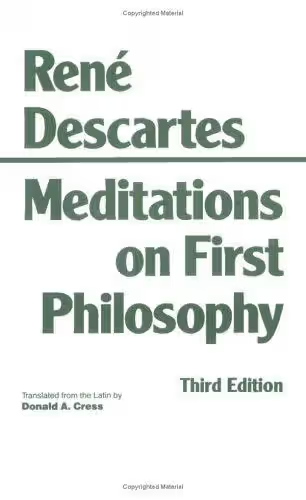
Descartes, R. (1993). Meditations on First Philosophy (3rd ed.; D. A. Cress, Trans.). Hackett Publishing Company.
Chapter Summary
The Meditations is a short work in six numbered meditations. It is presented as a sequence of days' meditations by a single thinker who sets out to discard every opinion that can be doubted and to rebuild knowledge from a secure foundation. Hackett's edition is a revised translation by Donald Cress, running to 72 pages. Descartes supplies a map of the work in his Synopsis, which says that each meditation prepares the next:
- doubt in the first
- the existence of the thinking self in the second
- God in the third
- truth and error in the fourth
- material nature and a second proof of God in the fifth
- material things and the distinction of mind and body in the sixth
The titles below are those of the public-domain Veitch translation. The Hackett volume may word them differently.
Meditation I: Of the Things of Which We May Doubt
The meditator resolves to rid himself of all opinions he has adopted. He does this by examining their foundations rather than each opinion in turn. The senses sometimes deceive, and dreaming shows that waking experience can be matched by illusion. Even arithmetic and geometry can be questioned if an all-powerful God, or a malignant and deceptive demon, has made him so as to go wrong. The meditation ends with the resolution to suppose this demon exists.
Meditation II: Of the Nature of the Human Mind; and That It Is More Easily Known Than the Body
The meditator finds that, however he is deceived, he must exist while he thinks, and that "I am, I exist" is certain whenever he considers it. He asks what he is and answers that he is a thing that thinks: it doubts, understands, affirms, denies, wills, refuses, imagines and senses. Then comes the example of a piece of wax, which stays the same although its colour, smell, shape and hardness all change. It shows that bodies are grasped by the mind and not by the senses or the imagination, and that the mind is better known than body.
Meditation III: Of God: That He Exists
Starting from the clear and distinct perception of himself as a thinking thing, the meditator considers his ideas as images. He distinguishes those that seem innate, those that come from outside and those that he has made. He argues that the cause of an idea must contain at least as much reality as the idea represents. On this principle, the idea of an infinite and perfect being cannot have originated in a finite thinker. A second argument asks what could have produced his own existence and concludes that it must be God. The idea of God is likened to the workman's mark on his work.
Meditation IV: Of Truth and Error
If God exists and is not a deceiver, how does error arise? The meditator locates error in the will, which extends further than the understanding and assents to what is not clearly and distinctly perceived. The remedy is to withhold judgement unless the perception is clear and distinct. The Synopsis adds that the Fourth Meditation treats only speculative truth, not sin, matters of faith or the conduct of life.
Meditation V: Of the Essence of Material Things; and, Again, of God; That He Exists
The meditator examines the ideas of material things, such as extension and the geometer's figures. He finds that they have determinate natures that do not depend on his will. He then offers a second argument for God from the idea of a supremely perfect being, which cannot be thought without existence. From this he concludes that the certainty of all science depends on knowing the true God.
Meditation VI: Of the Existence of Material Things, and of the Real Distinction between the Mind and Body of Man
The final meditation distinguishes understanding from imagination and argues that material things exist. It concludes that mind and body are really distinct substances while forming a close union. It reviews the errors of the senses, including the case of illness, and shows how God's goodness is compatible with them. It ends by explaining how the dream doubt of the First Meditation can now be set aside.
Key Concepts
Meditations I–II: Doubt and the Thinking Self
- Method of doubt: setting aside every belief that admits the slightest doubt, in order to find something certain.
- Malignant demon: the hypothesis of a powerful deceiver, used to extend doubt to mathematics.
- "I am, I exist": the first certainty, which the meditator cannot doubt while he thinks.
- The wax: the example that shows how bodies are known by the understanding.
Meditations III–V: God, Error and Material Nature
- Objective reality of ideas: the degree of reality an idea represents, which must have an adequate cause.
- Clear and distinct perception: the criterion of truth, whose reliability rests on God's not being a deceiver.
- Will and understanding: the two faculties whose mismatch explains error.
- Ontological argument: the argument in Meditation V that existence belongs to the idea of a supremely perfect being.
Meditation VI: Mind, Body and the World
- Imagination and pure understanding: two different powers of the mind.
- Real distinction of mind and body: the claim that they are distinct substances.
- Union of mind and body: the sensations of hunger, pain and thirst that show the mind is more than lodged in the body.
Critical Analysis
Strengths
- A tightly sequenced argument. Each meditation depends on the one before, and Descartes's Synopsis states that dependence. This makes the work unusually easy to follow if it is read in order. The Pomona survey described below follows this order, giving Meditation II its own session and grouping III–V as the case for God's existence and non-deceptiveness.
- Short and self-contained. The volume has 72 pages, so a student can read the whole work in a sitting or two, then return to the harder arguments.
- A readable, careful translation. The publisher quotes Roger Ariew and Marjorie Grene, who describe Cress's revised version as having an unusually high degree of readability while remaining faithful to the original. Cress's translation also appears in the Ariew and Watkins anthology.
- Method as well as content. The first-person form asks the reader to carry out the doubt. In his Preface to the Reader, Descartes advises reading the work only if one is willing to meditate with him.
Limitations
- Objections and Replies are not included. In the Preface to the Reader, Descartes asks readers not to judge the work until they have read the Objections with the Replies. A 72-page volume cannot contain them, so readers should look for them elsewhere or use a commentary. Anthologies are one route. The Pomona course below follows the six meditations with the Hobbes–Descartes exchange and pairs Meditation VI with the Elisabeth–Descartes correspondence, all from the same anthology.
- The most contested steps are the proofs of God. The certainty of clear and distinct perception in Meditations IV and V depends on the arguments for God in III and V. The Synopsis concedes that neither proof is perhaps free from difficulties. Readers need critical secondary sources to assess these steps.
- Little apparatus in this edition. The publisher's description mentions the revised translation but no introduction or commentary. Background on Descartes's aims and the debates the work provoked must come from other books.
Where It Fits in the Course
The Meditations is the rationalist starting point of the modern philosophy course. Hume's Enquiry concerning Human Understanding responds from the empiricist side: its Section XII answers Cartesian doubt and criticises the appeal to God's veracity. Reading the two together brings out the contrast between the two ways of grounding knowledge.
Two recent syllabi illustrate two settings for the book:
- A broad survey. Pomona's Spring 2025 history of modern philosophy is themed on materialism and its critics. Its Descartes sequence assigns Discourse on Method together with Meditation I.
- A concentrated period course. UBC's Summer 2025 seventeenth-century course sets a close reading of Descartes's central writings: Discourse on Method, then the Meditations, then selections from Principles of Philosophy.
Neither syllabus states formal prerequisites. Both courses are detailed under "Common course assignments" below.
For background and commentary, Garrett Thomson's Bacon to Kant and Anthony Gottlieb's The Dream of Enlightenment introduce the period for first-time readers. Jonathan Bennett's Learning from Six Philosophers, Volume 1, devotes its first part to Descartes. It asks of each argument what problem it addresses, how it is meant to work and whether it succeeds, which is useful once the text has been read. Kant's Critique of Pure Reason is an advanced work to come to later.
How to Use This Book
The book is for undergraduates in modern philosophy, epistemology and philosophy of mind courses, and no prior study of philosophy is required.
A practical plan:
- Read the Meditations in order, one a day if possible. In each, mark the belief under examination, the reason for doubt, the provisional conclusion and the new premise carried into the next step.
- Core: Meditations I and II, which contain the method of doubt and the first certainty; Meditation III for the first argument for God; and Meditation VI for mind and body.
- Next: Meditations IV and V, which complete the case for the reliability of clear and distinct perception.
- Afterwards: read Descartes's Synopsis as a summary, if your edition includes it. Then read a selection of the Objections and Replies in a larger collection.
- Write out the main arguments as numbered premises, in particular the argument from the cause of an idea and the argument that mind and body are really distinct.
Common course assignments
- Pomona College, Philosophy 42, History of Modern Philosophy (Spring 2025; syllabus), required anthology.
- Text: the Meditations is read within Ariew and Watkins, eds., Modern Philosophy: An Anthology of Primary Sources (3rd ed., Hackett, 2019), in Cress's translation. No separate copy is required.
- Schedule: Discourse with Meditation I; Meditation II (certainty of existence, the self as mind, the wax); Meditations III–V together; Meditation VI with the Elisabeth correspondence. Two further sessions cover Hobbes's objections and Descartes's replies.
- The sequence also works as a template for self-directed reading.
- UBC, PHIL 314, Philosophy in the 17th Century (Summer 2025; syllabus), required Dover text.
- Text: the required-text list names the Meditations and Discourse on Method in Dover edition, without further bibliographic details.
- Schedule: five sessions, May 21 to June 4, are given to the Meditations. The syllabus does not assign individual meditations to days, so this is a sustained reading block rather than a meditation-by-meditation plan.
- Free access: the syllabus also points to a Wikisource author page.
Edition notes
The edition listed here is the standalone Cress translation, Hackett third edition (1993, 72 pages). Neither course assigns this standalone volume.
- Pomona: its "third edition" is the 2019 anthology's edition number, not this volume's, so the anthology's page ranges will not match the standalone text. Follow meditation numbers rather than pages.
- UBC: the syllabus does not name the translator of the Dover edition. Its Wikisource link offers free access but may differ from the Dover text in translation and pagination.
Edition and Sources
Meditation titles and the account of Descartes's Preface to the Reader and Synopsis in this guide follow the public-domain English translation by John Veitch (Wikisource). For the Hackett volume (Donald Cress's translation, third edition, 72 pages), check whether your copy includes the Preface and Synopsis. The description of Cress's translation follows Hackett's publisher page for ISBN 9780872201927. Course details come from the Pomona and UBC syllabi linked above.