01 / Reading Guide
Reading Guide
Citation
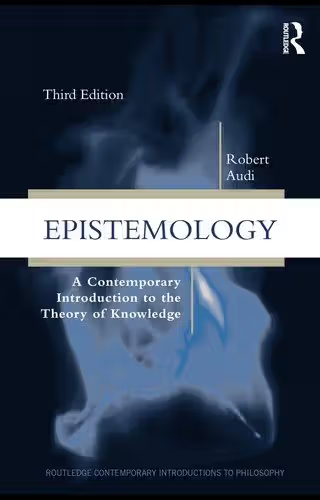
Audi, R. (2011). Epistemology: A Contemporary Introduction to the Theory of Knowledge (3rd ed.). Routledge.
Chapter Summary
The book runs to about 430 pages in the Routledge Contemporary Introductions to Philosophy series. After a preface and an introduction it is organised in three parts and fifteen chapters, followed by an annotated bibliography and an index. The publisher's table of contents is labelled "selected contents", so section-level detail is not available; the summaries below follow the chapter titles and the publisher's description.
Part 1: Sources of Justification, Knowledge, and Truth (Chapters 1–7)
Chapters 1–2: Perception: Sensing, Believing, and Knowing; Theories of Perception: Sense Experience, Appearances, and Reality. The book begins with perception. The first chapter links sensory experience, perceptual belief and perceptual knowledge, and the second moves to rival theories of what perception is and how appearances relate to reality. The publisher highlights perceptual content among the topics given fuller treatment in this edition.
Chapter 3: Memory; Chapter 4: Consciousness: The Life of the Mind. Memory and consciousness are treated as further sources of justification and knowledge, the second under the heading of the life of the mind.
Chapters 5–6: Reason I: Understanding, Insight, and Intellectual Power; Reason II: Apriority, Necessity, and Provability. Reason has two chapters. The first concerns understanding and insight; the second the a priori, necessity and provability. The publisher names self-evidence and the a priori as topics given enhanced treatment in the third edition.
Chapter 7: Testimony. Knowledge acquired from what others say gets its own chapter, completing the list of sources.
Part 2: The Structure and Growth of Justification and Knowledge (Chapters 8–9)
Chapter 8: Inference and the Extension of Knowledge. The question changes from where knowledge comes from to how it grows by inference from what is already known.
Chapter 9: The Architecture of Knowledge. The title points to the overall structure of justified belief and knowledge, the question of how beliefs support one another.
Part 3: The Nature and Scope of Justification and Knowledge (Chapters 10–15)
Chapters 10–11: The Analysis of Knowledge: Justification, Certainty, and Reliability; Knowledge, Justification and Truth: Internalism, Externalism, and Intellectual Virtue. These chapters turn to what knowledge and justification are. The titles name the analysis of knowledge, certainty and reliability, the internalist and externalist approaches, and intellectual virtue. The publisher says the third edition adds material on the "value problem": why knowledge and justified true belief matter more than merely true belief.
Chapter 12: Scientific, Moral, and Religious Knowledge. Knowledge in three domains is considered, which fits the publisher's note that the edition expands the book's connections with philosophy of science and ethics.
Chapters 13–14: Skepticism I: The Quest for Certainty; Skepticism II: The Defense of Common Sense in the Face of Fallibility. Two chapters on skepticism close the argument. The second title indicates a defence of common sense that allows for human fallibility. The publisher adds that the edition includes the skeptical challenge of rational disagreement.
Chapter 15: Conclusion. The final chapter is titled simply "Conclusion"; the contents list gives no further detail.
Key Concepts
Part 1: Sources
- Perceptual knowledge and perceptual content: how experience yields belief and knowledge, and what perceptions represent (named in the titles of Chapters 1–2 and in the publisher's description).
- Memory and consciousness: treated as sources of justification and knowledge alongside perception.
- The a priori, necessity and self-evidence: knowledge grounded in reason rather than experience (Chapters 5–6).
- Testimony: knowledge and justification derived from what other people say (Chapter 7).
Part 2: Structure
- Inference: reasoning as the way knowledge is extended beyond its sources (Chapter 8).
- The architecture of knowledge: the way justified beliefs are organised and depend on one another (Chapter 9).
Part 3: Nature and scope
- Internalism and externalism: contrasting views about what makes a belief justified (Chapter 11).
- Intellectual virtue: a virtue-based approach to knowledge, named in Chapter 11 and highlighted in the publisher's description.
- The value problem: why knowledge and justified true belief matter beyond true belief (new in the third edition).
- Skepticism and fallibility: the quest for certainty and the case for common sense despite fallibility (Chapters 13–14).
Critical Analysis
Strengths
- Breadth with a clear organising idea. The three-part structure moves from where knowledge comes from, to how it is structured and extended, to what it is and how far it reaches. Perception, memory, consciousness, reason and testimony are each treated in their own chapter before any theory of justification is introduced.
- Treatment of scientific, moral and religious knowledge. Chapter 12 applies the general theory to three specific domains, and the publisher describes expanded connections to philosophy of mind, philosophy of science and ethics.
- Current topics added to the traditional ones. The third edition adds intuition, rational disagreement and the value problem, and strengthens contextualism, understanding, virtue epistemology and testimony.
- Reception. Endorsements printed on the publisher's page (Kevin McCain, Peter Graham, Ralph Kennedy and E. J. Coffman, from earlier and current editions) call it comprehensive and accessible. McCain judges it suitable for advanced undergraduate courses and introductory graduate courses. These are marketing quotations, not independent reviews.
Limitations
- Length and density. At roughly 430 pages and fifteen chapters, it is a full-semester text. The publisher presents it as a comprehensive survey rather than a short first encounter.
- A survey rather than an argument for one view. The chapter titles and the publisher's description present a survey of concepts, theories and emerging research, so readers who want a sustained defence of a single position will need the specialised books listed below.
- Two chapters of skepticism come last. Readers who want to meet the skeptical problem early must jump ahead, since the book defers it to Chapters 13–14.
Where It Fits in the Course
Audi is the longest and most systematic of the general introductions in this course. Jennifer Nagel's Knowledge: A Very Short Introduction and Duncan Pritchard's What Is This Thing Called Knowledge? are gentler starting points: a short introduction to the study of knowledge, and a short-chapter textbook with summaries and study questions. Noah Lemos's An Introduction to the Theory of Knowledge is a concise treatment that sets out each theory of knowledge and justification with the strongest objections. Audi covers a wider range of sources of knowledge, at greater length.
After Audi, the two specialised works in the course become approachable. Timothy Williamson's Knowledge and Its Limits argues that knowledge cannot be analysed into belief plus further conditions, a thesis easier to follow after Audi's Chapters 10–11 on analysis and justification. Ernest Sosa's A Virtue Epistemology develops a virtue-theoretic account of knowledge, which Chapter 11's discussion of intellectual virtue prepares for.
How to Use This Book
The book suits second- or third-year undergraduates who have had a first philosophy course and want a full, systematic account of epistemology, as well as beginning graduate students who need a survey. The publisher states that the edition was made clearer for an undergraduate audience, and no logic or specialised background is stated as a prerequisite.
For a one-semester course, read the introduction, then Part 1 in order. Chapters 1 and 2 give the vocabulary of sources and justification that later chapters assume. Part 2 (Chapters 8–9) is short and carries the structure of justification, so it should not be skipped. In Part 3, Chapters 10, 11, 13 and 14 form the core argument about knowledge and skepticism; Chapter 12 can be treated as an application, and read selectively according to interest in science, ethics or religion.
A reader with limited time can take Chapters 1, 8–11 and 13–14 as a compact route through the central problems, then fill in memory, consciousness, reason and testimony. The annotated bibliography at the end is a ready list of further reading. Pair each chapter with a short passage from a primary source, and use Nagel or Pritchard first if the vocabulary of justification is unfamiliar.