01 / Reading Guide
Reading Guide
Citation
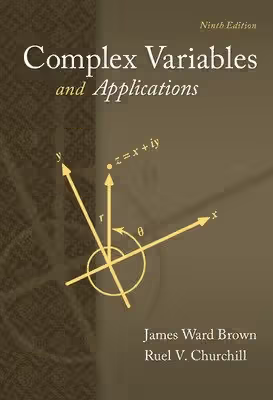
Brown, J. W., & Churchill, R. V. (2014). Complex Variables and Applications (9th ed.). McGraw-Hill Education.
Chapter Summary
The ninth edition has twelve chapters on about 460 pages plus front matter, with a bibliography, a table of transformations of regions and an index. Chapters are divided into short numbered sections of a few pages each, and many are followed by sections simply titled "Examples". The publisher's description says the edition keeps the content and style of earlier editions while adding extended explanations of theorems, more detailed arguments and the separation of topics into their own sections.
Chapter 1: Complex Numbers
Sums and products, algebraic properties, vectors and moduli, the triangle inequality, conjugates, the exponential form, arguments of products and quotients, roots of complex numbers, and regions in the complex plane.
Chapter 2: Analytic Functions
Functions and mappings (with w = z² as the first example), limits including limits involving the point at infinity, continuity and derivatives. The chapter derives the Cauchy–Riemann equations and sufficient conditions for differentiability, including in polar coordinates. It then defines analytic functions and harmonic functions and closes with uniquely determined analytic functions and the reflection principle.
Chapter 3: Elementary Functions
The exponential and logarithmic functions, branches and derivatives of logarithms, the power function, trigonometric and hyperbolic functions with their zeros and singularities, and inverse trigonometric and hyperbolic functions.
Chapter 4: Integrals
Integrals of complex-valued functions of a real variable lead to contours and contour integrals, including examples with branch cuts and upper bounds for their moduli. The chapter treats antiderivatives and the Cauchy–Goursat theorem, with proofs, for simply and multiply connected domains. It continues to the Cauchy integral formula and its extension, Liouville's theorem and the Fundamental Theorem of Algebra, and the maximum modulus principle.
Chapter 5: Series
Convergence of sequences and series, Taylor series and Laurent series (both with proofs), absolute and uniform convergence of power series, continuity, integration and differentiation of power series, uniqueness of series representations, and multiplication and division of power series.
Chapter 6: Residues and Poles
Isolated singular points and residues, Cauchy's residue theorem, the residue at infinity, the three types of isolated singular points, residues at poles, zeros of analytic functions, and the behaviour of functions near isolated singular points.
Chapter 7: Applications of Residues
Evaluation of improper integrals, including integrals from Fourier analysis, using Jordan's lemma, indented paths, indentation around a branch point and integration along a branch cut. The chapter also treats definite integrals involving sines and cosines, the argument principle, Rouché's theorem and inverse Laplace transforms.
Chapter 8: Mapping by Elementary Functions
Linear transformations, the transformation w = 1/z, and linear fractional transformations, including mappings of the upper half plane. Mappings by the exponential function, sin z, z² and branches of z^(1/2), square roots of polynomials, and an introduction to Riemann surfaces follow.
Chapter 9: Conformal Mapping
Preservation of angles and scale factors, local inverses, harmonic conjugates, and how harmonic functions and boundary conditions transform under conformal maps.
Chapter 10: Applications of Conformal Mapping
Steady temperatures (in a half plane and in a quadrant), electrostatic potential, and two-dimensional fluid flow with the stream function, including flows around a corner and around a cylinder.
Chapter 11: The Schwarz–Christoffel Transformation
Mapping the real axis onto a polygon, triangles and rectangles, degenerate polygons, and physical examples: fluid flow in a channel through a slit and with an offset, and the electrostatic potential about the edge of a conducting plate.
Chapter 12: Integral Formulas of the Poisson Type
The Poisson integral formula and the Dirichlet problem for a disk, related boundary value problems, the Schwarz integral formula, the Dirichlet problem for a half plane, and Neumann problems.
Key Concepts
Chapters 1–3: Complex numbers and functions
- Exponential form and roots: writing complex numbers with modulus and argument to compute products, powers and roots.
- Cauchy–Riemann equations: the conditions on real and imaginary parts that characterise complex differentiability.
- Harmonic function: a solution of Laplace's equation, closely tied to analytic functions.
- Branches of the logarithm: choices of a single-valued logarithm and their derivatives.
Chapters 4–5: Integration and series
- Contour integral: integration of a complex function along a path in the plane.
- Cauchy–Goursat theorem and Cauchy integral formula: the central results of complex integration.
- Liouville's theorem and the maximum modulus principle: consequences of the integral formula.
- Laurent series: expansions with negative powers, valid near isolated singular points.
Chapters 6–7: Residues
- Residue theorem: computing contour integrals from residues at isolated singularities.
- Jordan's lemma and indented contours: techniques for evaluating improper real integrals.
- Argument principle and Rouché's theorem: counting zeros and poles inside a contour.
Chapters 8–12: Mappings and boundary value problems
- Linear fractional transformation: maps of the form (az + b)/(cz + d), which carry circles and lines to circles and lines.
- Conformal mapping: angle-preserving maps that transform harmonic functions and boundary conditions.
- Schwarz–Christoffel transformation: maps of the upper half plane onto polygonal regions.
- Poisson integral formula: the solution of the Dirichlet problem for a disk.
Critical Analysis
Strengths
- Theory chosen for applications. The publisher states that the book is designed to develop the theory that is prominent in applications, with special emphasis on residues and conformal mapping. The contents bear this out. Two chapters are devoted to residues and four to mappings and their use, ending with steady temperatures, electrostatics, fluid flow and Dirichlet and Neumann problems.
- Full proofs of the central theorems. Taylor's and Laurent's theorems and the Cauchy–Goursat theorem each have their own proof sections. Readers can see the arguments while instructors can choose to skip them.
- Small, separable sections. Most sections run two to five pages. The publisher describes the ninth edition's separation of topics into their own sections as an improvement, which makes it easy to assign precise reading.
- Reference tools. A table of transformations of regions is collected in an appendix for use with Chapters 8–11. Footnotes point to other texts for the more delicate results of advanced calculus, so students with different calculus backgrounds can follow the arguments.
Limitations
- Advanced calculus results are cited, not proved. The footnote references for delicate advanced-calculus results show that some foundations are taken from other books. Students who want a self-contained rigorous development will need a more theoretical text.
- Classical in content. The topics stop at Poisson-type formulas, Riemann surfaces and the Schwarz–Christoffel transformation. Topics such as the Riemann mapping theorem or entire-function theory do not appear among the section titles.
- Not a visual or computational text. The contents emphasise analytic technique. Students who learn best from geometric pictures or computer experiments may want a companion.
Where It Fits in the Course
Brown and Churchill is the standard methods-and-applications first course in this course list. Matthias Beck and colleagues' A First Course in Complex Analysis is a free, shorter alternative for a first course, and the two can be read side by side. Brown and Churchill goes much further into residue applications, conformal mapping and physical boundary value problems. Tristan Needham's Visual Complex Analysis develops the same subject through geometric pictures and works well alongside Chapters 1–3 and 8–9 here. Ian Stewart and David Tall's Complex Analysis is an intermediate text that gives more attention to rigour and topology.
For a more theoretical second course, Lars Ahlfors's Complex Analysis and Stein and Shakarchi's Complex Analysis develop the subject as pure mathematics. They prove what Brown and Churchill cites and continue to topics such as conformal mapping theory at a deeper level. Students heading toward physics or engineering will find Brown and Churchill's Chapters 7 and 10–12 the most directly useful. Students heading toward pure mathematics should use it as a computational foundation before Ahlfors or Stein–Shakarchi.
How to Use This Book
The book is written as a textbook for an introductory course on the theory and applications of functions of a complex variable, typically taken by mathematics, physics and engineering students after calculus. Multivariable calculus is the working prerequisite. An introduction to proofs helps with the proof sections but is not essential.
- Core one-semester path: Chapters 1–7, from complex numbers to residues and their applications. The proof sections in Chapters 4 and 5 can be read lightly on a first pass.
- Applications track: after Chapter 7, take Chapters 8–10 for mappings and their physical uses. Add Chapter 11 or 12 for courses in engineering or mathematical physics. Keep the appendix table of transformations at hand.
- Practice: the many "Examples" sections are the model for the exercises. Work several improper integrals by residues in Chapter 7 until choosing the contour becomes routine.
- Self-study: read each short section and work its exercises before moving on. Use Needham's book for geometric intuition, and Beck and colleagues' free text for a second explanation of the core theory.