01 / Reading Guide
Reading Guide
Citation
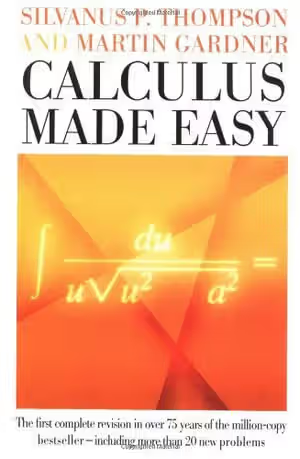
Thompson, S. P., & Gardner, M. (1998). Calculus Made Easy (revised and expanded ed.). St. Martin's Press. Free public-domain edition of Thompson's original text (2nd ed., 1914): https://www.gutenberg.org/ebooks/33283
Chapter Summary
Silvanus P. Thompson, a physicist and author of technical books on electricity, published Calculus Made Easy anonymously in 1910 ("by F.R.S.") and enlarged it in a second edition in 1914, adding, in his words, "a considerable number of worked examples and exercises". The book's subtitle announces its programme: a "very-simplest introduction" to the methods "generally called by the terrifying names" of the differential and integral calculus. A prologue and twenty-one chapters are followed by an "Epilogue and Apologue", a table of standard forms and answers to nineteen sets of exercises. The 1998 edition by Martin Gardner keeps Thompson's text but, according to the publisher, adds a new introduction, three new chapters, modernised language and methods throughout, and an appendix of practice problems; Gardner's chapters come first, so chapter numbers in the 1998 edition are shifted relative to the original. The summaries below follow Thompson's chapters, which form the body of both editions.
Prologue and Chapter I: To Deliver You from the Preliminary Terrors
The prologue sets the tone ("What one fool can do, another can") and accuses textbook writers of hiding how easy the easy parts are. Chapter I then removes the "preliminary terror" in two paragraphs: d simply means "a little bit of", and the integral sign is a long S meaning "the sum of all the little bits".
Chapter II: On Different Degrees of Smallness
Using minutes and seconds and sums of money in pounds, shillings and pence, Thompson shows that small quantities can be small of the first order or of the second, and that a small quantity multiplied by another small quantity can be neglected. This idea replaces formal limits throughout the book.
Chapter III: On Relative Growings
Constants and variables are introduced, and the derivative is presented as the ratio of the small growth of one variable to the corresponding growth of another, dy/dx, illustrated by examples such as a rectangle whose length and breadth change together.
Chapters IV–VI: Simplest Cases; Next Stage. What to Do with Constants; Sums, Differences, Products and Quotients
Working from first principles (let x grow to x + dx, expand, discard second-order smalls), Thompson derives the derivative of x², then of xⁿ, shows that added constants vanish and multiplied constants remain, and builds the rules for sums, differences, products and quotients. Each chapter has its own exercises.
Chapter VII: Successive Differentiation
Differentiating repeatedly, with the notation f(x), f′(x), f″(x), and a few exercises.
Chapter VIII: When Time Varies
Time as the independent variable: velocity and acceleration as first and second derivatives, illustrated with trains, motor-cars, a falling stone and other moving objects.
Chapter IX: Introducing a Useful Dodge
The substitution now called the chain rule: replace a complicated inner expression by a single letter, differentiate in two steps and multiply.
Chapter X: Geometrical Meaning of Differentiation
The derivative as the slope of a curve, with many plotted examples showing where curves rise, fall and turn.
Chapter XI: Maxima and Minima
Setting the derivative to zero to find greatest and least values, with Thompson's characteristic engineering problems (most economical dimensions, most efficient arrangements) and a long set of exercises.
Chapter XII: Curvature of Curves
The second derivative as the rate at which the slope changes, used to distinguish maxima from minima.
Chapter XIII: Other Useful Dodges
Partial fractions, which simplify the differentiation of complicated fractions, and the derivative of an inverse function.
Chapter XIV: On True Compound Interest and the Law of Organic Growth
The longest chapter. Starting from simple and compound interest, Thompson reaches the number ε (e) as the limit of ever more frequent compounding, develops the exponential series, natural logarithms and the "logarithmic rate of growing", and then the "die-away" curve, Newton's law of cooling and the time-constant.
Chapter XV: How to Deal with Sines and Cosines
The derivatives of sine, cosine and related functions, derived geometrically from a small change in angle, with applications to oscillating quantities.
Chapter XVI: Partial Differentiation
Functions of two or more variables, differentiating with respect to one while holding the others constant, and maxima and minima of functions of two independent variables.
Chapter XVII: Integration
The integral sign explained as summation of indefinitely many small bits, with simple geometrical sums, and a short discussion of convergent series.
Chapter XVIII: Integrating as the Reverse of Differentiating
Integration as undoing differentiation, the constant of integration, a list of simple integrals, the special case of 1/x leading to the logarithm, and double and triple integrals.
Chapter XIX: On Finding Areas by Integrating
Areas under curves by summing thin strips, definite integrals between limits, areas in polar coordinates and volumes of solids such as the sphere, with applications such as work done in compressing a gas.
Chapter XX: Dodges, Pitfalls, and Triumphs
Integration by parts and substitution ("dodges"), warnings about zero, infinity and indeterminate quantities ("pitfalls"), and the use of differential equations to solve physical problems ("triumphs").
Chapter XXI: Finding Some Solutions
A brief introduction to differential equations through eight worked examples, from equations whose rate of change is proportional to the quantity, through equations with a sinusoidal forcing term, to second-order equations whose solutions are oscillations or exponentials, and a partial differential equation for waves. Thompson stresses that integration "is an art" learned by practice.
Epilogue and Apologue
Thompson anticipates the professional mathematicians' objections: that the book makes calculus look easy, gives away trade secrets, does not prove its methods rigorously and leaves out the difficult parts, and admits cheerfully that the last charge is true, since the book was written for beginners deterred by conventional teaching.
Key Concepts
Chapters I–III: The language
- d as "a little bit of": the differential dx as a small increment of x.
- Orders of smallness: products of small quantities are negligible compared with the quantities themselves.
- Differential coefficient: dy/dx, the ratio of corresponding small growths.
Chapters IV–XIII: Differentiation
- First principles: deriving rules by letting a variable grow by a small amount and discarding second-order terms.
- Rules for sums, products and quotients: built up from the simplest cases.
- The "useful dodge": substitution to differentiate composite expressions, the chain rule.
- Maxima and minima: where the first derivative is zero, with the second derivative showing which.
- Partial fractions: splitting a fraction to make it easier to handle.
Chapters XIV–XVI: Growth, oscillation and several variables
- The number ε: arising from compound interest taken to the limit; its exponential function is its own derivative.
- Law of organic growth: growth whose rate is proportional to the current size, and its reverse, the die-away curve.
- Derivatives of sine and cosine: the basis for treating oscillations.
- Partial differentiation: rates of change with respect to one variable at a time.
Chapters XVII–XXI: Integration and differential equations
- Integral as a sum: adding indefinitely many small elements.
- Constant of integration: the undetermined constant introduced when reversing differentiation.
- Definite integral and area: the integral between limits as the area under a curve.
- Integration by parts: one of the "dodges" for bringing an expression into integrable form.
- Differential equation: an equation involving derivatives, whose solution describes a physical process.
Critical Analysis
Strengths
- Removes fear first. The prologue and Chapter I do exactly what they promise: the symbols are demystified before any rule is introduced, and the conversational tone, addressed to "fellow fools", persists to the end.
- Everything derived, nothing memorised. Each rule is built from the "little bit" argument in front of the reader, so a student can reconstruct a rule rather than recall it. Chapter IV's derivation for x² and its generalisation are a model of this approach.
- Practical, engineering-flavoured examples. Maximum and minimum problems, interest and cooling, electric lamps and gas compression connect calculus to measurement and design, reflecting Thompson's background.
- Exercises with answers. Nineteen sets of exercises, each with answers at the back, and many fully worked examples make the book usable without a teacher.
- Unusually wide reach for its size. In about 250 pages it reaches exponentials, partial derivatives, polar areas, volumes and second-order differential equations.
Limitations
- No limits and no rigour, by design. The "orders of smallness" argument stands in for the limit concept throughout, and the Epilogue openly declines to prove the methods. Students who go on to analysis will have to relearn the foundations; Gardner's added chapters, by the publisher's account, partly address this in the 1998 edition.
- Dated notation and language in the original. Thompson writes ε for e, "differential coefficient" for derivative, uses pounds and shillings, and addresses "fifth-form boys"; the 1998 edition modernises language and methods.
- Uneven coverage. Integration techniques are compressed into a few "dodges", and topics such as the formal definition of the integral, sequences, Taylor series and vector calculus are absent or only touched on.
- Not a course textbook. The book has no systematic sections, objectives or graded problem sets of the kind a semester course expects; it is a primer or companion.
Where It Fits in the Course
In this course it is the gentlest entry point: a short, self-contained primer for students who are anxious about calculus or who want an intuitive preview before a formal course. Calculus Volume 1 (OpenStax) is a free, full first-semester text that develops functions, limits, derivatives and integrals with many worked examples and exercises, and Thomas' Calculus is a comprehensive sequence text extending to multivariable calculus. Either can be the main textbook, with Thompson read alongside, chapter by chapter, for intuition: Chapters II–VI before the derivative rules, Chapter IX before the chain rule, Chapter XIV before exponentials and logarithms, Chapters XVII–XIX before integration.
Binmore and Davies's Calculus: Concepts and Methods and Wrede's Advanced Calculus belong much later, when students need the rigour and the multivariable and vector theory that Thompson deliberately leaves out.
How to Use This Book
The only prerequisite is comfort with school algebra: expanding brackets, manipulating powers and fractions, and basic geometry and trigonometry for the later chapters.
- Core sequence: Prologue and Chapters I–XI cover the ideas of a first course in differentiation; read them in order and do every exercise set before moving on.
- Second stage: Chapters XIV (exponential growth and decay) and XV (sines and cosines) complete the standard functions; Chapters XVII–XIX cover the essentials of integration.
- Optional on first reading: Chapters XII–XIII, XVI and XX–XXI are extensions (curvature, partial fractions, partial derivatives, integration dodges, differential equations) that are best read once a formal course reaches those topics.
- Check every answer against the answers at the back, and redo the first-principles derivations without the book.
- Pair it with a modern textbook for the definition of a limit and for practice with the notation used in exams.
Readers of the 1998 edition should note that its chapter numbers differ from Thompson's because Gardner's new chapters come first; the chapter titles above remain a reliable guide.
Edition and Sources
This guide is based on reading the public-domain text of Thompson's second edition (Macmillan, 1914), as transcribed by Project Gutenberg (eBook #33283, PDF version): the second-edition preface, contents, prologue, every chapter's opening and main worked examples, the exercise sets and answers, the table of standard forms and the Epilogue and Apologue. The 1998 St. Martin's edition revised by Martin Gardner, which the site lists, was not available; its additions (new introduction, three new chapters, modernised language and methods, appendix of practice problems) are described from the publisher's description on Google Books.