01 / Reading Guide
Reading Guide
Citation
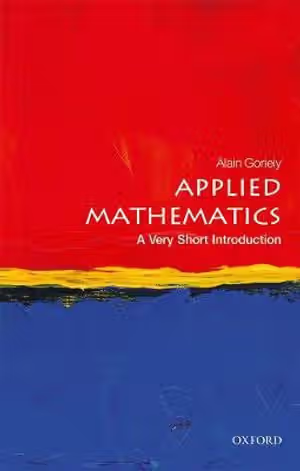
Goriely, A. (2018). Applied Mathematics: A Very Short Introduction. Oxford University Press. Very Short Introductions.
Chapter Summary
The book has about 140 pages: eight chapters, a short epilogue, a list of further reading and an index. Each chapter title pairs a playful question with a subtitle naming its examples. The publisher describes the aim as a compact but comprehensive view of applied mathematics and its relations with pure mathematics, science and engineering: its early achievements in physics and engineering, its emergence as a separate field after the Second World War, and its role in the sciences today. At the time of publication the author held the Chair of Mathematical Modelling at Oxford and directed the Oxford Centre for Industrial and Applied Mathematics.
Chapter 1: What's so funny 'bout applied mathematics? Modelling, theory, and methods
The opening chapter sets out what applied mathematics is: the building of mathematical models, the theory that supports them and the methods used to analyse them. It frames the relationship between applied mathematics and the pure mathematics, science and engineering around it.
Chapter 2: Do you want to know a secret? Turkeys, giants, and atomic bombs
A chapter built on three examples of very different scale, from cooking a turkey to the size of giants and the energy of an atomic bomb. Their common thread is reasoning from physical quantities and their dimensions, which can give answers before any equation is solved.
Chapter 3: Do you believe in models? Simplicity and complexity
The chapter discusses what a model is and how much detail it should carry, weighing simple models against complex ones.
Chapter 4: Do you know the way to solve equations? Spinning tops and chaotic rabbits
Once a model is written down, its equations must be solved. The chapter takes the motion of spinning tops and a chaotic model of a rabbit population as its cases.
Chapter 5: What's the frequency, Kenneth? Waves, quakes, and solitons
Waves are the subject: vibration and frequency, waves in the Earth after earthquakes, and solitons, solitary waves that keep their shape.
Chapter 6: Can you picture that? X-rays, DNA, and photos
The chapter turns to images: how mathematics lets X-ray measurements be turned into pictures, how it enters the study of DNA, and how photographs are represented and processed.
Chapter 7: Mathematics, what is it good for? Quaternions, knots, and more DNA
Here the direction is reversed: mathematics developed for its own sake, such as quaternions and knot theory, that later found uses, including in the study of DNA.
Chapter 8: Where are we going? Networks and the brain
The last chapter looks forward to newer areas: networks and the modelling of the brain, a field in which the author works. A brief epilogue follows.
Key Concepts
Chapters 1–3: What applied mathematics does
- Mathematical modelling: turning a question about the world into a mathematical problem, analysing it and interpreting the answer.
- Theory and methods: the two other parts of the subject, alongside models, that the first chapter names.
- Dimensional reasoning: using the units and scales of physical quantities to estimate answers, the theme of the turkey, giant and atomic-bomb examples.
- Simplicity versus complexity: the trade-off between models simple enough to analyse and models detailed enough to be realistic.
Chapters 4–5: Equations and waves
- Solving equations: finding exact, approximate or numerical solutions of the equations a model produces.
- Chaos: behaviour of a deterministic system, such as a population model, that is so sensitive to its starting point that long-term prediction fails.
- Solitons: solitary waves that travel without changing shape.
Chapters 6–8: Images, unexpected uses, new frontiers
- Mathematical imaging: reconstructing and representing images, from X-ray scans to digital photographs.
- Quaternions and knots: structures from pure mathematics that later found applications.
- Networks: collections of connected nodes, used here as a way into modelling the brain.
Critical Analysis
Strengths
- Shows the whole field in very little space. In about 140 pages the book moves from what modelling is, through dimensional reasoning, equations and waves, to imaging, pure mathematics put to use and the study of networks and the brain.
- Built around concrete examples. Every chapter subtitle names its cases (turkeys and atomic bombs, spinning tops and rabbits, X-rays and photographs), so each idea is introduced through a problem, not a definition.
- Takes the link with pure mathematics seriously. Chapter 7 is devoted to pure mathematics that became useful, and the publisher stresses the book's attention to the relationship between pure and applied mathematics.
- Written by a working applied mathematician. The author's research in mechanics, biological growth and the brain is close to the final chapter's subject, which looks at where the field is going.
Limitations
- A survey, not a course. At this length each topic can only be sketched; the book has no exercises and does not teach techniques a student could use in a problem sheet.
- A selection of examples. The chapters favour mechanics, waves, imaging and biology. Other parts of applied mathematics, among them optimization, statistics and operational research, the subject of most of the other books in this course, do not appear in the table of contents.
Where It Fits in the Course
This is the course's general introduction: a short, readable account of what applied mathematicians do, to read before or alongside the textbooks. Its subject is the field as a whole, not one technique.
The other books in the course are textbooks with exercises. Guenin, Könemann and Tunçel's A Gentle Introduction to Optimization is the natural first textbook on the optimization side, needing only linear algebra; Chong, Lu and Żak's An Introduction to Optimization and Boyd and Vandenberghe's Convex Optimization go much further into optimization theory and algorithms. Ian Jacques's Mathematics for Economics and Business and Adam Ostaszewski's Advanced Mathematical Methods present mathematical methods with economic and other applications. Goriely gives the motivation and the wider picture; none of these replaces him, and he replaces none of them.
How to Use This Book
The book suits anyone starting a mathematics, physics or engineering degree, students choosing between pure and applied options, and general readers curious about modelling. The series is written for general readers, and school mathematics is the only background assumed.
Read it straight through, in a few sittings. Chapters 1–3 are the core, since they explain what modelling is and how applied mathematicians reason about scale and simplicity; Chapters 4–8 each centre on their own examples and can be read selectively according to interest: Chapters 4 and 5 for dynamics and waves, Chapter 6 for imaging, Chapter 7 for the link with pure mathematics, Chapter 8 for current research directions.
To get more from it, try the scaling arguments of Chapter 2 on examples of your own, and follow the further reading list into one topic that catches your interest. Students who then take courses in differential equations, mathematical methods or optimization can come back to the relevant chapter as a reminder of why the techniques matter.