01 / Reading Guide
Reading Guide
Citation
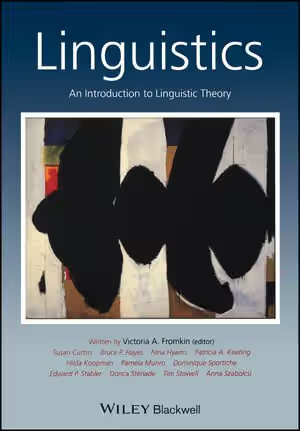
Fromkin, V. A. (Ed.). (2001). Linguistics: An Introduction to Linguistic Theory. Wiley-Blackwell.
Chapter Summary
The book is a textbook of about 770 pages written by twelve linguists for undergraduate linguistics majors and first-year graduate students. Rather than describing language in general terms, it sets out the formal analysis of each core area and shows how hypotheses are stated, tested against data and revised. It has fifteen chapters in four parts, with a glossary of key terms and a bibliography. Each area is treated in the same way: the principles common to all languages, how they show up in the grammars of particular languages, and how they are revealed in children's acquisition of the language. The acquisition of each area gets its own chapter.
Part I, Introduction: Chapter 1, Linguistics: The Scientific Study of Human Language
The first chapter presents linguistics as a science and locates the book within it. Its sections run from Panini to Chomsky and after, through the aims of linguistic theory and what constitutes knowledge of language (the lexicon, morphology, syntax, semantics, phonetics and phonology), to the different senses of "grammar" (mental grammar, universal grammar, descriptive, teaching and prescriptive grammars), the logical problem of child language acquisition, the distinction between competence and performance, and "doing" linguistics. A sidebar surveys other branches of the field, such as historical linguistics, sociolinguistics and psycholinguistics, and marks theoretical (generative) linguistics as the subject of this text.
Part II, Morphology and Syntax: Chapters 2–6
Chapter 2, "Morphology: The Structure of Words," is a long chapter (about 65 pages) on word structure. Chapter 3, "Syntax I: Argument Structure and Phrase Structure," at over 100 pages is the longest chapter in the book. Chapter 4, "Syntax II: Syntactic Dependencies," continues the study of sentence structure, and Chapter 5, "Syntax III: The Distribution of Verbal Forms: A Case Study," presents a case study of the distribution of verbal forms. Chapter 6, "Acquisition of Word and Sentence Structure," asks how children acquire these systems.
Part III, Semantics: Chapters 7–10
Chapter 7, "Semantics I: Compositionality," introduces the principle that the meaning of a complex expression is built from the meanings of its parts. Chapter 8, "Semantics II: Scope," and Chapter 9, "Semantics III: Cross-Categorial Parallelisms," take up two further topics in the study of meaning. Chapter 10, "Acquisition of Meaning," closes the part by turning to children.
Part IV, Phonetics and Phonology: Chapters 11–15
Chapter 11, "Phonetics: The Sounds of Language," is the book's treatment of speech sounds. Chapter 12, "Phonology I: Basic Principles and Methods," Chapter 13, "Phonology II: Phonological Representations," and Chapter 14, "Phonology III: Explanation and Constraints in Phonology," move from basic principles and methods of analysis to phonological representations and to explanation and constraints; the publisher notes that the book covers recent developments in theory such as Optimality Theory. Chapter 15, "Acquisition of Phonetics and Phonology," ends the book with children's acquisition of sounds.
Key Concepts
Chapter 1: Introduction
- Competence and performance: what a speaker knows of the language versus how that knowledge is used.
- Kinds of grammar: mental, universal, descriptive, teaching and prescriptive grammars.
- The logical problem of acquisition: how children come to know a language.
Chapters 2–10: Morphology, syntax and semantics
- Argument structure and phrase structure: the core topics of the first syntax chapter.
- Syntactic dependencies: the subject of the second syntax chapter.
- Compositionality and scope: how the meaning of complex expressions is determined.
- Acquisition of structure and meaning: each area's chapter on child language.
Chapters 11–15: Phonetics and phonology
- Phonological representations: the structure assigned to sound patterns in the grammar.
- Constraints in phonology: the explanation of sound patterns through constraints, the subject of Chapter 14; the publisher lists Optimality Theory among the recent developments covered.
- Acquisition of phonetics and phonology: how children acquire a sound system.
Critical Analysis
Strengths
- Hypothesis-driven teaching. The publisher describes the book as showing how hypotheses are stated, tested against data and revised, and as including exercises and data-analysis problems within and at the end of each chapter so that students learn what it means to actually do linguistics.
- Depth of specialist authorship. The chapters are written by twelve linguists, each an expert in the field they cover, which the publisher stresses as a feature.
- A parallel treatment of the grammar and its acquisition. Each of the three main areas of grammar (morphology and syntax, semantics, sounds) ends with a chapter on acquisition, so theory is repeatedly tied to the question of how children learn the system.
- Study aids. The publisher lists an extensive glossary of key terms, chapter summaries and further reading lists, and the glossary alone runs to nearly forty pages.
Limitations
- A theory-focused scope. Chapter 1 states that this text concerns theoretical (generative) linguistics, and the contents have no chapters on sociolinguistics, historical change or language use; it is not a general survey of the whole field.
- Demanding for beginners. The book presents itself as an introduction for linguistics majors and first-year graduate students, and its chapters on syntax and phonology are long and technical. It is not a first course.
- Date. It was published in 2001, so later developments in the theories it presents are not included.
- Heavy length. At about 770 pages, it is more than a single course can cover without selection.
Where It Fits in the Course
Fromkin and colleagues' Linguistics: An Introduction to Linguistic Theory is the theory-oriented introduction in the course. Fromkin and colleagues' An Introduction to Language, Yule's The Study of Language, O'Grady and colleagues' Contemporary Linguistics and the Language Files materials are broader introductions for students new to the subject, covering the main areas with accessible explanations and applications. Radford and colleagues' Linguistics: An Introduction also concentrates on linguistic theory and analysis, with detailed theoretical discussion and extensive exercises, and is the closest comparison.
A student would normally begin with one of the broad introductions and take this book next, when the aim is to learn to analyse data formally in morphology, syntax, semantics and phonology. Jackendoff's Foundations of Language is a more specialized work that builds on this kind of grounding and argues for an alternative architecture of the language faculty.
How to Use This Book
The book is for linguistics majors and first-year graduate students who already know basic terms such as phoneme, morpheme and constituent and want to practise formal analysis.
A practical plan: read Chapter 1 first, then take Parts II–IV in the order the course requires; within a part the chapters are numbered in sequence (Syntax I, II and III; Phonology I, II and III), so they are best read in order. Work the exercises and data-analysis problems rather than only reading the text, since that is the book's method. Use the chapter summaries to review and the glossary for terms, and read the acquisition chapter at the end of each part as the link between the theory and child language.