01 / Reading Guide
Reading Guide
Citation
Fromkin, V., Rodman, R., & Hyams, N. (2018). An Introduction to Language (11th ed.). Cengage Learning.
Chapter Summary
The eleventh edition has ten chapters and runs to about 620 pages with glossary and index. The book first appeared in the 1970s; Victoria Fromkin taught linguistics at UCLA from 1966 until her death in 2000, Robert Rodman was a professor of linguistics and computer science at North Carolina State University, and Nina Hyams is a professor of linguistics at UCLA whose research is on children's language development and syntax. The publisher addresses the book to students of education, languages, cognitive science, psychology, anthropology, English and the teaching of English as a second language, says it assumes no prior knowledge of linguistics, and describes its style as light and friendly, with a blend of humour and broad coverage. An unusual feature of the order is that grammar comes before sound: morphology, syntax and meaning (Chapters 2–4) precede phonetics and phonology (Chapters 5–6).
Chapter 1: What Is Language?
The opening chapter sets out what speakers know when they know a language, what linguists mean by grammar and by Universal Grammar, how human language differs from other communication systems, and the relation between language and thought.
Chapter 2: Morphology: The Words of Language
Words are analysed into content and function words and into morphemes, the minimal units of meaning, before the chapter turns to rules of word formation, morphology in sign languages, and practical analysis of morphemes in data.
Chapter 3: Syntax: The Sentence Patterns of Language
The syntax chapter explains what syntactic rules do, sentence structure and phrase structure trees, the internal structure of phrases, grammatical dependencies, Universal Grammar's principles and parameters, and sign language syntax.
Chapter 4: The Meaning of Language
Meaning is approached through what speakers know about sentence meaning, compositional semantics and the cases where compositionality goes awry, lexical semantics, and pragmatics.
Chapter 5: Phonetics: The Sounds of Language
This chapter introduces sound segments, articulatory phonetics, the major phonetic classes and syllabic sounds.
Chapter 6: Phonology: The Sound of Language
Phonology covers the pronunciation of morphemes, phonemes and distinctive features, phonological rules, prosodic phonology and sequential constraints, why phonological rules exist, and how to carry out phonological analysis.
Chapter 7: Language in Society
The first of the chapters on language in use deals with regional and social dialects, languages in contact, language and education, and language in use.
Chapter 8: Language Change: The Syllables of Time
The longest list of topics in the book covers regular sound change; phonological, morphological, syntactic and lexical change; reconstruction of "dead" languages; extinct and endangered languages; genetic classification and language types; the causes of change; and the history of writing.
Chapter 9: Language Acquisition
The acquisition chapter treats the linguistic capacity of children, the role of adult input, and knowing more than one language.
Chapter 10: Language Processing and the Human Brain
The final chapter covers the mind at work in producing and understanding language, brain and language, language and brain development, and dissociations between language and other cognitive abilities as evidence for a modular mind.
Key Concepts
Chapters 1–4: Language and grammar
- Linguistic knowledge: the unconscious knowledge of sounds, words and sentences that speakers have.
- Universal Grammar: the principles common to all human languages, with parameters of variation.
- Morpheme: the smallest unit of meaning in a word.
- Phrase structure tree: a diagram of the hierarchical structure of a sentence.
- Compositional semantics and pragmatics: how sentence meaning is built from parts, and how context shapes interpretation.
Chapters 5–6: Sounds
- Articulatory phonetics: describing speech sounds by how they are produced.
- Phoneme and distinctive feature: the contrastive sound units of a language and the properties that distinguish them.
- Phonological rule: a regular pattern of how sounds are pronounced in context.
Chapters 7–10: Language in society, time and the mind
- Dialect: a regional or social variety of a language.
- Regular sound change and reconstruction: the basis for comparing languages and recovering their ancestors.
- Language acquisition: how children acquire language from input and innate capacity.
- Modularity: the idea that language is a distinct component of the mind, supported by dissociations from other cognitive abilities.
Critical Analysis
Strengths
- Wide audience, no prerequisites. The publisher explicitly addresses students from education, psychology, anthropology, English and TESL, and assumes no prior linguistics, which makes the book usable in mixed classes. It is the required textbook both in a psychology course and in a writing course with no prerequisites (see the TAMIU and Western courses below).
- A readable style. The publisher emphasises the book's light, friendly style and its humour, features the book has kept across many editions.
- Sign language integrated. Sign language morphology and syntax are treated within the core grammar chapters (Chapters 2 and 3), which supports the claim that the analysis applies to human language in general.
- Hands-on analysis. Sections on identifying morphemes and on phonological analysis teach students to work with data, not only to learn terms.
- Acquisition and the brain. The publisher highlights childhood language development, adult second language acquisition and recent advances in neurolinguistics, and the last two chapters are given to acquisition and to processing and the brain; Hyams's own research is on children's language development.
- Chapters that stand alone. Both courses below assign chapters out of order or in part, which suggests the chapters can be taught selectively.
Limitations
- Edition date. The eleventh edition dates from 2018, so more recent research in areas such as acquisition and neurolinguistics is not covered.
- Grammar before sounds. The order (syntax and semantics before phonetics) does not match courses that start with sounds; instructors and readers may need to reorder chapters. The Western writing course below does exactly this, reading Chapters 5 and 6 straight after Chapter 1 and before Chapter 2.
- Gaps in the contents. Writing appears only as a section on its history in Chapter 8, and there is no chapter on computational approaches to language; second language learning is covered within the acquisition chapter rather than separately.
Where It Fits in the Course
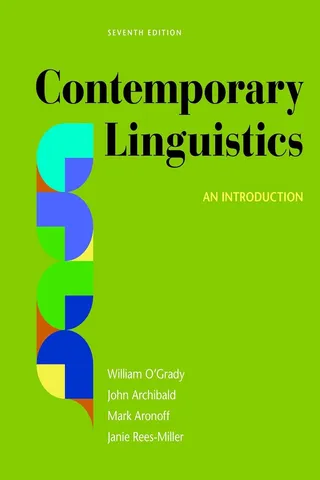
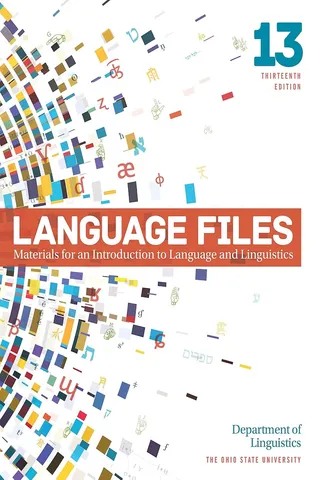
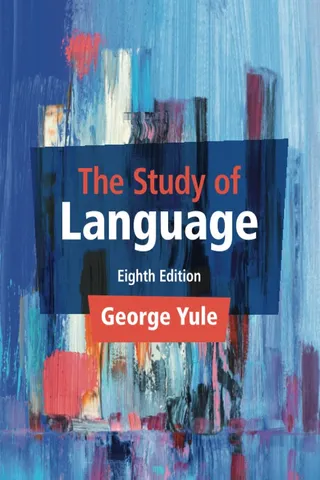
Among the introductory books in this course, Fromkin, Rodman and Hyams is the friendly all-round survey. George Yule's The Study of Language is an accessible introduction with clear explanations and examples, good for a first read or for students outside linguistics. O'Grady and colleagues' Contemporary Linguistics covers similar ground in fifteen chapters, with separate chapters on second language acquisition, psycholinguistics, writing and the Indigenous languages of North America. Language Files is a modular textbook of short units that allows flexible coverage, useful alongside this text.
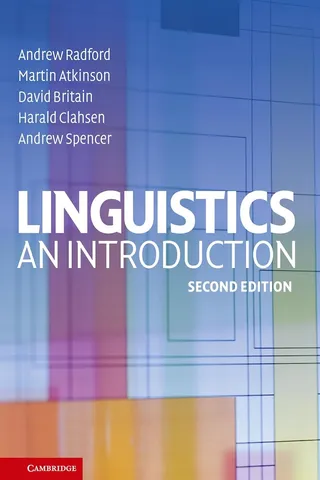
For more depth, Radford and colleagues' Linguistics: An Introduction gives more detailed theoretical discussion and exercises, and Linguistics: An Introduction to Linguistic Theory (edited by Fromkin, with Hyams among its authors) is a theory-driven survey of morphology, syntax, semantics, phonetics and phonology, a natural continuation for students who want formal analysis. Ray Jackendoff's Foundations of Language is an advanced synthesis that connects linguistics with psychology, neuroscience and evolution, best read after Chapters 1, 9 and 10.
Two Fall 2025 courses take different routes through the same book. At Texas A&M International University it anchors a broad language-and-cognition survey for psychology students; at Western University it supports a selective, English-focused course for writers that puts sound before word and sentence structure. Neither assigns the whole volume.
How to Use This Book
The book suits first-year students in linguistics and in the many neighbouring fields the publisher lists. No background in linguistics is required.
A practical plan:
- Core: Chapter 1, then Chapters 2–6. If the course starts with sounds, Chapters 5–6 can be read before 2–4, but Chapter 6 opens with the pronunciation of morphemes, so read the first sections of Chapter 2 beforehand.
- Do the analysis: the morpheme identification section in Chapter 2 and the phonological analysis section in Chapter 6 are where problem-solving skills are built; work every exercise you are set, with a classmate if possible.
- Choose among the later chapters: Chapter 7 for sociolinguistics, Chapter 8 for historical linguistics and writing, Chapters 9–10 for psycholinguistics and the brain. A one-term course can select two or three.
- Use the glossary: use it while reading, and build your own list of key terms per chapter for revision.
Check which edition the course uses before buying, since page references and exercises differ between editions.
Common course assignments
- TAMIU PSYC 4309, Foundations of Language (Fall 2025; required textbook; syllabus). The schedule assigns Chapter 1 (animal and human language; language and thought), Chapters 2–5 without page limits, and later chapters by page range: Chapter 7 on language in society and in use, Chapter 8 on language change and the history of writing, Chapter 9 on acquisition and bilingualism, and Chapter 10 on brain and language and its development. Chapter 6 does not appear in the schedule. Readings are paired with lecture slides, and writing tasks apply the material to everyday situations.
- Western Writing 2550A, The English Language for Writers (Fall 2025; required textbook, no prerequisites; course outline). The order is Chapter 1 (Standard English), Chapters 5 and 6 (English sounds and phonology), Chapter 2 (morphology and etymology), Chapter 3 pp. 75–98 only (syntax and figures), and Chapter 4 (semantics and tropes); Chapter 7 (stylistics and register) and Chapter 10 (language, the brain, the machine and writing) are also scheduled. No textbook reading is specified for the pragmatics or case-study sessions. The analysis serves clearer writing and rhetorical practice.
If you are following either course, keep to its chapter selections and page limits rather than reading cover to cover.
Edition notes
Both courses require the eleventh edition, the same numbered edition as this guide. Western cites it as Cengage, 2021, and TAMIU prints ISBN 978-1133310686, whereas the edition listed here is the 2018 release with ISBN 978-1-337-55957-7. Treat this as a difference in printing, year or identifier, not as evidence of a new edition. The course page ranges belong to each course's specified copy and may not line up exactly with yours.
Edition and bibliographic source
Cengage gives the eleventh-edition paperback (ISBN 9781337559577) a 2018 release date and a ©2019 copyright date; the citation above uses the release year. MindTap subscriptions and electronic formats carry different identifiers and dates.