01 / Reading Guide
Reading Guide
Citation
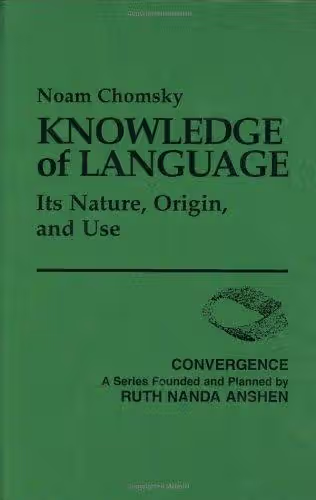
Chomsky, N. (1986). Knowledge of Language: Its Nature, Origin, and Use. Praeger.
Chapter Summary
The book has a preface and five chapters, in about 300 pages of text. Chapters 1–4 form a connected statement and defence of Chomsky's approach to what he calls "Plato's problem": how people come to know so much about language when the evidence available to them is so limited. Chapter 5 turns to the converse, "Orwell's problem": how people can know so little about language when they have so much evidence, a question the book takes up through the use and misuse of language in politics. By the author's own admission in the preface, the last chapter is not closely related to the rest. The book was published in Praeger's Convergence series and followed Chomsky's Lectures on Government and Binding (1981).
Chapter 1: Knowledge of Language as a Focus of Inquiry
The opening chapter introduces knowledge of language as the focus of linguistic inquiry, the theme the subtitle develops as the nature, origin and use of that knowledge. Chapters 1 and 2 together give a brief history of ideas about language and place the author's view in that history.
Chapter 2: Concepts of Language
Part of the book's aim is to identify the fundamental concepts of language, and this chapter, with Chapter 1, prepares the ground for the technical argument that follows.
Chapter 3: Facing Plato's Problem
The longest chapter by far, taking up roughly 170 of the book's roughly 300 pages. It presents the technical evidence for the claim that the mind contains innate principles and parameters of language, and sets out proposals about what some of these are. The book's list of frequently occurring terms, such as binding theory, c-command, empty category, D-structure, anaphor and expletive, gives a sense of the technical apparatus.
Chapter 4: Questions about Rules
The chapter answers criticisms of Chomsky's use of the terms "rules" and "know," defining both and defending the use of deductive reasoning in linguistic work.
Chapter 5: Notes on Orwell's Problem
A brief, separate discussion of the use and misuse of language in politics, a theme of Chomsky's writing since the late 1960s. It stands apart from the technical chapters.
Key Concepts
Chapters 1–2: Framing
- Knowledge of language: the speaker's internalized knowledge, treated as the object of linguistic inquiry.
- Nature, origin and use: the three questions the subtitle names.
Chapter 3: Plato's problem
- Plato's problem: how people know far more about language than their experience could teach them.
- Innate principles and parameters: the proposed universal principles of language, with limited points of variation.
Chapters 4–5: Rules and Orwell's problem
- Rules and knowing: the senses of "rule" and "know" used in linguistic theory, and the role of deductive argument.
- Orwell's problem: why people know so little about the use of language in politics when the evidence is plentiful.
Critical Analysis
Strengths
- A consolidation of the author's approach in the 1980s. The book restates and defends the theory developed in the preceding decade, in answer to critics, which makes it a single place to see both the claims and the reasons given for them. The description by David Lightfoot on the publisher's page calls it a clear introduction to current thinking on grammatical theory.
- A strong statement of the case for innate structure. Frederick Newmeyer judged it Chomsky's most persuasive defence of the idea that the study of linguistic structure provides insight into the human mind, and Julius Moravcsik described it as an excellent contribution to the philosophy of language and mind that makes Chomsky's current ideas on syntax accessible to non-specialists (these are publisher-quoted endorsements).
- Accessible outside Chapter 3. An EBSCO Research Starters overview of the book observes that a reader with fairly minimal knowledge of linguistics can follow the gist of the argument in the chapters other than the third.
- A bridge to the philosophy of mind. Chapter 4 defines and defends the terms "rules" and "know" as used in linguistics, which makes the book relevant to philosophy and cognitive science as well as to linguistics.
Limitations
- A technically dense core. The same overview notes that the technical nature of Chapter 3 in effect limits the book's readers to linguistics scholars. Readers need a grounding in generative syntax to follow it.
- Tied to its moment in the theory. The book dates from 1986 and predates Chomsky's The Minimalist Program (1995), so later developments of the theory are not covered.
- An uneven last chapter. Chapter 5, on language and politics, is by the author's own account loosely connected to the rest.
Where It Fits in the Course
Within the syntax course, Knowledge of Language is the theoretical statement behind the textbooks. Carnie's Syntax: A Generative Introduction and Tallerman's Understanding Syntax teach how to analyse sentences, the first within the generative framework and the second in a largely theory-neutral, descriptive way; Burton-Roberts's Analysing Sentences builds the analysis of English sentence structure step by step with exercises. These are the books to use to learn syntactic analysis before attempting Chomsky.
Chomsky's own Syntactic Structures is the earlier landmark of generative grammar; reading it first shows the starting point from which Knowledge of Language develops. Read Knowledge of Language after a generative syntax textbook, when the interest has shifted from how to analyse sentences to why linguistic theory takes the form it does and what it claims about the mind.
How to Use This Book
The book is for advanced undergraduates and graduate students in linguistics, philosophy of language and cognitive science who have already studied generative syntax, and for anyone who wants to read Chomsky's own account of the 1980s theory.
A practical plan: read Chapters 1 and 2 first, as they frame the questions and are the most accessible. Read Chapter 3 slowly alongside a generative syntax textbook, treating it as the technical core and looking up unfamiliar terms; readers mainly interested in the philosophical argument can read it selectively. Then read Chapter 4 for the discussion of rules and knowledge, and Chapter 5 separately, as a short essay on language and politics. Keep track of the argument for innate principles in Chapter 3, since Chapter 4 goes on to answer criticisms of the terms in which it is stated.