01 / Reading Guide
Reading Guide
Citation
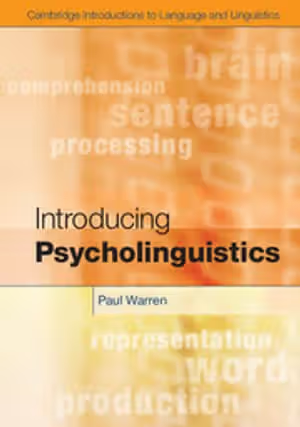
Warren, P. (2012). Introducing Psycholinguistics. Cambridge University Press.
Chapter Summary
The book belongs to the Cambridge Introductions to Language and Linguistics series and runs to 13 chapters of roughly 12–24 pages each (234 pages of text), followed by a glossary, references and an index. The preface sets its scope: how adult native speakers turn an idea into an utterance and derive meaning from what they hear or read, using evidence from observation, experiments and brain imaging. Each chapter opens with a list of key terms and a preview of what the reader will learn, and closes with a summary, exercises and annotated suggestions for further reading. Production comes first (Chapters 2–6), then comprehension (Chapters 7–12).
Chapter 1: Introduction
An overview of the field and of the book. It opens with a puzzle about the mental lexicon: listeners can say almost instantly that an invented word such as splundle is not one they know, which shows that word look-up cannot be a simple search through a list.
Chapter 2: Planning utterances
The longest chapter in the book shows that building an utterance involves several levels of planning. Its evidence comes from pausing and hesitation, from speech errors, and from the way pronunciation signals a sentence's grammatical structure more fully than punctuation does.
Chapter 3: Finding words
How speakers retrieve words from the mental lexicon. Pauses and speech errors again serve as evidence: word finding depends on how likely a word is in its context, some errors reveal competition between alternatives for the same slot, and others show interference from words associated with the intended one.
Chapter 4: Building words
The second stage of lexicalisation: assembling a word's form from its stored morphological and phonological structure (stress, syllables, sounds) and converting the resulting string of sub-lexical units into an articulatory plan. Speech errors show where this process goes wrong.
Chapter 5: Monitoring and repair
How speakers check their own output and correct it. Repairs turn out to be structured in ways that help listeners, and repairs of errors differ from revisions of inappropriate wording; the goal-oriented speaking tasks behind much of this evidence are introduced.
Chapter 6: The use of gesture
A chapter less common in introductions to the field. It distinguishes gestures that add content from those that manage conversation, sorts gestures into symbolic, pointing and depicting types, argues that gestures help speakers as well as listeners, and explains why gesture varies across languages as well as cultures.
Chapter 7: Perception for language
The bridge to comprehension: the perceptual skills, visual and auditory, that language processing depends on, where spoken and written input pose the same questions and where they differ, and how the language system shapes the interpretation of perceptual cues. Findings from acquisition show how early these skills develop.
Chapter 8: Spoken word recognition
Recognition as a series of stages: contact between the speech input and stored word representations, activation of candidates, and selection of a single word. Both the input and the context matter, and recognition is affected by word frequency, recent exposure and similarity to other words.
Chapter 9: Visual word recognition
Reading single words. The chapter reviews the factors known to affect recognition, compares three model types (with reference back to the Cohort model of spoken word recognition), discusses converting print to sound, presents the dual-route model of reading, and uses the main types of dyslexia as evidence about the skills reading involves.
Chapter 10: Syntactic sentence processing
How readers and listeners assign structure to a string of words. Function words and grammatical endings help, and parsing models built on preferred strategies explain garden-path sentences. The evidence comes mainly from reading-time and eye-tracking studies.
Chapter 11: Interpreting sentences
The non-syntactic information used in comprehension: plausibility, the structures that particular verbs and other words tend to occur in, and the prosody of spoken sentences, closing with a comparison of accounts that differ in when each source of information is used.
Chapter 12: Making connections
Comprehension above the sentence: how pronouns and other devices link to earlier mentions, how listeners draw inferences, and how speakers mark information as new or already known, with some attention to how speakers signal these links.
Chapter 13: Architecture of the language processing system
A retrospective chapter that relates production to comprehension (especially in lexical processing), spoken to visual processing, and language to other knowledge systems, and sets out the competing views on whether language processing is organised into modules.
Key Concepts
Language production (Chapters 1–6)
- Mental lexicon: the store of words in a speaker's memory, which the book shows cannot be searched like a list.
- Speech errors: slips of the tongue such as word exchanges, used as evidence for the stages of utterance planning.
- Lexical selection and word-form building: the two stages of lexicalisation, finding a word and then assembling its sound structure.
- Self-monitoring and repair: speakers' checking of their own output and the structured ways they correct it.
- Co-speech gesture: gestures that add content or manage conversation, and that help speakers as well as listeners.
Language comprehension (Chapters 7–13)
- Dual-route model of reading: the idea that written words can be read either through spelling-to-sound conversion or as whole words.
- Garden-path sentences: sentences whose initially preferred structure turns out wrong, evidence for parsing strategies.
- Prosody: the phrasing and intonation of spoken sentences, which affects the structure listeners assign.
- Given and new information: how speakers mark what is already known, and how listeners use that marking.
- Modularity: the question of whether separate processing modules handle different kinds of linguistic information.
Critical Analysis
Strengths
- Written for linguists without psychology. The preface states that the author is a linguist writing mainly for linguistics students, so no prior familiarity with psychology is assumed and key linguistic terms are explained. Åsa Abelin, reviewing the book in Moderna Språk (2013), found it useful both for newcomers and as a review text for linguistics students.
- Short, integrated chapters. Every chapter follows the same pattern of key terms, preview, summary, exercises and annotated reading. Abelin notes the references forward and back between chapters, and Chapters 3, 4, 9, 10 and 11 each open by recalling what earlier chapters established.
- Methods students can try. The book argues that informal observation and simple experiments can contribute to the field; Abelin highlights acceptability tests and systematic collection of slips of the tongue. The publisher describes online demonstrations of experimental techniques, sound and video files and flashcards, marked in the book's margins.
- Broad coverage of speech. In line with what Abelin calls the book's declared bias towards spoken language, production gets five chapters, including full chapters on gesture and on monitoring and repair.
Limitations
- Adult native-speaker processing only. The preface limits the focus to adult native speakers, so first and second language acquisition and bilingualism have no chapter; acquisition appears only as evidence about the early development of perceptual skills in Chapter 7. In a course that covers acquisition, other books must supply it.
- Some technical points are only mentioned. Abelin judged the claim that the book suits psychology students without linguistics somewhat strong, because items such as syntactic trees and spectrograms are mentioned only briefly. Readers without an introductory linguistics course will need one alongside.
- English examples. Abelin observes that the examples are in English and that teachers working with non-native speakers will need parallel examples from their students' languages.
- Prosody unevenly covered. Despite a declared bias towards spoken language, Abelin found that prosody is not always covered where phonetics and phonology are described; it is treated mainly in Chapters 2 and 11.
- Age. The book dates from 2012 and has not been revised.
Where It Fits in the Course
Warren is a first textbook of adult language processing, and it pairs naturally with William O'Grady's How Children Learn Language, a concise, non-technical account of first language acquisition. Between them the two short books cover the course's two halves at an introductory level: Warren for production and comprehension, O'Grady for development, the topic Warren leaves out.
The broader introductions come next. Matthew Traxler's Introduction to Psycholinguistics and Julie Sedivy's Language in Mind are wider textbooks that add acquisition and, in Traxler's case, the breakdown of language systems and neuroscience evidence; students who have read Warren will find the production, word recognition and sentence processing chapters familiar ground. Trevor Harley's The Psychology of Language is a research-led account written from cognitive psychology that sets findings against competing models at every level and adds bilingualism and disorders; it is the place to go after Warren for depth. Eve Clark's First Language Acquisition is a graduate-level, usage-based treatment of child language and follows O'Grady rather than Warren.
How to Use This Book
The book suits undergraduates in linguistics or English language taking a first course in psycholinguistics, and psychology students who already have some linguistics. The preface asks for no psychology; a basic grasp of phonetics, morphology and syntax helps with Chapters 4, 7 and 10.
A reading plan:
- Start with Chapter 1, then read the production block (Chapters 2–5) in order, since each chapter builds on the speech-error evidence introduced in Chapter 2. Chapter 6 on gesture can be read at any point after Chapter 2 or left for a course that covers multimodal communication.
- Comprehension: read Chapter 7 before Chapters 8 and 9, which build on it; Chapters 10 and 11 form a pair on sentences; Chapter 12 extends comprehension to discourse.
- Finish with Chapter 13, which works as a review of the whole book before an exam.
- For a comprehension-only course, read Chapters 1, 2 and 7–13.
Use the preview at the start of each chapter as a checklist and test yourself against it after reading. Do the exercises, and use the online demonstrations with the chapters they accompany; as Abelin suggests, they work best when a teacher explains what each demonstration shows. Try one of the simple methods the book describes, such as logging the speech errors you hear for a week and classifying them with the categories from Chapters 2–4.