01 / Reading Guide
Reading Guide
Citation
O'Grady, W. (2005). How Children Learn Language. Cambridge University Press.
Chapter Summary
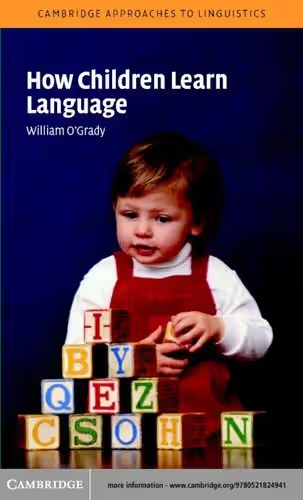
The book is a short volume in the Cambridge Approaches to Linguistics series: seven chapters and about 200 pages of text (viii + 240 pages in all, with 36 illustrations), followed by two appendices, notes and references. The publisher describes it as an engaging, accessible account of how children learn to produce and distinguish sounds, acquire words and meanings, and master the rules for building sentences, together with the experiments and techniques researchers use to study these processes. Its key features, in the publisher's words, are an accessible style that assumes no knowledge of linguistics, coverage of all the major phenomena of language development (sounds, words, meanings and structure), and attention not only to what is known about acquisition but to how it is known. The author is Professor of Linguistics at the University of Hawaii.
Chapter 1: Small talk
A six-page opening chapter that introduces the book. Its starting point, in the publisher's description, is the contrast between the difficulty adults have in learning a new language and the speed with which children master their first.
Chapters 2–3: The great word hunt; What's the meaning of this?
The two longest chapters (about 33 and 40 pages) deal with words: how children come to have words, and how they work out what those words mean. Together they cover the "acquisition of words and meanings" that the publisher names as one of the book's three main topics.
Chapters 4–5: Words all in a row; What sentences mean
These chapters (about 34 and 29 pages) move from words to sentences: putting words together, and interpreting the resulting sentences, the "rules for building sentences" in the publisher's description.
Chapter 6: Talking the talk
A chapter of about 20 pages that completes the account of what children learn before the book turns to explanation.
Chapter 7: How do they do it?
The closing chapter of about 34 pages asks the question in its title: how children accomplish the learning described in the earlier chapters.
Appendices: Keeping a diary and making tape recordings; The sounds of English
Two short appendices. The first offers guidance for readers who want to record a child's language themselves, keeping a diary and making recordings; the second sets out the sounds of English, a reference for the phonetic material in the book.
Key Concepts
Chapters 1–3: Starting out and words
- First language acquisition: the process by which children master the language around them without formal instruction.
- Word learning: how children acquire the thousands of words of their language.
- Word meaning: working out what words refer to and how far their meanings extend.
Chapters 4–7: Sentences and explanation
- Sentence building: combining words according to the rules of the language.
- Sentence interpretation: understanding what sentences mean, beyond the meanings of their words.
- Explaining acquisition: accounting for how children learn so much so quickly.
- Research methods: the experiments and observational techniques, such as diaries and recordings, through which acquisition is studied.
Critical Analysis
Strengths
- Accessible to non-specialists. The publisher stresses that the book assumes no knowledge of linguistics and is written for general readers and parents as well as students. The Journal of Child Language, quoted by the publisher, judged that its engaging style and accessibility combined with scientific rigour make it ideal for a lay audience and for introductory undergraduate courses on language acquisition.
- Shows how we know. Rather than listing milestones, the book explains the experiments and techniques researchers use, so readers learn to evaluate claims about children's language.
- Compact and complete. In about 200 pages it covers sounds, words, meanings and sentence structure, with the longest chapters given to vocabulary and meaning, and ends with a chapter on explanation.
- Invites observation. The appendix on keeping a diary and making recordings gives readers a practical way to study a child's language themselves.
Limitations
- Dated research base. Published in 2005, the book does not reflect later work on acquisition, and the publisher's claim that it draws on the latest research refers to the field as it stood then.
- English-centred reference material. The appendix on the sounds of English suggests that English is the main language of reference; readers interested in acquisition across languages will need other sources.
- Introductory depth. As a short, non-technical book it gives an overview rather than a detailed treatment of competing theories; students taking a full course will need a textbook alongside it.
Where It Fits in the Course
This is the gentlest introduction to child language on the psycholinguistics and acquisition list, suited to the first weeks of a course or as background reading. Eve Clark's First Language Acquisition is the fuller textbook on the same subject, taking a usage-based view centred on interaction, conversation and feedback and drawing on many languages besides English; read it after O'Grady for depth and for the research literature.
Warren's Introducing Psycholinguistics and Traxler's Introduction to Psycholinguistics place acquisition within the wider study of how people produce and understand language, Warren at an introductory level and Traxler with more experimental detail. Sedivy's Language in Mind and Harley's The Psychology of Language give broader and more research-heavy accounts, with development treated alongside adult processing.
How to Use This Book
The book suits first-year students in linguistics, psychology, education and speech and language therapy, students taking a single acquisition option, and parents or general readers. No background in linguistics or psychology is needed.
- Read it straight through. At about 200 pages the book can be read in a week or two; the chapters build from words to sentences to explanation.
- Core for a course: Chapters 2–5, the bulk of the content on words, meanings and sentences.
- Discussion: Chapter 7, the best starting point for comparing the explanations taught in a fuller course.
- Practice: use the first appendix to keep a short diary of a young child's speech, or to record and transcribe a sample, and the second appendix as a guide to the sounds of English when transcribing.
After reading, follow the notes and references to the original studies on topics that interest you, and move on to a full textbook such as Clark's for current research and for acquisition in languages other than English.