01 / Reading Guide
Reading Guide
Citation
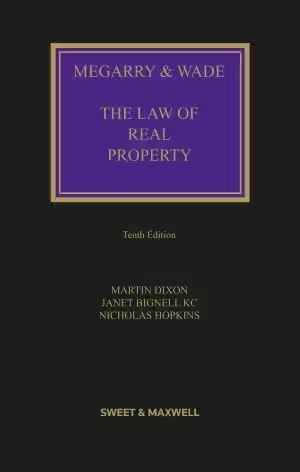
Dixon, M., Bignell, J., & Hopkins, N. (Eds.). (2024). Megarry & Wade: The Law of Real Property (10th ed.). Sweet & Maxwell.
Chapter Summary
The tenth edition has thirty-four chapters and two appendices. The publisher presents it as a single-volume account of the whole English law of real property, together with related subjects such as conveyancing, leases and wills and intestacy, first published in 1957 and placing the law in its historical context. It introduces substantive areas before dealing with the priorities that arise between competing interests. The chapters below follow the table of contents and are grouped by subject.
Chapters 1–4: Introduction; Tenures and estates; Estates; Possession of land
The opening chapters set out the framework of the subject: the introduction, the doctrines of tenure and estates, the estates themselves, and possession of land. The publisher notes that the book places the development of land law in its historical context, and this is where that grounding begins.
Chapters 5–7: Unregistered conveyancing: titles and incumbrances; Registration of title; Adverse possession and limitation
The treatment of how title is proved and protected: unregistered conveyancing, registered land, and the acquisition of rights through adverse possession and limitation.
Chapter 8: Perpetuities and accumulations
A chapter on the rules against perpetuities and accumulations, a topic that the publisher singles out as not covered in other titles.
Chapters 9–13: The use of trusts in the law of real property; Creating trusts of land; The Trusts of Land and Appointment of Trustees Act 1996; Co-ownership; Wills and intestacy
Five chapters connect land with trusts, from the use of trusts in real property to the creation of trusts of land, the 1996 Act and co-ownership, and then wills and intestacy.
Chapters 14–15: Contracts of sale; Proprietary estoppel
Contracts for the sale of land, and proprietary estoppel.
Chapters 16–22: The nature and creation of leases; Determination of tenancies; Common obligations of landlord and tenant; Leasehold covenants; Leasehold conveyancing; Security of tenure; Fixtures
The long leasehold section runs from the nature and creation of leases to their determination, the obligations of landlord and tenant, leasehold covenants, leasehold conveyancing and security of tenure. It ends with fixtures.
Chapters 23–25: The nature and creation of mortgages and charges; The rights of the parties under a mortgage or charge; Priority of mortgages
Mortgages and charges in three steps: nature and creation, the rights of the parties, and priority.
Chapters 26–30: The nature of easements and profits; The creation of easements and profits; Enforcement and extinguishment of easements and profits; Species of easements and profits; Other incorporeal hereditaments
Five chapters on easements and profits (nature, creation, enforcement and extinguishment, and the species), followed by other incorporeal hereditaments.
Chapters 31–34: Freehold covenants; Commonhold; Licences; Legal incapacity
The final chapters treat freehold covenants, commonhold, licences and legal incapacity.
Appendices A–B
Appendix A holds historical material relating to estates, interests, ownership and possession; Appendix B deals with successive interests: settled land. The publisher describes the book as a repository of historical material that cannot easily be found elsewhere.
Key Concepts
Estates and title (Chapters 1–8)
- Tenure and estates: the historical basis of English land holding.
- Unregistered and registered title: the two systems for proving and protecting title.
- Adverse possession and limitation: acquisition of rights through possession.
- Perpetuities and accumulations: limits on the duration of future interests.
Trusts, co-ownership and transactions (Chapters 9–15)
- Trusts of land: the subject of the 1996 Act chapter.
- Co-ownership: shared ownership of land.
- Contracts of sale and proprietary estoppel: how rights in land arise from agreement and from conduct.
Leases, mortgages and lesser rights (Chapters 16–34)
- Leasehold covenants and security of tenure: the obligations and protections within tenancies.
- Priority of mortgages: how competing mortgages are ranked.
- Easements and profits; freehold covenants; licences: rights in or over land that fall short of ownership.
- Commonhold: a form of ownership dealt with in Chapter 32.
Critical Analysis
Strengths
- Breadth in one volume. Thirty-four chapters cover the whole of the subject, from estates and registration to leases, mortgages, easements, covenants and licences, and add related topics such as wills and intestacy and fixtures.
- Unusual topics included. The publisher names the chapters on wills and perpetuities, and material on settlements and rentcharges, as aspects that other titles do not consider, and the appendices keep historical material on estates and settled land.
- Authority. The publisher describes it as frequently cited in court and drawn on by parliamentary draftsmen, and it is edited by two academics and a practising barrister, Janet Bignell KC.
- Case referencing. The publisher says it includes extensive case referencing showing how the law applies in practice, and that it highlights the issues that arise on priorities between competing interests.
Limitations
- A treatise, not a first textbook. The structure follows the law's own divisions and begins with tenure and estates, which assumes a land law course already completed.
- Size. With thirty-four chapters and two appendices it is a reference to be consulted by topic, not read straight through.
- Historical weight. The publisher stresses the historical material, which helps with questions about why the law developed as it did but is more than many modern land law questions need.
Where It Fits in the Course
This is the largest and most detailed book on the property and land law list. Land Law Directions and Modern Land Law are introductory textbooks, the first in plain language with diagrams and worked examples, the second a concise narrative; they belong to the first land law course. Land Law by Elizabeth Cooke is a short introduction written as continuous prose, which suits a reader who wants the shape of the subject before the detail. Land Law: Text, Cases, and Materials combines extracts with commentary, with particular attention to registered land and equity, and is the natural study companion for a second-level course.
Elements of Land Law by Gray and Gray is a scholarly treatise with extended reflection on the concept of property, so it serves a reader interested in theory; Megarry and Wade is the more complete account of the rules and their history. Use it after a textbook, when an essay or dissertation requires an exact statement of the law.
How to Use This Book
The book suits final-year undergraduates writing land law essays or dissertations, postgraduates, and trainee practitioners who need a more exact statement than a student textbook gives. A completed land law course is the sensible starting point.
A practical plan:
- Do not read it straight through. Start from the contents list or the table of statutes, read the relevant chapter in full and follow the footnotes to the cases.
- Core chapters for most courses: 2–7 (estates, registration and adverse possession), 10–12 (trusts of land and co-ownership), 15–16 (estoppel and leases), 23–25 (mortgages) and 26–30 (easements and profits).
- Specialist chapters: 8 (perpetuities), 13 (wills), 22 (fixtures), 32 (commonhold) and the appendices when a question turns on historical or technical detail.
- Check against a textbook: compare the treatise's statement of a rule with your main text, and use the historical material when a question asks why the law took its present form.